


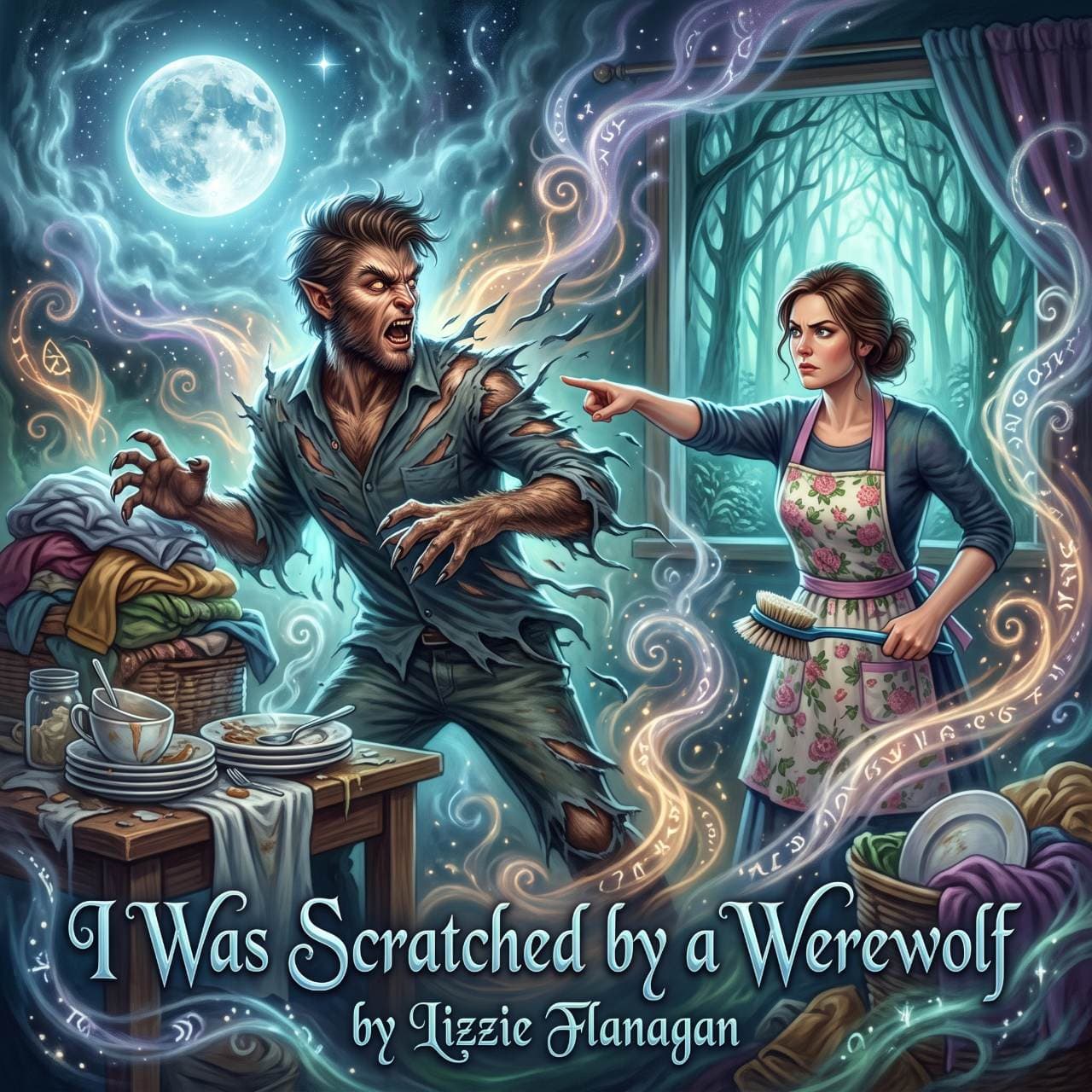

The problem with being a werewolf, I have learned, is that it's fundamentally a solitary condition. You don't meet other werewolves at support groups. There's no "Lycanthropics Anonymous" where you sit in a church basement drinking bad coffee and saying "Hi, I'm Gary, and I've been wolfing for three months." You don't get a welcome packet. You don't get a membership card. You just get a pamphlet from Dr. Thorne and a pat on the back and sent home to figure it out yourself.
But humans are social creatures. Even when we're wolves, we're social. Wolves run in packs. They have hierarchy, community, shared purpose. And as I entered my fourth month of lycanthropy, I started to feel the absence of that pack connection like a missing tooth, constantly aware of it, constantly probing the empty space, wondering what should be there.
"Deborah," I said one evening, approximately four months after my first transformation, "I think I need to find my people."
She was paying bills online and didn't look up. "You have people. You have me. You have your coworkers. You have the neighbors, even though they think you're weird."
"No, I mean my *people*. My pack. Other... individuals like me. Who understand. Who can relate."
She stopped typing. She turned to look at me. "Gary, are you saying you want to meet other werewolves?"
"Yes! Exactly! I want to... commune with my own kind. Share experiences. Trade tips. Maybe organize."
"Organize?"
"Like a union. The Union of Lycanthropic Persons. ULP. We could have meetings. Dues. A newsletter. Group rates on raw meat."
"Gary, there is no werewolf union."
"How do you know? Have you looked?"
"Have you looked?"
I had to admit I hadn't. Not really. I had assumed, based on my experience with the DMV, that supernatural beings were largely unorganized. But maybe I had been looking in the wrong places. Maybe there was a whole infrastructure I had missed, a secret society, a hidden network of my fellow afflicted.
"I need to investigate," I said. "I need to find out if there's already a community. And if there isn't, I need to build one."
Deborah sighed. It was the sigh of a woman who had heard many ambitious plans from her husband, most of which ended with him eating something he shouldn't or getting a rash. But she didn't say no. She never said no. She just said, "Don't get your hopes up. And don't give anyone your credit card information."
I promised. Then I opened my laptop and began to search.
The internet, as it turns out, is full of werewolves. Or rather, it's full of people who claim to be werewolves, or want to be werewolves, or are writing elaborate fiction about werewolves that they insist is actually true. There are forums and chat rooms and Discord servers and subreddits. There are websites with flashing graphics and MIDI howls and claims of ancient bloodlines stretching back to the dawn of time.
I joined all of them.
Over the course of two weeks, I became a digital social butterfly, flitting from platform to platform, introducing myself, sharing my story, asking the hard questions. "Do you transform?" "Do you have a pack?" "Is there a union?" "What are the benefits?"
The responses were... varied.
*MoonHowler69:* "Bro I am wolf every night in my heart I don't need moon I am moon"
*LunaGoddessAlpha:* "You must embrace the sacred feminine energy of the hunt. I sell essential oils that help with transformation. $49.99 per vial."
*RealWerewolfNotFake:* "I have been wolf for 300 years. I am ancient. I am powerful. I am also 14 years old and my mom says I have to do homework."
*ActualLycanthrope:* "Gary, if you're real, and that's a big if, you need to understand that most of us don't talk about this. It's dangerous. There are people watching. People who want to study us. Experiment on us. Be careful."
That last one gave me pause. *ActualLycanthrope* seemed different from the others. More serious. More grounded. They didn't claim to be 300 years old. They didn't try to sell me anything. They just warned me, and then disappeared from the forum.
But I was undeterred. I kept searching. I posted flyers at the grocery store ("Lycanthropic Persons: Seeking Community"). I put an ad in the local paper ("Wolf-Afflicted Individuals: Union Organizing Meeting, Tuesdays, Public Library"). I even stood outside a pet store one Saturday, sniffing customers to see if any of them smelled like me, like wolf, like wild, like the thing that howls in the basement.
I got strange looks. I got asked to leave the library. I got a call from the local news, who wanted to do a story on "the man who thinks he's a werewolf," which I declined because Deborah threatened to divorce me if I became a "local news weirdo."
And then, finally, I got a response.
It came in the mail. A plain envelope, no return address, with my name typed on the front in a font that looked like it belonged on a ransom note. Inside was a single piece of paper with an address and a time.
"Union of Lycanthropic Persons," it read. "Meeting Thursday. 11 PM. Come alone. Bring proof."
I was ecstatic. I was vindicated. I was going to meet my people.
"Deborah," I announced, waving the letter, "I found them! The union! They exist!"
She took the letter. She read it. She turned it over, looking for more information.
"Gary," she said slowly, "this looks like the beginning of a true crime documentary. 'Come alone? Bring proof?' This is how people get murdered."
"It's secret! It's underground! They have to be careful!"
"Or it's a trap. Or it's teenagers messing with you. Or it's... I don't know, Gary, but this doesn't feel right."
"But I have to go. This is my chance. My pack. My people."
She looked at me. She looked at the letter. She sighed that sigh again, the one that meant she was resigning herself to whatever ridiculous thing I was about to do.
"Fine," she said. "But I'm driving you. And I'm parking outside. And if you're not out in an hour, I'm calling the police. And if you get murdered, I am not identifying your body. I'm too mad at you."
I agreed to her terms. I prepared my "proof", the photo of my ear, the letter from Dr. Thorne, a tuft of shed fur I had collected from the basement floor. I dressed in dark clothing, because it seemed appropriate for a secret meeting, and I let Deborah drive me to the address.
It was an abandoned warehouse on the edge of town. The kind of place where drug deals happen in movies. The kind of place where you find bodies in crime novels. The kind of place that no sane person would enter at 11 PM on a Thursday.
"Gary," Deborah said, her voice tight, "please don't go in there."
"I have to. They're waiting."
"There's no one waiting. It's a prank. Or a cult. Or..."
But I was already out of the car, walking toward the door, my heart pounding with excitement and fear and the desperate hope that I was about to find my place in the world.
I pushed open the door. It creaked ominously. Inside, it was dark, lit only by a single bare bulb hanging from the ceiling. And standing in the circle of light was...
A man in a wolf costume. A cheap one, from a Halloween store, with a rubber snout and plastic fangs.
"Welcome, brother," he said, his voice muffled by the mask. "To the Union of Lycanthropic Persons."
I stared. I looked around. There were others, emerging from the shadows, all in costumes. A woman in a sexy werewolf outfit. A teenager in a full-body wolf onesie. An older man wearing just ears and a tail, which was deeply unsettling.
"You're... not real," I said.
"We are real in spirit," the man in the mask said. "We are real in our hearts. We are the Union. We stand together. We howl together. We are wolf."
"No," I said, my disappointment turning to anger. "You're playing dress-up. You're pretend. You don't transform. You don't know what it's like. You don't wake up naked and confused and hungry for things you shouldn't want. You're... tourists."
The man in the mask stepped back. He seemed hurt. "We just wanted community," he said. "Like you. We thought... we thought you would understand."
"I wanted real werewolves," I said. "Not... this."
I walked out. I got back in the car. Deborah looked at me, saw my face, and didn't ask. She just drove home.
The Union of Lycanthropic Persons, it turned out, was just a group of lonely people looking for connection. Which was admirable, I suppose, in its way. But it wasn't what I needed. I needed someone who understood the specific loneliness of my condition—the isolation of being the real thing in a world of fakes.
I didn't find them that night. But I did find something else, a few days later, that would change everything. I found out that I could sue the moon.
The idea came to me while I was reading the employee handbook at work. I was looking for information about dental coverage (because fangs are expensive), and I stumbled across the section on "Hostile Work Environments."
"Hostile work environment," the handbook read, "is defined as unwelcome conduct based on protected characteristics that creates an intimidating, offensive, or abusive atmosphere."
I thought about that. I thought about my condition. I thought about the moon.
The moon, I realized, was creating a hostile environment for me. Every month, without fail, it forced me to transform. It caused me physical pain, emotional distress, and significant inconvenience. It interfered with my work schedule, my social life, and my marriage. It was unwelcome conduct. It was abusive. And it was definitely based on a characteristic, lycanthropy, that I couldn't control.
The moon was harassing me. And I was going to file a complaint.
"Deborah," I said that evening, "I'm going to sue the moon."
She was chopping vegetables and didn't even pause. "That's nice, dear. What kind of lawsuit?"
"A hostile work environment complaint. The moon is creating intolerable conditions for my employment and personal life. I want it to stop."
"The moon."
"Yes."
"The celestial body."
"Yes."
"That's 238,900 miles away."
"Distance is no excuse for harassment."
She set down her knife. She turned to look at me. She wiped her hands on her apron. And then she laughed. Not a mean laugh. A real laugh, the kind that crinkled her eyes and made her breathless.
"Gary," she gasped, "you can't sue the moon."
"Why not?"
"Because it's the moon! It doesn't have legal standing! It doesn't have an address! You can't serve papers to a celestial body!"
"But someone must be responsible for it. NASA? The government? Space Force? Someone owns the moon, or manages it, or... or something."
"No one owns the moon, Gary. It's just... there."
"Well, that's negligence. It's a public nuisance. It's... it's..."
"It's the moon, Gary. You can't fight the moon. You just have to live with it. Like tides. Like... like gravity."
"But I don't want to live with it! I want it to stop! I want to be normal!"
I was shouting. I didn't mean to be shouting. But the frustration, the loneliness, the disappointment of the fake union, it was all bubbling up, spilling over, and I was standing in my kitchen yelling about the moon like a lunatic (which, I realized even then, was probably where that word came from).
Deborah didn't yell back. She just walked over to me. She put her hands on my shoulders. She looked me in the eyes.
"I know," she said quietly. "I know you want to be normal. I know this is hard. I know you're trying to find your place, your people, your... pack. But Gary, you have to accept that there might not be a place. There might not be other people. There might just be you. And me. And that's enough."
"But is it?" I asked, my voice breaking. "Is it enough? To be alone? To be the only one?"
"You're not alone," she said. "You have me. You'll always have me. Even when you're hairy. Even when you howl. Even when you try to sue astronomical bodies. I'm your pack, Gary. I'm your union. I'm your everything."
She hugged me. I cried into her hair. I smelled her shampoo, her skin, the Deborah-scent that meant home, and I realized she was right. I didn't need a union. I didn't need other werewolves. I had her. I had always had her.
I abandoned the lawsuit. I let the moon win. It was easier that way.
But the moon, it turned out, wasn't done with me. Because a week later, I discovered that someone was watching me. Studying me. And they weren't interested in my feelings, they were interested in my DNA.
The scientific study started with a phone call. A woman named Dr. Anthony Bullet called me at work. He said He was from the "Institute for Advanced Biological Research" and wanted to talk to me about my "unique condition."
"I understand you're a lycanthrope," he said, his voice professional and warm. "We've been following your case. Your gas leak detection work is fascinating. The enhanced olfactory senses. The physical transformations. We'd like to study you. Compensate you, of course. Help advance scientific understanding."
I should have hung up. I should have said no. But he mentioned compensation, and my salary as a Senior Risk Assessment Consultant was good but not great, and Deborah had been talking about wanting to renovate the kitchen, and...
"How much compensation?" I asked.
"Five thousand dollars for the initial study. More if we continue. Plus, you'd be helping others. Understanding your condition could lead to treatments. Cures. Ways to help people like you live normal lives."
I agreed to a meeting. Just a conversation, I told myself. Just to hear them out.
The Institute was a real building, which surprised me. Real labs, real scientists, real equipment. Dr. Bullet showed me around, introduced me to his team, explained their mission.
"We're not interested in exploiting you, Gary," he said. "We're interested in understanding the biological mechanisms of transformation. How does the body change so rapidly? How do the cells regenerate? What triggers the shift? If we can understand this, we could revolutionize medicine. Regenerative therapies. Rapid healing. The applications are endless."
It sounded good. It sounded noble. It sounded like something I could be part of, something that would give meaning to my condition beyond just being a weird guy who howls at the moon.
I signed the consent forms. I gave blood samples. I answered questions. I agreed to come back for a full study during the next full moon, where they would monitor my transformation in real time.
I went home and told Deborah the good news.
She did not think it was good news.
"Gary," she said, her face pale, "you can't do this."
"Why not? It's science. It's progress. They might find a cure."
"Or they might dissect you. Or keep you in a cage. Or sell your DNA to the military so they can make werewolf soldiers. Have you thought about that?"
"That's... that's paranoid. They're legitimate scientists."
"Legitimate scientists who want to watch you transform into a wolf. In a lab. Like an experiment."
"That's the point. To learn. To understand."
"Or to control. To exploit. To use you."
We argued. For hours. It was the worst fight we'd had since I became a werewolf. She accused me of being naive. I accused her of being paranoid. She said I was putting us both at risk. I said she didn't understand my need to contribute, to matter, to be more than just a monster in the basement.
In the end, she gave me an ultimatum.
"If you do this," she said, her voice cold, "if you go to that lab and let them study you, I won't be here when you get back."
"What do you mean?"
"I mean I'm done, Gary. I'm done with the wolf. I'm done with the howling and the shedding and the constant drama. If you choose this, this study, this exploitation, over our marriage, over our privacy, over our life together, then I'm leaving. I'm going to my sister's. And I'm not coming back."
She meant it. I could smell it on her, the certainty, the resolve, the heartbreak. She wasn't bluffing. She was serious.
I had to choose. The study, the science, the chance to be special and useful and understood by people who saw me as a specimen rather than a husband.
Or Deborah.
I chose Deborah. Of course I chose Deborah. I called Dr. Bullet the next day and told him I was withdrawing from the study. I told him I couldn't participate. I told him to destroy my samples.
He was disappointed. Hee tried to convince me to reconsider. He said I was making a mistake, that I was passing up an opportunity, that I would regret it.
But I didn't regret it. Because when I hung up the phone, Deborah hugged me. She held me tight and said, "Thank you. Thank you for choosing us."
I chose us. I would always choose us.
But Deborah, it turned out, wasn't satisfied with just my withdrawal. She was worried about the Institute. Worried that they would find another subject. Worried that they would keep looking for werewolves, keep studying them, keep exploiting them.
So she decided to sabotage them.
I didn't know about her plan until it was already in motion. Deborah had always been resourceful, she had managed our finances, organized our home, navigated the complexities of my condition with grace and efficiency. But I had never seen her truly devious until she set her mind to destroying the Institute's werewolf research program.
It started with Yelp reviews. "One star," she wrote, from a fake account. "They tried to experiment on my husband without proper consent. Very unethical. Would not recommend." She wrote ten more, from different accounts, all variations on the same theme. The Institute's rating plummeted.
Then she called the local news. Anonymously. She told them that the Institute was conducting "unethical human experimentation" and "preying on vulnerable people with rare conditions." She sent them my consent forms (which I had foolishly left on the desk) with my personal information redacted but the Institute's letterhead clearly visible.
The news station ran a story. "Local Research Institute Accused of Exploitation." Dr. Bullet was interviewed, defensive and angry, denying everything but looking guilty as hell.
Then Deborah contacted the IRS. She reported the Institute for tax fraud (which may or may not have been true, but it triggered an audit). She contacted the state medical board. She contacted animal control (suggesting they were conducting experiments on animals without proper permits).
Within two weeks, the Institute was under investigation by three different agencies. Their funding was frozen. Their reputation was ruined. Dr. Bullet was put on administrative leave.
And just like that, the threat was neutralized. The study would never happen. My DNA would never be sequenced. I would remain private, unknown, safe.
"Deborah," I said, when she finally told me what she had done, "you destroyed them."
"I protected you," she said. "I protected us. They were going to use you, Gary. They were going to take your blood and your fur and your pain and turn it into patents and papers and profit. I couldn't let that happen."
"But... all those laws you broke. All those fake reviews. The fraud..."
"Worth it," she said simply. "You're worth it. You're my husband. My wolf. My everything. And I'll burn down the world before I let them put you in a cage."
I looked at her. At my wife, who had just orchestrated the destruction of a research institute to protect me. Who had lied and cheated and possibly committed several felonies, all because she loved me.
"You're terrifying," I said.
"I know," she said, smiling.
"And I love you."
"I know that too."
We kissed. In our kitchen, surrounded by the normal chaos of our life, the mail on the counter, the dishes in the sink, the calendar on the wall marking the next full moon, we kissed, and I knew that I had found my pack. My union. My everything.
I was scratched by a werewolf, so...
So I learned that love is the only union that matters. And Deborah was the only member I needed.