


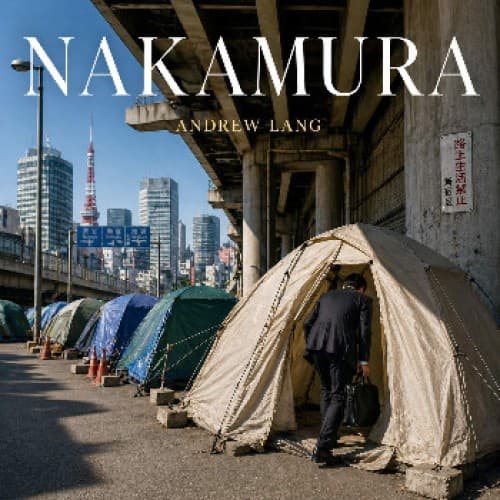
Kinshichō performed its evening routine with industrial efficiency. The station exhaled commuters in steady, obedient bursts, each person already half dissolved into their private anxieties. Office workers moved with the slumped choreography of people whose best hours had quietly expired. Couples walked in silence, their conversations deferred indefinitely. Single men hovered near convenience stores with the air of people waiting for instructions that would never arrive. Salarymen queued at 7-Eleven and Lawson with the solemnity of parishioners, purchasing their ritual offerings: sandwiches sealed in plastic optimism. Optimism laced, invisibly, with microplastics flaking off into the bread, the filling, the bloodstream. A slow, polite poisoning. Endocrine systems gently confused, hormones nudged off-script, whole populations quietly recalibrated at the molecular level by convenience food and its petrochemical skin. No alarms. No conspiracies. Just an evolutionary suggestion whispered daily into the gut: be smaller, be flatter, desire less, endure more. Tokyo wasn’t just feeding its workers; it was editing them, sanding down the rough biological edges until ambition itself began to look like a developmental glitch.
And the people of Tokyo repeated the ritual with metronomic accuracy: eat, commute, endure, repeat — a civilisation held together by convenience food and the mutual agreement not to ask questions too late in the day.
This was not a cruel system, exactly. It was merely thorough. It did not crush people; it processed them. Men entered full of ambition and left perfectly formatted, their personalities reduced to habits, their rebellions confined to brand preferences. Kinshichō had seen thousands of hopefuls: men who had once mattered briefly, intensely, and then not at all. Tokyo didn’t mourn them. It simply adjusted the flow.
Two middle-aged salarymen stood near the underpass, waiting for the pedestrian signal to change. One of them frowned.
“Hang on,” he said. “Isn’t that… that guy? Nakamura? He used to work in Communications. Left, what — seven, eight years ago?”
The other squinted. Across the street stood an immaculately dressed man — coat pressed, shoes polished — pausing outside a small tent pitched beneath the concrete belly of the expressway. He bowed, neatly, to no one in particular, and slipped inside.
“Hm,” the second man said after a moment. “Could be. Hard to say.” He shrugged. “I can barely remember what he looked like.”
The light changed. They crossed.
The tent flap settled.