


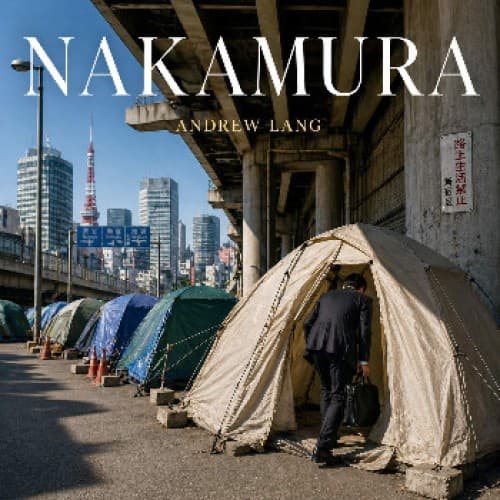
They met at a café in Funabashi, close enough to Nakamura’s apartment that the geography itself felt conspiratorial. The place had the agreeable neutrality of success: pale wood, soft lighting, an espresso machine that hissed with professional confidence. It was the sort of café you chose when you wanted to believe your life had coherence.
His daughter arrived first. Mika, twenty-five, composed and alert, the kind of young woman who gave the impression of being mildly busy even when seated. She hugged him quickly, warmly, then pulled back to look at him with that mixture of affection and appraisal children reserve for parents they’ve quietly outgrown.
“Otōsan,” she said. “You look tired.”
“I’m always tired,” Nakamura replied. “It’s my brand.”
His son, Haruto, arrived moments later, tall and earnest, wearing work trousers that still carried the seriousness of someone newly employed. He bowed — not deeply, but sincerely — and shook Nakamura’s hand as though the gesture mattered.
They sat. Coffee arrived. The ritual of family resumed as if it had been paused rather than invented.
Haruto spoke first, modestly, about his job at the industrial plant. Engineering. Systems. Processes that either worked or catastrophically didn’t. It was a good job. A skilled job. One that paid accordingly. Nakamura listened with visible pride, nodding slowly, absorbing the vocabulary of competence like a man warming himself near a fire he no longer owned.
“You dodged a bullet,” Nakamura said eventually. “Both of you. Salaryman life is useless. A long, bureaucratic way of dying indoors. I’m glad you never went near it.”
Mika laughed. “You always say that.”
“And I’m always right,” Nakamura said. “They ignore me at work now. Completely. Which is fine. I’ve been there so long I’m invisible. But the boss — the Shachō — he knows my value. We’re close. That’s what matters.”
They nodded, instinctively deferential. This was a familiar refrain, delivered often enough to sound like wisdom rather than complaint.
Mika talked about her business: an online reputation management firm, run with two university friends. Clients, strategies, metrics. It was doing well. Very well, in fact. Nakamura listened with an air of amused distance, as though business acumen were a genetic trait that had skipped his own generation and reappeared intact in his children.
When his wife came up — inevitably — Nakamura waved a hand.
“Oh, you know your mother,” he said. “Always insisting we go out. I tell her I’m exhausted, but no — there’s some new restaurant opening, so she drags me along like I’m some kind of food reviewer.”
Mika rolled her eyes. Haruto groaned in unison.
“Typical mum,” they said, perfectly synchronised.
“And I don’t care about overtime anymore,” Nakamura went on. “I just go home on time now. But that’s when the traps begin. Last week she booked a night at the cinema. Three-hour film. Subtitles. I sat there wondering which act of my life had led me to this.”
Mika laughed. “She might be a pain,” she said, “but she dotes on you.”
Nakamura smiled at that — a small, satisfied smile — and lifted his cup.
“Well,” he said, “someone has to.”