


Part Four
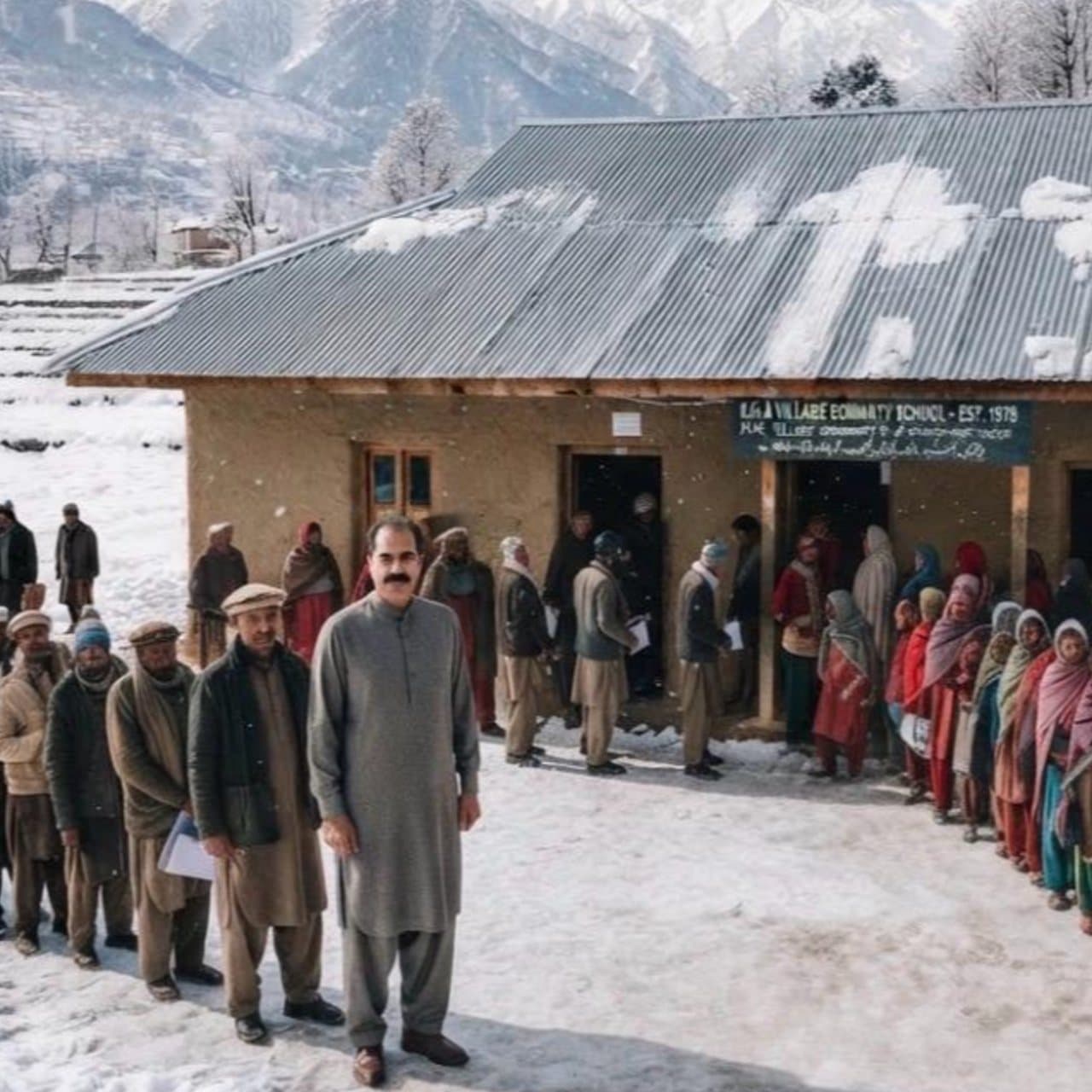
They said, “Identity cards are not something you can rely on here. We will sit with you and identify the people. We will tell you which tribe a person belongs to and what his or her name is. You have the register. Keep crossing off their names, issuing them ballot papers, and marking their thumbs.”
Then they explained the second matter.
“This election is being contested between two tribes. One lives on the right side of the River Indus, and the other on the left. The tribe on the right is called Shoomikhel, and the one on the left is called Kukihel.
“The custom here is for the men and women of one tribe to stand in the same queue. There is no separation by gender within that queue. The men and women of the other tribe will likewise form their own single queue.
“If you insist on separating them in this way, there will be fighting and quarrelling. People will start throwing stones, and it will become a serious problem. Do you understand?”
That was the advice they gave us.
As far as exempting them from the identity-card requirement was concerned, I agreed. But having the women and men of one tribe stand together in one queue, and those of the other tribe together in another, rather than separating the men’s and women’s queues, was not quite acceptable to me.
I was rather taken aback. I had my own cultural inhibitions: I myself am from Khyber Pakhtunkhwa, and I had never seen or heard of anything like this in my life.
“No,” I said. “All the men will stand in one queue, and all the women in another. Only then will
polling begin. Otherwise, until they agree to this, I will not start the election.”
The more modern-looking Kohistani men who had come up from the cities said, “Sir, please sit for a little while. We will speak to them. Have some tea in the meantime. It does not matter if polling is delayed by another hour or an hour and a half. It is hardly such a great problem here.”
They went down, and I sat drinking tea. We were all ready, waiting for them to form their queues so that we could begin voting. There were hardly more than seven hundred and fifty voters in all —say, three hundred women and four hundred and fifty men. It was not a very large number. I knew we could complete the whole process quite comfortably in two or two and a half hours.
We were sitting there when suddenly there was a tremendous bang, as though a shot had been fired or a bomb had exploded. Stones began striking the school’s tin roof. It sounded like a bombardment.
I was astonished. What was happening?
The people who had come to vote had started throwing stones to force us to begin polling and conduct it the way they wanted.
There was one particularly interesting thing about this. The inspector accompanying us began shouting in Pashto, which I also spoke with him. Translated into Urdu, what he was saying meant, “Sahib, get into a lying position! A lying position! A lying position!” In other words, lie flat on the ground so that a stone would not strike me on the head.
I was standing there, thinking, “If I lie down, might all the rest of my people run away?”
Anyway, I moved to one side, beside a wall, as the stone-throwing continued.
Then the men from the village came back up and said, “Sir, this is the situation. They insist on following their tradition: the men and women of each tribe must stand together in their own single queue.”
“Well, what can I say now?” I replied. “I find it a little embarrassing, but that is my own cultural inhibition. They do not feel that way. They have their own customs and traditions. Let us do it their way.”
As soon as I agreed, the men went down and the stone-throwing stopped. Separate queues for the Shoomikhel and Kukihel formed almost automatically, and voting began. It proceeded very peacefully.
We had also given them a very stern warning. To prevent anyone from creating another problem, we told them, “When you go to the city, there is a magistrate before whom you appear. He can have you handcuffed, send you to jail, or hand you over to the police. I have all those powers. If anyone causes even the slightest disturbance, we will write down his name here, and when he comes to the city, we will have him arrested.”
So we thoroughly frightened and warned them. But apart from their insistence on these cultural practices and customs, there was nothing else objectionable about their behaviour. They agreed, and voting got under way.
The main business was over in about two or two and a half hours. The afternoon passed, and it was around four or half past four, about Asr time. I could not see anyone coming from anywhere in the distance.
But the village men said to me, “Sir, please extend the polling time. Some people arrive late. If they get here and find that polling has already closed, there could be a problem. Since we started late, it would be better to continue until later as well.”
So we carried on. One or two people at a time kept arriving from both tribes. Eventually, we asked them, “Shall we close now?”
At about a quarter to seven, we closed the school doors, lit the lanterns and the other lights we had, and began the counting process. Before the counting itself, they served us very nice tea with generous refreshments.
Then the counting began. There were two heaps of ballot papers, one on either side, with their polling agents seated nearby.
The polling agents were the same well-dressed Kohistani men in trousers who had come from the cities. They had some education and knew how to count. What I found particularly interesting was the behaviour of the other people sitting behind them. They watched the agents’ fingers, anxiously feeling that the opposing side might be winning.
The men sitting on both sides looked pale and were smoking cigarettes. Whenever one side’s tally fell a little behind, the men on that side would take a drag and then exhale with a long, whistling sound, expressing their anxiety: “Oh, let us not lose! Let us not lose!”
But we told them very calmly, “Not a sound. Not a word. We have to finish the entire process.”
They asked, “When will you announce the election result?”
“When the counting and all the work are complete,” we replied. “After that, we will sit down calmly and determine what the election result is. All right?”
At this point, we needed to act with considerable wisdom. A single careless word from anyone could have created a problem for us.
I asked the Kohistani polling agents to step outside for a while. We then discussed the situation among ourselves and decided that we would not announce the election result there at all. We would keep both sides happy and leave the announcement to the Assistant Commissioner. Our job was to deliver the bags safely to his office, along with the completed forms.
We had to handle both sides in such a way that they would neither harm us nor harm each other, and would instead help us reach our headquarters safely and as comfortably as possible the following day. By then, night had fallen, and there was no possibility of beginning the return journey that evening.
When the agents came back inside, we said, “Look, you are such good people, and you have
shown us such wonderful hospitality. We respect both your tribes. This is your area, and we do not want any kind of trouble.
“As far as we can see, it looks as though the votes on both sides are exactly equal. There may be a difference of one or two votes, but we congratulate both sides. You have both participated enthusiastically in the election.