


Part Five
“Now we have a request. Toss a coin between yourselves. One side can host us tonight, give us dinner, let us sleep comfortably, and provide breakfast in the morning. That side will then be free of further responsibility. The other side can bring its mules and everything necessary and accompany us to the jeep-accessible road, making the journey as easy and painless for us as possible.”
They were sensible people too. They replied, “Both sides will contribute. We will host you tonight, and tomorrow morning both sides will go with you. We will see you into the jeeps and then continue on foot ourselves to headquarters.”
“That is a very good decision,” we said. “We agree.”
That night, they lit fires around our room, arranged lighting, and served us excellent tea. They also gave us something very good to eat—I cannot remember whether it was kheer or halwa. We slept very comfortably.
In the morning, we all bathed in hot water. Each of us had one spare set of clothes, which we put on without ironing. Then we set off.
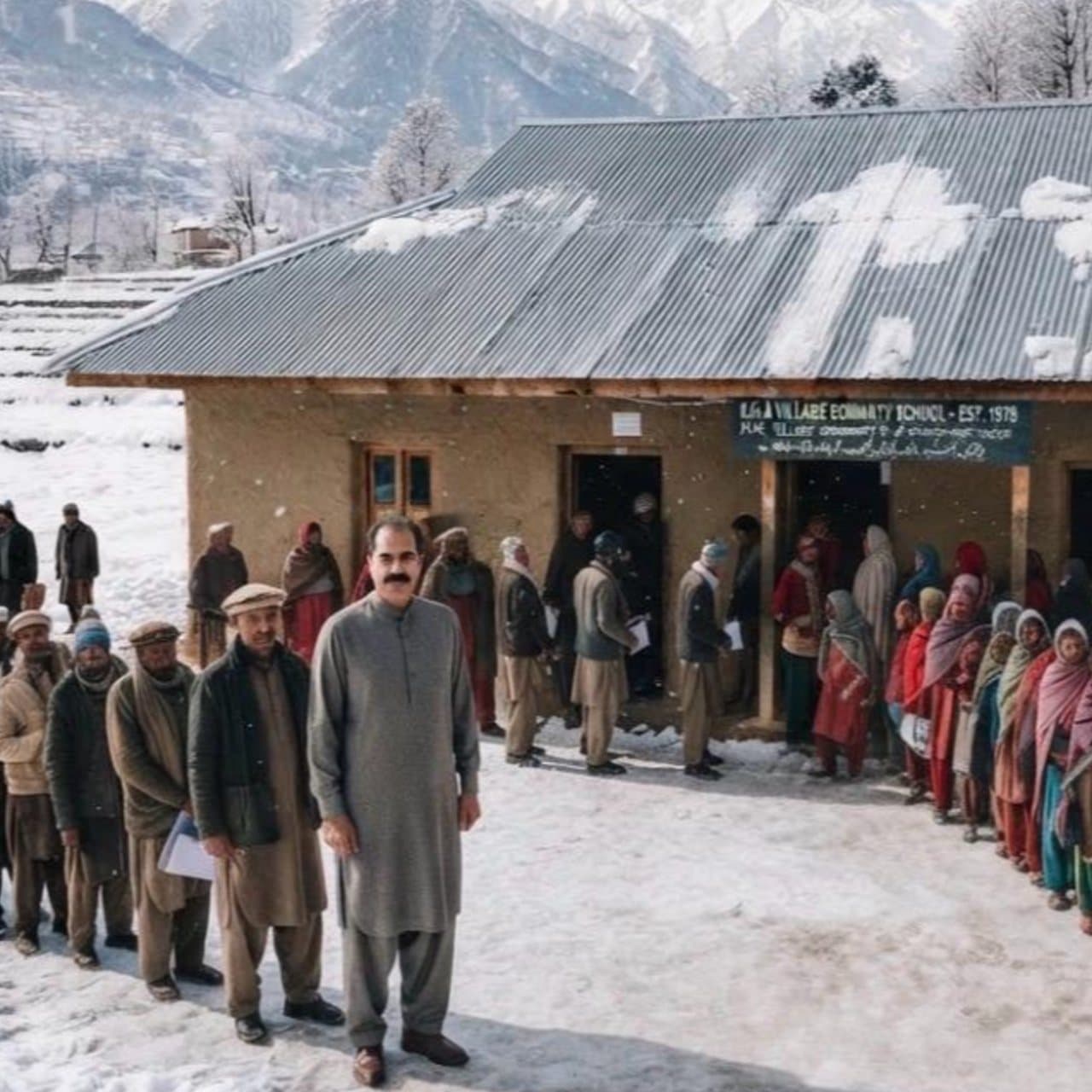
There had been sixteen or seventeen of us when we arrived. On the return journey, there were about sixty or seventy around us—thirty or thirty-five men from one tribe and thirty or thirty-five from the other. They went ahead of us, while their elders offered us blessings because we had conducted the election peacefully and in accordance with their wishes.
So we began our return journey. On the outward journey, most of the route had been uphill, along narrow paths. This time, they also gave us wooden pegs or stakes to use as supports. Two men accompanied each one of us so that no one would fall or have any other difficulty. They supported us as we walked.
Since the return route was downhill, the journey that had taken perhaps twelve hours, or ten hours, on the first day took us about eight hours on the way back. Along the way, they kept giving us food and drink, and we stopped for short rests. They also gave considerable support to those who were weaker.
Interestingly, when we were about halfway back, I remembered the sick young constable we had left behind. What had happened to him? The men who had gone to check on him had not returned.
When we reached that part of the route, they told us, “There are four men waiting for you just ahead.”
One was the young constable who had been ill, another was the attendant we had left with him, and the other two were the men who had gone to check on them. They had stayed and slept there too. They had taken food with them, as well as some warming remedies and things for applying warm compresses.
They were waiting for us. I was very happy to see them, and we took them along with us.
Eventually, we reached the jeep-accessible road, at about eight or a quarter past eight in the evening. I got into my jeep with my men and went to the Assistant Commissioner’s office. From the other direction, my colleague Amjad Khan arrived in his jeep from the other village.
We waited a little while. The Assistant Commissioner welcomed us warmly and thanked us. He gave me an envelope containing some money—five or six hundred rupees—and gave another to Amjad. He then gave each of us another envelope, saying, “This is for your staff. Distribute it equally among them.”
When I opened my own envelope, there were six hundred and fifty rupees inside. Amjad opened his, and it also contained six hundred and fifty rupees.
Amjad and I both thanked the Assistant Commissioner, Captain Yousuf Khan, and said, “Please
be kind enough to take this back. This cannot compensate for the effort we made, the enthusiasm with which we went on this adventure, or the exhaustion and hardship we endured. This money has come from the government. Please return it to the government. We do not want it.”
“No,” the Assistant Commissioner said. “This is your money. It is the remuneration due to you.”
“No, sir,” we replied. “This is not appropriate remuneration for us. You are a Grade 17 officer, and so are we. Either give us nothing, or give us the proper travelling and daily allowances, which would come to about three thousand rupees each.”
“All right,” he said. “I will write to the department.”
“There is no need for you to write,” we replied. “We had to serve our country, and we have done so.”
“Well, at least let the men who accompanied you receive their money,” he said.
“Certainly,” we replied. “Give them what they are entitled to, and give them our money as well. Double it, and please open your own wallet a little too. Write to the government and arrange more money for them. One poor young man became ill on the way, and the others worked hard too.”
I also spoke about the inspector. “He carried out the whole task exceptionally well. He worked very hard.”
In this way, the Assistant Commissioner was happy, and so were we.
When we came out of his office, Amjad looked at me and laughed, and I looked at him and laughed. We were in such a terrible state. Our bodies were bruised, our hands had thorns in them, our faces had turned yellow, our legs were trembling, and we were in a dreadful condition from lack of sleep. We looked as though we had returned from some great jihad or a war.
Amjad said, “You are not going back to Dasu, Kohistan, tonight. You are staying with me.”
Amjad was not only my colleague and counterpart in the other subdivision; he had also been two years senior to me at university. We used to meet from time to time at our head office in Abbottabad. He came from an aristocratic family, had very good manners and a very generous heart, and treated me like his younger brother.
He lived in a very large house in Pattan, built entirely on pillars, with the River Indus flowing beneath it. It was a mud house, constructed from unbaked bricks, but very well and beautifully built. There was an opening in the middle through which his servants could lower a container or a bucket and draw water directly from the river. It was a delightful place.
When we arrived, his two servants said, “First of all, you must bathe.”
After we had bathed, they said, “Now go to sleep.”
“Something to eat?” we asked.
“No,” they replied. “Do not eat anything just now. Go straight to sleep and rest. Whenever you wake up, you will have your food.”
We went to sleep at about half past one or two in the morning. We both woke at about nine or ten the following morning. We were both young men. I was twenty-three, and Amjad Khan must have been twenty-four or twenty-five.
When we woke, delicious cooking aromas were coming from the adjoining room. There was no separate room designated as a kitchen. Large pots had been set over the fire, with desi chicken, desi eggs, and very aromatic spices cooking inside.
We got up, brushed our teeth, and performed our ablutions. Then the servants placed large bowls of yakhni—broth or soup—in front of us. We each drank two bowls.
After a little while, energy began to return to our bodies. Our legs warmed up, we began to feel ourselves again, and we enjoyed it immensely.
Then they served us tea.
“Now rest a little more,” they said. “For an hour or an hour and a half. Afterwards, we will serve you lunch.”
At lunchtime, they gave us roast goat meat, rice, and all the other things, followed by tea.
That memorable journey became a part of my life. I remember it as one of the most unforgettable experiences of my youth and the early days of my career. Whenever I think about it, I feel proud of myself. At the same time, I wonder: how did I manage to do all that?
And that was the final part of my story, of this memoir.