


Part Two
Then the FC inspector said to me, “Sir, it would be better not to stay here too long. We should continue our journey. In another two or three hours, God willing, dawn will break and we will have daylight. Then perhaps we will be able to see a village or some other settlement. Wherever we find people living, we will go there and somehow arrange to get some breakfast.”
He understood the Kohistani language as well. He went on to say, “I think we should reach our destination by eleven or twelve in the daytime.”
I shone my torch carefully over my companions’ faces and bodies to see whether anyone was badly injured or having some other difficulty. Among them, I noticed a very innocent-looking young Pathan, a Levies constable with a very fair complexion. He was probably even younger than I was.
His face had become very red. When I placed my hand on his forehead, I found that he had a high fever. When I asked him about it, he pulled up his shalwar and showed me that his leg was badly injured. He had fallen two or three times.
By then, we had covered almost three-quarters of the outward journey. I suggested that we seat him at the front on a mule, with another man behind him to support him. But the inspector told me, “No, it would be better not to take him any farther. Let us leave some provisions here for him and have someone stay with him. Once he feels better, he can join us later.
“That would be wiser than taking him farther on, because bringing him back would then be
difficult. We will find neither a dispensary nor any medicine here. It is better not to take the risk.”
So that was what we decided. There was a little shelter formed by large stones fitted together—it was not really a hut. We spread a mat beneath it and settled him there. We gave him a little milk to warm over the embers after we had gone, along with a small piece of jaggery. He could have that and then sleep, if he could manage to sleep. There was, after all, considerable danger there.
If he felt better, the companion staying with him would bring him up to join us the next day. If he did not recover, we would send a mule back from our destination so that he could be taken back to Pattan. That was our decision, and that was what we did.
We continued our journey. After about another three hours of travelling, at around five or a quarter past five in the morning, a little light began to appear in the sky. A pale whiteness emerged, and our eyes, too, brightened.
We saw the River Indus below us, with mountains rising above it, and we were climbing those mountains. Looking down, we could see nothing except the Indus. The mountain range ran alongside the river, and we kept climbing.
At about a quarter to six in the morning—perhaps 5:45 or 5:49—we spotted a settlement in the growing daylight. There were houses made of earth, with roofs of metal sheets, and we could see a few sheep—two, four, perhaps five.
“Thank Allah!” we said. “At last, a settlement—people!”
We sat down there and felt a little warmth from the sun. We sent the inspector and one or two constables down to find out whether we could get anything to eat or drink. Even if we had to pay, it would be good to rest there and have some milk, tea, or breakfast—whatever they had. Even maize bread would be a blessing.
When they went down, they found an elderly woman, a very old man, and a young man. The young man had a long, untrimmed beard and was holding a stick in his hand. He was bringing the sheep and goats out of the house. We had seen him before I sent the inspector down to speak to him about breakfast.
The inspector spoke to him in the local language and explained that we would pay them. There were sixteen of us—sixteen or seventeen, allowing for the young constable, whom we hoped might also join us.
They said, “All right. We will charge each of you one hundred rupees and prepare breakfast for you from whatever we have.”
When the inspector returned with this news, we were overjoyed. We went straight down to the house, weeping as we went. There were no charpoys, so we spread out our own mats. We had gathered our animals—the mules and the others—and tethered them together in one place farther up before going down.
Within an hour or an hour and a half, our hosts lit a fire and boiled some milk. They then added culinary leaves and dried flower petals, which they used in place of ordinary tea leaves. I remembered seeing these sold in shops in Dasu and Pattan. They gave the drink a pleasant taste and aroma. We thought even that was a great blessing.
They also gave us bread made from red maize, along with small, sweet, black amlok, a fruit also available in winter in our towns and urban markets. We thanked Allah and had a very good breakfast. It brought us great relief.
But our heads were still spinning, and there was scarcely any strength left in our legs to continue the journey.
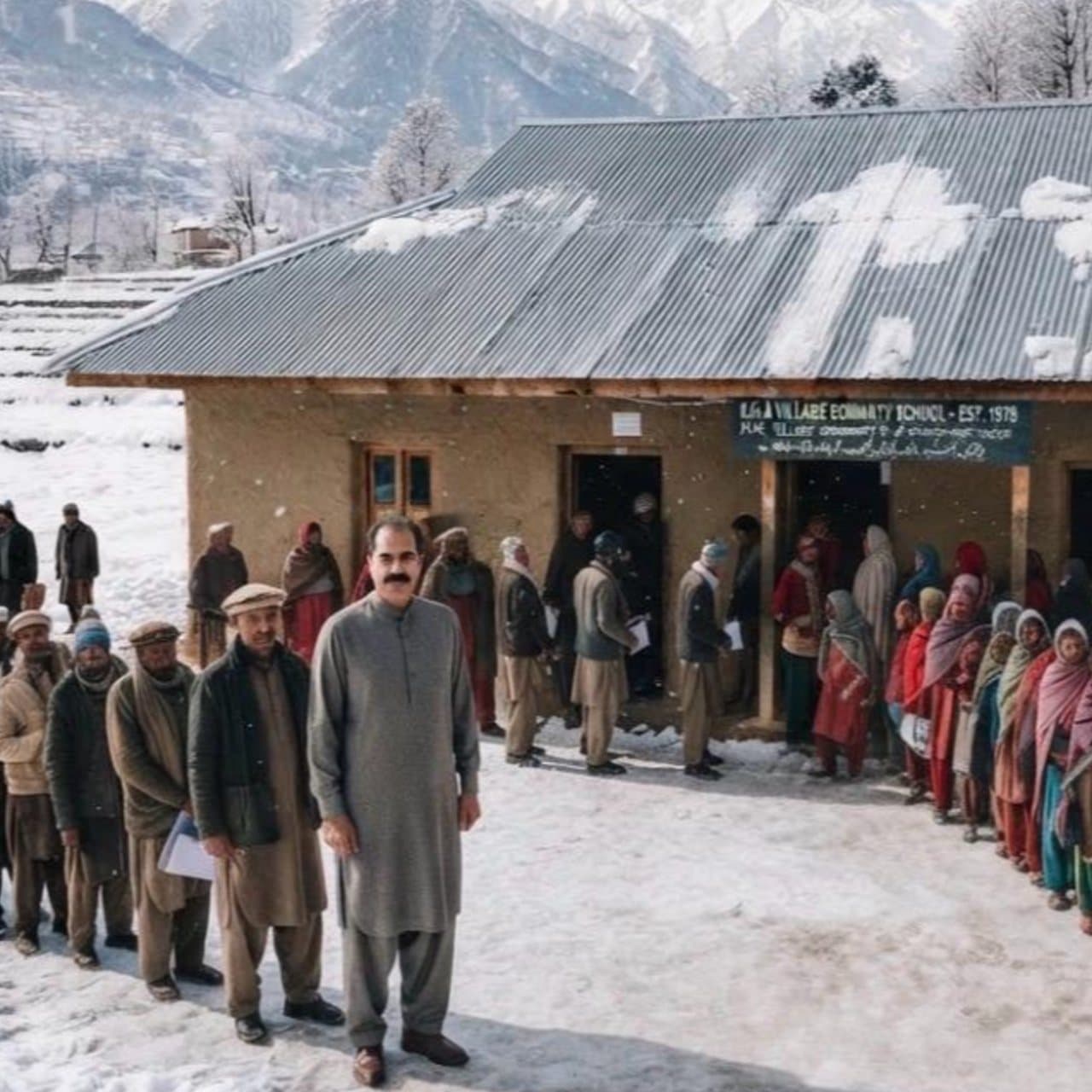
While we were still having breakfast, we saw a curious sight: before long, a large number of mules and people were coming towards us. They greeted us very warmly and said, “From now on, you are our guests. Our village is just nearby, and that is where the polling station is.”
They included the candidates from both sides contesting the election, as well as their relatives. This brought us some relief. At least, we thought, we were now in the care of other people, and they would look after us.
We joined them and began walking. They were so eager to help that they almost wanted to carry us on their shoulders. Instead, we leaned on them for support and kept walking and walking, stopping to sit down and getting up again along the way.
Someone said to me, “Sir, polling was supposed to begin at eight this morning. It is already nine, and by the time we reach the village, it will be eleven.”
I replied, “Never mind. I have the authority to adjust the timings. We have made it here, but this is a remote area where simply getting people to the place is extremely difficult. There is no way to communicate, either. We can adjust the polling hours ourselves, announce them, and proceed accordingly. Even the voters will have great difficulty reaching this polling station. Let us get there first, and then decide what to do.”
We finally arrived at about a quarter to twelve. As soon as we reached the village, they gave us warm quilts, pillows, blankets, and woollen coverings called balanjay, made from sheep’s wool. They covered us up, and we fell into such a deep, carefree sleep that it was as though we had not slept for six months. We were utterly, utterly exhausted.
Everyone fell asleep except the inspector, who continued to stand guard over us.
When I woke up at about 2:45 or 2:50 in the afternoon, I said to him, “Now you should sleep. I am awake. Let the others sleep; they can get up whenever they wake naturally.”
After that, I bathed in hot water. I was still wearing the same clothes and did not change them. I thought I would change before setting off on the return journey.
We settled the inspector down to sleep. He was considerably older—perhaps fifty or fifty-five at the time—whereas I was