


Part One
It was September 1986. At that time, Pakistan was under General Muhammad Zia-ul-Haq’s government. He was the President of Pakistan, and Muhammad Khan Junejo was the Prime Minister.
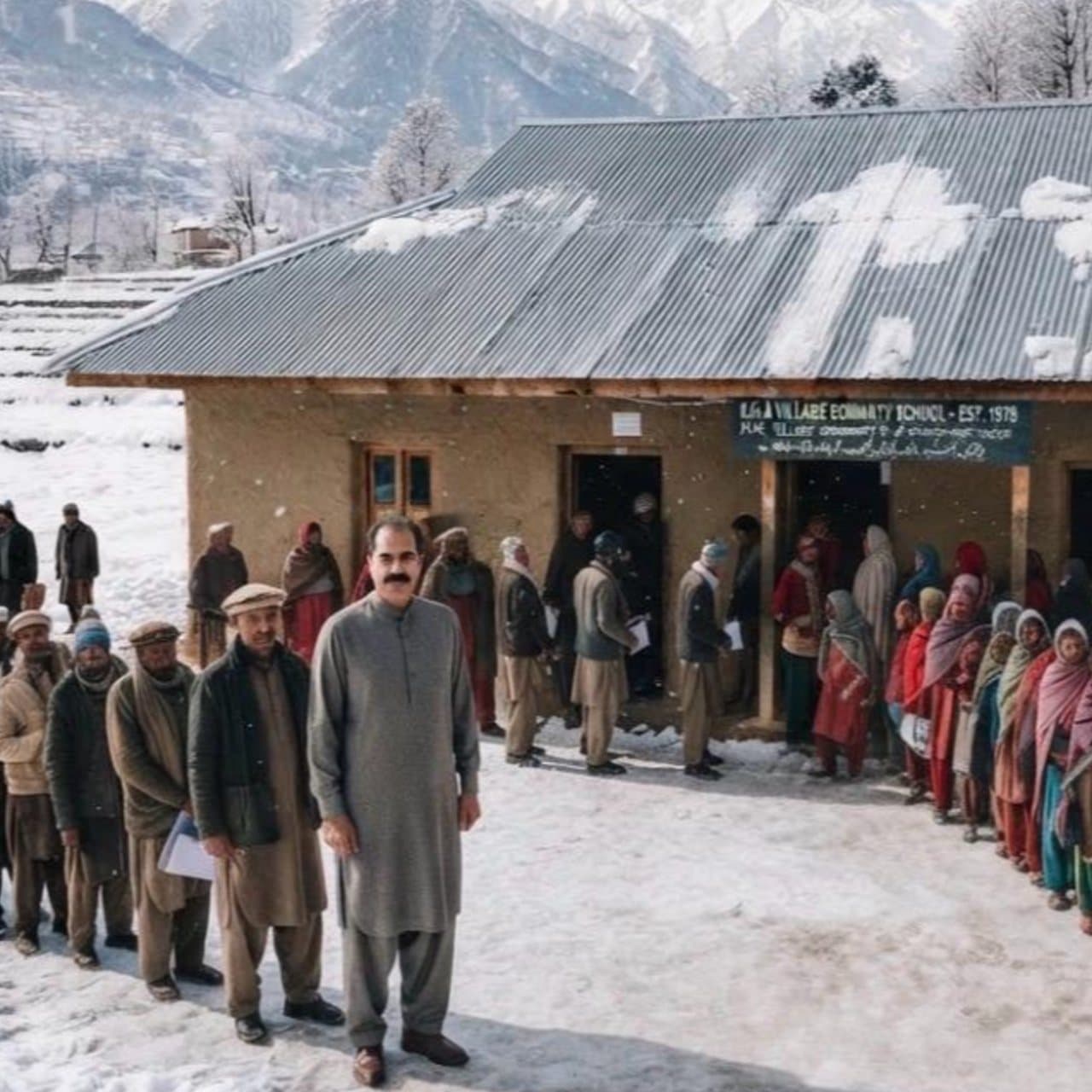
I had just started my very first job, with a posting in Dasu, in Dasu Tehsil of Kohistan District. While I was serving there, it was suddenly announced that local body elections were to be held in the country. I was assigned election duty as a presiding officer at a polling station in the neighboring subdivision, which was called Pattan.
This story is so interesting and so full of adventure that anyone reading it will surely enjoy it.
The whole of Kohistan District—Dasu and the neighboring tehsil of Pattan—was a succession of towering mountains. Apart from the road, there was scarcely any level ground on which to place a foot.
Then, suddenly, we received a letter informing us that I had been assigned duty as a presiding officer in Palas, a remote village in Pattan. There was a tehsil office in Pattan, where the Assistant Commissioner, Captain Yousuf, was posted. He summoned us and gave us some instructions. We received our briefing and a little basic training at the Tehsil Municipal Committee office in Dasu, Kohistan, the district headquarters. Staff were also assigned to accompany us, and we were told that we had to reach our destinations the following week.
Part of the route—about ten or fifteen kilometers—was accessible by jeep. Beyond that, we would have to continue on foot. Well, it was an adventure, and I was very young at the time. I must have been barely twenty-two or twenty-three—twenty-three, yes, I was twenty-three years old. So I gathered my courage.
A colleague of mine, who was posted in Pattan, had also been assigned similar duty in another remote village in Pattan. He encouraged me as well. His name was Amjad Khan, and he was from Balakot, from a very aristocratic family of nawabs. He said, “Never mind. Let us do our duty and see what happens.”
A week later, we went to the Assistant Commissioner’s office. We picked up our respective bags there, and a jeep set off with me. Accompanying me were some FC and Levies personnel, an FC inspector, and some teachers from LAMIC, the Literacy and Mass Education Commission. This was a form of adult education programme started during Muhammad Khan Junejo’s time. Many teachers were recruited on contract, and some schools were established in mosques. I also recalled its connection with Nai Roshni and a system of schools. Some of its teachers joined us.
At first, I got into a jeep with three or four other men. Another jeep came up from behind, and we got into that one.
Before we left, we were instructed to take roasted chickpeas, some jaggery, and other dry provisions, such as biscuits. If we could take a little milk, we were to take that too. We had a long journey ahead, and we might need these things along the way.
As a precaution, they also told us, “When you get out of the jeeps, you will find a canister of petrol in each one. That petrol is not for the jeeps. There will be mules and donkeys waiting farther along, and you must load everything onto them.
“When night falls and you are still travelling farther into the mountains, climbing towards those remote heights, you may find nothing to eat or drink, no people, no living thing at all. If it gets dark, you will need to keep animals away, keep yourselves warm, and have some light. Use your torch to look for a tree. If you find a tree that is dry, or [a few words describing the tree’s condition are unclear], pour a little petrol onto it and set it alight. You can then rest there for a while.”
So, invoking the name of Allah, we climbed into the jeeps and set off at about half past eleven in the morning. I think we got out of the jeeps about half an hour later. Mules were waiting for us ahead, and we continued on our way, a whole troop moving together like a caravan.
As we travelled on, some of the men mounted the mules. There were about three or four mules. Among the men were FC constables and some Levies constables, and the inspector leading them also mounted one. I could not manage to ride, because I had no experience of riding a mule or a horse. We were wearing trainers.
We walked and walked. Before we knew it, it was time for Asr prayers. Then came Maghrib, and then Isha. Somewhere along the way, we came across a little water. Some of the men performed their ablutions, offered their prayers, and then resumed walking with us.
By then, people were beginning to feel hungry. They opened their bags and started eating whatever they had brought. We collected what little water there was and drank that too. Then we continued our journey.
The route took us up and down the mountains: a climb, a descent, a short stretch of level ground, then another climb and more narrow paths. It was so dark that we could not see the paths. We had torches and tried to light our way with them. Sometimes one of us would move ahead; sometimes someone would fall behind.
As the presiding officer, I was worried about the staff and the FC men accompanying me. I feared that someone might fall and be injured. I wanted to make sure everyone was accounted for, so that we would not go farther ahead only to discover that three or four men had been left behind or had fallen—God forbid that anything should happen to them. So I kept looking both ahead and behind.
Our legs began to ache, and we began to feel hungry too. Almost all the supplies we had brought were running out. But we did not lose heart, and we continued on our way.
In the darkness, we had to negotiate paths strewn with large rocks, loose stones, and sharp, pointed stones. Stumbling and falling among the bushes, we kept pressing on and on. Thorns began to catch in our clothes, and the sharp edges of the stones began to scrape our arms and legs. We were beginning to be in a bad state.
By the time we had travelled farther along like this, it was about two o’clock in the morning. It was completely dark. When we looked up towards the sky, we could make out the mountains, but below us we could see nothing at all. Still, invoking Allah’s name, we kept going, because the mule handlers accompanying us knew the way. We ourselves had no idea where the path was leading.
I stopped for a moment and suggested to my companions that we should halt somewhere for an hour or an hour and a half and get some rest. If we had any food left, we could sit down properly, share it out, and eat. Once we had recovered a little strength, we could continue our journey.
The Kohistani men leading us kept telling us, “Just a little farther, sahib. Only one mile to go, only one mile.” They would call even ten or so miles “one mile,” because they were completely uneducated and accustomed to that terrain. We had no idea of this. Taking their word that there was only a mile left—even allowing that their one mile might mean two or two and a half—we kept going.
Eventually, we stopped. We spread some mats, or something similar, on the ground and tethered the mules to one side. Our Kohistani companions had a particular kind of grass with them—I do not know exactly what it was—which they fed to the animals. They settled them down to rest as well.
We found a dried tree stump, poured a little petrol onto it, and set it alight. Our bodies began to warm up a little. We gathered whatever biscuits, chickpeas, and roasted maize kernels we had left. There was also a little sheep’s milk in a canister. We shared it all among ourselves.