



Ganga read him the letters that evening, since he could not bear to read them himself in front of her, and his own eleven-year-old handwriting, in her voice, sounded like a message sent from a country that no longer existed.
The first letter said very little — that he missed the rain, that the city he now lived in had no waterfall, that he hoped Shivappa was keeping well and had not sold his bicycle.
The second letter, written some months later, said one thing Rohan had entirely forgotten writing, and which now undid him completely:"I have decided that when I am grown, I will come back to Jog, and you will take me to see the falls again, and this time I will not be afraid to stand close to the edge, because you will be holding my hand, and you have never once let me fall."
Ganga folded the letter carefully and placed it back in the box.
"There is one more thing," she said. "I was not going to mention it. But I think, now, you should know."
She told him then of the last conversation she'd had with her father, some weeks before he died. He had told her, without explanation, that he wanted to be taken — after he was gone, whenever that day came — to sit near the viewpoint one final time, his ashes released into the gorge below, into the same water that fell, always falling, toward the Sharavathi.
"He said the falls had raised more children than he had," Ganga said. "He said he wanted to go home to them."
It had already been done, eight months ago, exactly as he had asked.
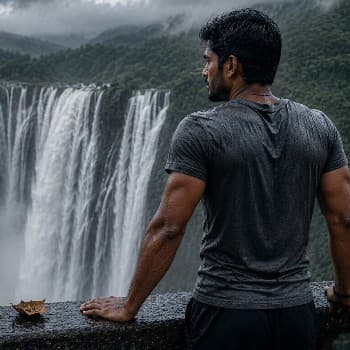
Rohan walked, alone, the next morning, to the viewpoint where the shop no longer stood. The rain from the previous evening had passed, and the gorge lay open before him in a way it rarely did in the wet months — the mist thinning just enough to show, far below, the white violence of water that had been falling in that exact place for longer than anyone currently alive had been watching it.
He stood at the railing for a long time. He did not cry, though he had expected to. He felt, instead, a strange and enormous stillness — the stillness of a person standing, at last, at the exact centre of something he had spent ten years circling without knowing it.
He took from his pocket a single dry leaf he had picked up on the path that morning, without quite knowing why he had picked it up. He folded it, clumsily, the way a hand half-remembers a skill it has not practised in a decade. He walked to the small stream that fed into the falls, knelt, and set the leaf-boat into the water.
It turned once. It caught the current. It vanished around the bend, toward the edge, toward the fall, toward whatever waited on the other side of the roar that had never, in all these years, stopped.
He understood, watching it go, that some people do not stay in our lives to be thanked. They stay only long enough to teach us how to love without asking anything back — and then they are gone before we have learned how to say so.
He stood at the railing until the mist closed in again, until Jog disappeared, as it always eventually did, into its own weather.
Then he turned, and walked back down the hill, toward Ganga's house, where a cup of tea he had not finished was still waiting to be finished — and where, he understood now, some part of him would always, in some way, be waiting too.