


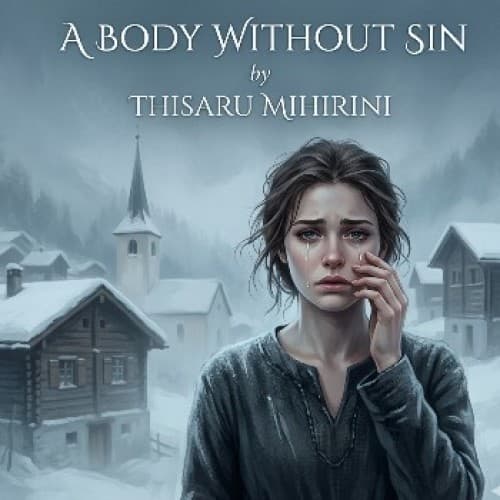

The village of Binn, tucked deep within the quiet folds of the Swiss Alps, woke slowly under a pale sky. Morning light spilled gently over wooden chalets, grazing their slanted roofs still dusted with the memory of last night’s frost. A thin river whispered through the valley, its water clear and cold, reflecting a world that looked far more peaceful than it truly was.
In that village, where everyone knew everyone—and judged even more—lived a girl they had already named long before they knew her story.
Elena Weiss.
She stood barefoot on the creaking wooden floor of her small home, staring out of a narrow window framed by worn curtains. The cold seeped through the glass and into her skin, but she did not move. It was a familiar kind of cold—the kind that settled not just in the body, but somewhere deeper.
Behind her, a faint cough broke the silence.
“Elena…” her mother’s voice came weak and strained from the bed in the corner.
Elena turned immediately, her expression softening as she walked over. “I’m here, Mama.”
Her mother looked smaller every day, as if illness was slowly erasing her from the world. The blankets barely rose with her shallow breaths.
“You didn’t sleep again,” her mother murmured.
Elena forced a smile. “I did. You just didn’t notice.”
Another lie.
She had stopped counting the nights she lay awake, staring into the dark, thinking about everything she could not change.
At the small wooden table nearby, two schoolbags lay neatly packed. Her younger sisters—Lina and Sophie—were still asleep, their faces calm in a way Elena barely remembered feeling herself.
They had dreams.
She had responsibilities.
“I’ll make breakfast,” Elena said softly, brushing a strand of hair away from her mother’s pale face.
“There’s no bread left,” her mother replied.
Elena hesitated only for a second. “I’ll get some.”
There was no money.
But she had already decided what she would do.
—
By the time the sun had fully risen, Elena was walking down the narrow path that led out of the village. The mountains stood tall around her, beautiful and indifferent. The kind of beauty that tourists admired—but never stayed long enough to understand.
Her coat was thin, her shoes worn, but she walked with quiet determination.
People passed her.
Some nodded politely.
Others whispered.
“Elena Weiss…”
“That girl…”
“She works in the city, doesn’t she?”
“I heard what she does…”
Their voices followed her like shadows.
To them, she was simple to define.
A prostitute.
It was easier that way.
The truth required too much understanding.
—
The art studio was located in a neighboring town, just beyond the valley. It was a place filled with light, silence, and the scent of paint. Large windows allowed the sun to pour in, illuminating unfinished canvases and scattered brushes.
To Elena, it was both a refuge and a prison.
“You’re late today.”
The voice came from across the room.
Lucas Meier.
The artist.
The man she had never meant to love.
She looked up, her breath catching for a moment before she steadied herself. “The road was icy,” she said quietly.
Lucas studied her for a second, then nodded. “Get ready. We’ll start soon.”
There was no warmth in his tone.
No curiosity.
No concern.
Just instruction.
Elena moved behind a folding screen, her fingers trembling slightly as she removed her coat, then her dress, then everything else that separated her from the cold air.
This was her work.
This was how she fed her family.
When she stepped out, bare and exposed, the studio fell into a deeper silence.
She took her position.
Still.
Unmoving.
Untouchable in a way no one understood.
Lucas began to paint.
The sound of the brush against canvas filled the room, steady and focused. His eyes moved over her—not as a man looks at a woman, but as an artist studies form, light, proportion.
To him, she was not Elena.
She was shape.
Contrast.
Art.
Hours passed.
Her muscles ached, but she did not move. She had learned how to exist within discomfort, how to silence her body when it begged for relief.
“You’re perfect for this,” Lucas said suddenly, breaking the silence.
Her heart reacted before her mind could stop it.
Perfect.
The word echoed softly, dangerously.
“For… the painting?” she asked, her voice controlled, careful.
Lucas didn’t even look up.
“Of course,” he replied.
The fragile hope inside her cracked.
She lowered her eyes, staring at the wooden floor beneath her feet.
Of course.
It was always about the painting.
Always about the work.
Never about her.
Still, she couldn’t stop herself.
“Lucas…” she said after a long pause. “Do you ever see me as… more than this?”
The question hung in the air, heavy and irreversible.
He finally looked at her.
For a brief moment, their eyes met.
And in that moment, she searched desperately—for something, anything.
But what she found was distance.
“You’re important to my work,” he said carefully. “You inspire my best pieces.”
Her chest tightened.
“That’s not what I meant.”
He sighed softly, as if the conversation itself was unnecessary.
“Elena… don’t misunderstand things,” he said. “You know what this is.”
Yes.
She did.
Or at least, she thought she did.
But knowing didn’t make it hurt less.
“So that’s all I am?” she asked quietly.
He didn’t answer directly.
Instead, he turned back to his canvas.
That silence was louder than any words.
—
When the session ended, Elena dressed quickly, her hands colder than before. Lucas handed her the money without meeting her eyes.
It was enough for bread.
Maybe a little more.
But not enough to buy dignity.
Not in this village.
Not in this world.
“Same time tomorrow,” he said.
She nodded.
She always did.
—
By the time she returned home, the sky had darkened again. The mountains cast long shadows over the village, as if trying to hide it from the rest of the world.
Her sisters were at the table, eating.
Bread.
Soup.
Simple things.
But they smiled when they saw her.
“Akka—” Lina stopped herself, correcting. “Elena! We waited for you.”
Elena smiled back, her exhaustion hidden behind gentle warmth. “You should eat while it’s warm.”
Her mother watched quietly from the bed.
Later, when the girls had gone to sleep, she spoke.
“They’re starting to hear things,” her mother said softly.
Elena’s heart sank.
“What things?”
Her mother hesitated.
“What people say about you.”
Elena looked away.
“What do they say?” she asked, though she already knew.
Her mother’s voice broke slightly.
“They say you sell yourself.”
Silence filled the room.
Elena felt something deep inside her tighten—not anger, not shame, but something heavier.
“I don’t,” she said quietly.
“I know,” her mother replied. “But the world doesn’t care about truth.”
No.
It didn’t.
To them, there was no difference between exposure and sin.
Between survival and shame.
Elena stood and walked to the small mirror hanging on the wall.
She looked at herself.
Really looked.
The same face.
The same body.
The same person.
But seen so differently by others.
“Who am I?” she whispered.
The girl in the mirror did not answer.
Was she what they called her?
Or was she something they refused to understand?
Outside, the wind howled softly through the valley, carrying with it the whispers of a village that had already judged her.
Inside, Elena closed her eyes.
She was not what they believed.
She had never been.
But in a place like Binn, truth did not matter.
Only perception did.
And perception had already destroyed her.
Tears slid silently down her cheeks, unnoticed, unacknowledged.
Tomorrow, she would walk the same path.
Stand in the same room.
Be seen the same way.
And love the same man—
who would never, ever see her back.
Her story had only begun.
But somewhere deep within her, she already knew—
It was not a story meant for happiness.