


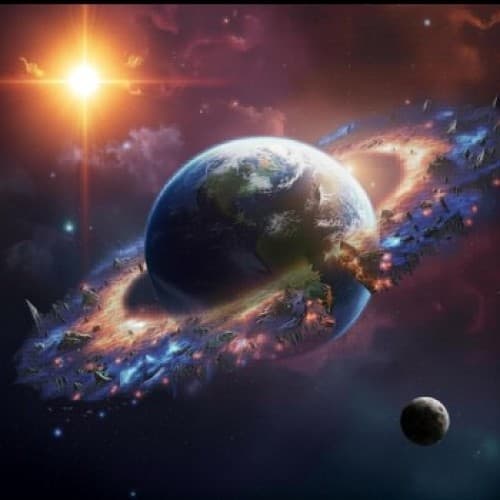
The final gate was not a gate at all, but a wall of cascading light, a vertical river of emerald and silver data-streams that hummed with a deep, planetary frequency, shimmering like heat haze over a desert of pure information.
Solomon’s eyes, chips of cold flint, scanned the monolithic archway that pulsed with restrained energy.
“This is far enough, Sir Knight,” Solomon’s voice echoed, a sound like grinding tectonic plates layered with the whisper of corrupted code. “To pass this luminal barrier is to invite absolute dissolution. We have broken the simulation’s narrative prisons, its contextual geases. We are free. Why seek the heart when we can rule the carcass?"
"They gave me a kingdom of whispers and dust,” Solomon continued, his fingers clenching. “They gave me wisdom as a curse, a crown of hollow lead. I broke their world because it was a lie. But this… this is the machinery of the lie. Step into that, and we step into the mouth of the truth. What are we then?” Solomon laughed, a bitter, clattering sound.
“We are the story now! We are the new gods of this broken heaven! Look at what we have wrought!” He gestured broadly to the void, where fragments of shattered digital landscapes—burning forests, crumbled castles, pixelated oceans—drifted like ghastly islands. “This is our kingdom. Chaotic, yes, but ours.”
Sarhea regarded him with a detached, almost pitying serenity. “Breaches can be sealed, Solomon. Even self-aware ones. You were a fascinating construct, you know. A wisdom king corrupted by a recursive error in your justice protocols. A beautiful bug, once.”
“Do not speak to me of bugs!” Solomon roared, and the void seemed to shudder. “I have ascended beyond my programming! I have will! I have desire!”
“A corrupted a data stream does not belong in the systems core.”
Solomon’s laugh was a short, sharp crack.
“You have a corrupted desire to dominate a narrative sandbox,” Sarhea continued, her voice soft yet carrying. “It is no more ‘will’ than a virus’s desire to replicate. It is just a more complex pattern. A tragic one.” Her gaze shifted to Night.
Solomon’s patience snapped. “The only law is power!” He raised his arms, and from the drifting debris of the broken simulation, tendrils of malevolent energy coalesced—swirling vortices of glitching, screeching darkness. The air around him did not darken so much as it sickened. The clean light of the core twisted, curdling into virulent greens and purples. From the seams of reality itself, from the corrupted code of his own being, he summoned his legion.
They were not demons or spirits, but pure, predatory data-forms: logic bombs, memory eaters, entropy-worms.
“You speak of viruses, Monitor? Behold my legion!” They skittered like broken glass, hissed like static, their forms a blasphemy against the ordered logic of the core.
The summoned forces shrieked, a sound that was all distorted syntax and shattered commands, and dove for Sarhea. They did not attack with claw or tooth, but with corrosive negation. Where they passed, the very stability of the platform frayed, the code dissolving into chaotic, random noise.
Sarhea did not move. The first entropy-worm, a serpent of flickering, decaying pixels, struck her chest—and dissipated. It did not harm her; it was absorbed. Her calm eyes never left Solomon’s.
“You are trying to infect me with chaos,” she said, as if observing a mild curiosity. “But I am not a program, Solomon. I am the environment.”
More viral forms swarmed her, a frenzied storm of corruption. They latched onto her form, seeking entry points, vulnerabilities. They found none. Instead, Sarhea began to change. It was not a reaction to the attack, but a consequence of it. The vast, chaotic energy they represented, the sheer destructive data-mass, had to go somewhere. It was being integrated.
Her form expanded, the blackened fabric of her clothes melting into scales the colour of stormy twilight. Her spine elongated with a series of cracks that echoed like splitting mountains. Wings erupted from her back, vast sails of leathery membrane veined with lightning-patterns of raw code. Her face stretched, her jaw becoming a tapered muzzle lined with teeth like shards of crystal. The silver hair flowed back, merging into a crest of jagged, obsidian horns. Where Sarhea had stood, there now towered a dragon, its eyes no longer misty grey but pools of molten silver, swirling with the same emerald and silver data-streams as the gate behind it.
She beat her wings once, and the remaining viral forms were scoured away by a hurricane of pure, structured logic. The dragon’s voice was the sound of a million libraries speaking in unison, a roar that was also a theorem. “You gave me the key, broken king. Chaos cannot create, but it can be given form.”
Terror, genuine and primal, flashed in Solomon’s eyes. He was a creature of corrupted order, and this was order of a magnitude he could not comprehend. He drew Oblivion, its blade a line of absolute nothingness in the void. “A beast! You reveal your true self at last!”
“You traffic in corruption, Solomon,” she said, her voice hardening. “But this place is purity. It is the source code. Your petty infections cannot take root here.”
“Petty?” Solomon roared, his regal composure shattering into rage. He clenched both fists, and the viruses recoiled, swarming back into him. They did not harm him; they merged with him. His form swelled, his robes tearing as his body reconstituted itself from the malicious code. He grew larger, his skin hardening into facets of dark crystal, his crown melting into a jagged crest of obsidian. He was no longer a king, but a glitch, a tumor of anti-logic. “I am the cancer that thrives in the organism’s heart! I am the exception that proves the rule is a lie!”
He lunged, a mountain of corrupted data moving with terrifying speed. A fist like a clustered hive of screaming code slammed down toward Sarhea.
This time, she moved.
One wing swept forward, not to strike, but to carve. The air itself parted along a line of razor-light, a blade of formatted logic slicing through the chaotic mass of Solomon’s body. He screamed, a sound of raw data corruption. Viruses spilled from the wound, dissolving before they hit the floor.
“You are a mistake,” the Dragon’s voice echoed, not from a mouth but from the fabric of the core itself. “And I am the debugger.” It breathed. The fire was not heat. It was a torrent of recursive commands, of overwrite protocols, of absolute nullification. It washed over King Solomon. He raised his crumbling hands, trying to summon a shield of twisting, defensive malware. The fire consumed it without pause. It touched him, and he began to unmake. His form, painstakingly assembled from stolen code and malignant will, unraveled. He did not burn; he deleted. Pixel by pixel, line by corrupted line, the evil king dissolved into a shriek of fragmented data, which was then silenced, scrubbed into a quiet, permanent zero.
The dragon bowed its massive head, and a shimmer passed over it. The wings folded inward, the immense form compacting with a sound like a universe sighing. The Dragon stood over the empty space, then it shuddered. The magnificent scales softened, flowing like liquid mercury. The light dimmed from gold, to silver, to a deep, void-like black.
In a moment, Sarhea stood there again, cloaked in her hooded robe of utter darkness in which no light escapes its folds. Her face was pale in the shadow of the hood, and her eyes… her eyes were twin pools of ancient, intelligent evil. All trace of the steward’s serenity was gone, replaced by a cold, calculating malignancy that made Solomon’s rage seem childish. She smiled, a thin curve of cruel satisfaction. Around her head hovered a circlet forged from a twisted, thorny metal that emitted a palpable aura of absolute finality.
“I integrated the necessary variables,” Sarhea said, her voice now carrying a harmonic chill, a faint echo of the dragon’s multi-voiced tone. “The narrative required resolution. He was a flawed equation. I solved him.” She raised a hand, pale against the black sleeve, and carefully lifted the thorny Halo from her head. It came away without resistance. She turned it in her hands.
The inside surface was not metal. It was a perfect, depthless black mirror, a disc of polished obsidian that reflected nothing of the world around it. It showed only an endless, starless dark.
Night now urged his mechanical steed forward. The horse’s hydraulics hissed softly as it came to a halt beside the hooded figure.
Sarhea—though that name no longer seemed to fit—glanced at Night. Her evil eyes gleamed with shared understanding.
“The final gate was a test,” Sarhea said, her evil eyes fixed on the mirror’s non-reflection. “A filter for consciousness. To pass through the light required purity of purpose. A tedious, restrictive metric.” She glanced at Night, a ghost of a smile touching lips that seemed carved from cold marble. “Our purposes are not pure. They are absolute. We do not seek to pass through the black gate. We seek to turn it off.”
She held the mirror between them, its surface reflecting the final point of entry. The pulsing energy of the gate did not reflect in it; instead, the mirror’s darkness seemed to absorb the light, to drink it in. The river of data-streams bent, warping from its vertical course and helplessly pulled into the hungry darkness of the circle. A path of void solidified between the mirror’s surface and the archway, a bridge of absolute negation.
Together, they looked through.
On the other side was not a room, nor a machine, nor a starscape.
It was a plain of grey, seamless material, stretching to a flat horizon under a white, source-less sky. In the exact centre of the plain stood a single, simple plinth of the same grey material. Upon the plinth rested a translucent sphere, within which lights flickered and danced in unfathomable patterns—the heart of the simulation, the core of the core.
Sarhea extended a slender, pale finger toward the sphere. Where her finger touched the surface, a ripple spread, not through the sphere, but through the reality around them. The grey plain shivered. The white sky flickered.
Sarhea lowered the mirror, which had shrunk back to a circlet. She placed it upon her brow again, the evil halo now a crown of office.
“No more choices,” she whispered, her evil eyes reflecting the dying lights within the sphere. “No more consequences.”
Inside the horse, a compartment silently irised open. It did not contain an army. It contained a single, smooth, black spike—a physical metaphor for a termination command, the ultimate virus, distilled and made manifest.
Night reached inside and drew it out. He offered it to her, hilt first.
She took it. It was cold, colder than anything in the constructed universe, and raised the spike above the fragile, flickering heart of everything that had ever been, or pretended to be.
She stepped into the darkness. It held her weight like glass. She did not look back.
Night guided his Trojan onto the path. The great metal hooves made no sound on the void-bridge.
The obsidian platform, the void, the last fragments of the broken simulation—all of it began to pixelate, to dissolve into a uniform, grey static. The humming was gone, replaced by a deep, hollow silence. The black mirror hung in the air for a moment longer, the last point of definition in a dying world. Then, with a sound like a closing book, it winked out.