


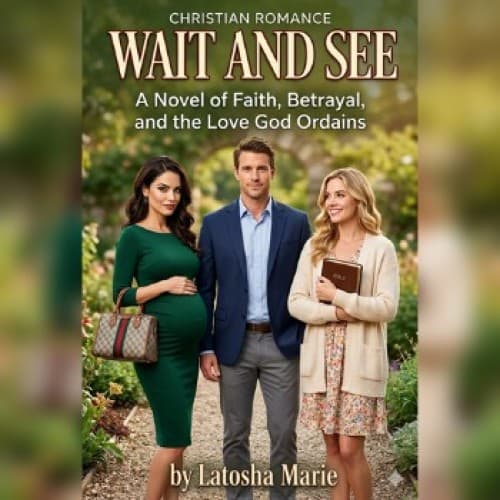

Chapter Ten: Courtship and Ceremony
"I need to tell you something," James said, two days after their conversation at the kitchen table. "Something I realized."
They were walking. He'd started doing this — taking the three of them out in the early evening, Samuel in the stroller, the neighborhood settling into its quieter pace as the day wound down. He'd asked if she wanted to walk and she'd said yes, and they'd been doing it most evenings since.
"The Holy Spirit corrected me," he said.
She glanced at him.
"About the marriage. The first one." He was looking ahead, at the path, at the way the light came through the trees. *"He told me — I asked why I'd been through all of it. I wasn't angry when I asked. I was just —" * He shook his head. "Genuinely wondering. And He said — and I knew immediately that He was right — that He gave me free will, and I chose to marry Eliza without asking Him first. Without actually seeking His will. I saw what I wanted and I told myself He hadn't said no, which isn't the same as yes."
Lorie was quiet.
"He said I had expected Him to bless what He hadn't ordained," James said.
She turned this over.
"That's honest," she said.
"Uncomfortably," James agreed.
"Did it take the weight off, or add to it?"
He thought about it.
"Both," he said. "Because I know I caused harm. To myself, to Samuel — what Samuel was born into wasn't his fault. That lands on me." He paused. "But it also means — He forgave me. He didn't set me adrift. He's still there. He's here. He's sending me you." He glanced at her sideways. "Which, honestly, I still can't entirely believe."
Lorie looked at Samuel in the stroller — awake, watching the trees with his usual serious fascination.
"I couldn't believe this job when I first read the listing," she said.
"Why?"
"Because you asked for a believer. An actual follower of Jesus Christ." She glanced at him. "You'd think that would be a given in job postings, but it's usually not. And you put it right at the top. Faith is not a preference, it is a requirement."
"It wasn't negotiable," James said.
*"No. And when I read it — I thought, this man knows what he needs, and he's not embarrassed to say so." * She looked back at Samuel. "And then the Spirit said that's yours, and I knew I had to come."
James stopped walking.
She stopped too and looked at him.
"I'm glad you came," he said.
It was so plain. So unvarnished. No rhetorical scaffolding around it. Just the honest thing, said plainly.
"Me too," she said.
Samuel grabbed the edge of the stroller canopy and made a comment.
They both looked at him.
"Yes," James said to Samuel. "I know."
"He agrees," Lorie said.
"He always does," James said, and they started walking again.
Meeting Aunt Matilda happened on a Saturday.
Lorie had told her about James. She'd called Matilda the night after the kitchen table conversation and had told her everything — plainly, completely, in the way she'd always told Matilda things, because she'd learned by watching her aunt that the truth said clearly is almost always easier to receive than the truth said in parts.
Matilda had listened without interrupting, which was itself a feat.
Then she'd said: "When do I meet him?"
Matilda Winters was sixty-three years old, five feet four, and entirely herself in the way of people who have had decades to decide who they are and have made their peace with it completely. She had silver hair she didn't dye, sharp brown eyes that missed nothing, and the physical warmth of someone who had been hugging people for comfort since before it was fashionable. She made a pie that had reduced grown men to silence. She had raised Lorie from age three with the steady, warm precision of someone who understood that motherhood was not a biological condition but a decision you made every single day.
She arrived on a Saturday with a pie, a overnight bag, and the frank assessment of a woman who had been praying over the situation since Lorie's phone call.
James met her at the door.
Matilda Winters looked at James Sidwell for approximately four seconds.
"Hmm," she said.
"Yes, ma'am," James said. He said it with a respect that was entirely genuine, and Matilda, who could tell the difference between performed respect and the real thing, noted it.
"You made mistakes," she said. She was not asking.
"Yes, ma'am," James said. "Significant ones."
"And you know it."
"Yes."
"And God corrected you."
"Clearly."
Matilda looked at him for another moment. Then she handed him the pie.
"Then let's eat," she said, and walked into the house.
Lorie appeared from the kitchen where she'd heard all of this and looked at James with an expression that said I told you.
James was holding the pie with the expression of a man who has been simultaneously evaluated and accepted and is still processing the speed of the transition.
"She likes you," Lorie said.
"How can you tell?"
"She gave you the pie," Lorie said. "She doesn't give pie to people she doesn't like."
James looked at the pie.
"I'll keep that in mind," he said.
The two weeks before the wedding were not what Lorie had expected, and they were exactly what she needed.
James had engaged a wedding coordinator named Priscilla who operated at a speed that could only be described as holy-Spirit-enabled, and within forty-eight hours there was a venue — a beautiful old church that the pastor, a man named Brodack who was the kind of shepherd who had known James for years, immediately confirmed as available — and a guest list and catering and a photographer and the particular waterfall of details that constitute a wedding. Lorie had been mildly overwhelmed by the pace of it until Priscilla, who had warm eyes and the unflappable calm of a woman who has organized miracles before, had sat her down and said: "You give me your vision. I make it happen. Your only job is to be present and let this man marry you."
Which turned out to be exactly the instruction Lorie needed.
She picked turquoise flowers for the ceremony because it was her favorite color and nobody told her she couldn't, and if that's not a small miracle then she didn't know what is.
In the two weeks, James courted her.
Not as performance. Not as a strategy toward an end. He courted her the way she'd always thought courtship should work but had never seen close up — with attention and intention, with the specific goal of making her feel known rather than just wanted.
He learned her. Or rather — he revealed how much he already knew, and added to it deliberately.
He knew she drove with a blanket across her lap because she hated being cold, even in the car. He'd started warming her car up on cold mornings without being asked. He knew she was offended by onions in her food — not allergic, not squeamish, offended, as if the onion were a personal affront — and he'd made dinner one night that was carefully, thoroughly onion-free, and set it in front of her with a face entirely without expression, and she'd looked down at the plate and then at him and said "You have no idea how much I appreciate this," and he'd said "I know exactly how much."
He brought her tea in the mornings because she'd mentioned she didn't always drink coffee first thing. He brought it correctly — the right tea, the right temperature, no additions she hadn't asked for. He left it on the kitchen counter for her on the mornings he was already heading out.
She came downstairs one Thursday to find a note beside the tea mug that said: Good morning. I noticed you've been staying up too late. Get some sleep tonight. — J.
She'd read it twice.
Then she'd drank her tea and thought about the way the Spirit calls a woman God's precious treasure, and how when it's true, the people He sends to reflect it back tend to do it in the most ordinary and most astonishing ways simultaneously.
She blushed, standing in the kitchen alone.
She kept doing that. Every time James said something true or kind or direct, or looked at her in the particular way he'd started looking at her — steady, unhurried, with all the calculation gone from it — she would blush with the unstoppable reliability of a person who has been mostly self-sufficient for so long that being seen feels almost physical.
He noticed.
He definitely noticed.
He discovered — she was certain he did it somewhat deliberately, which should have annoyed her but didn't — that complimenting her blush made her blush harder. He used this information with the restraint of a man who is managing a significant amusement.
"Don't," she said once.
"I haven't said anything," he said, eyes entirely innocent.
"You're thinking it," she said.
"I wouldn't know what you mean," he said, and his mouth was doing something she found intensely aggravating and also impossible to be genuinely irritated by.
"James," she said.
"Lorie," he said.
Samuel, from the bouncer, made a sound.
"See," James said. "He agrees with me."
"He's five months old," Lorie said. "He agrees with everyone."
"He's very discerning for his age," James said seriously.
Lorie shook her head. But she was smiling, she couldn't help it, and he saw it, and Samuel made the sound again.
She told him, one evening about a week before the wedding, about her mother and father. Not because it was required or because the courtship demanded it, but because she wanted him to know. Because she had decided that if she was going to marry this man — really marry him, with the fullness of herself and not just the practical arrangement of it — then he should know the shape of the thing that had formed her.
Her mother had died giving birth to her. Eclampsia, sudden and catastrophic, on the Tuesday that was supposed to be the beginning of everything but turned out to be an ending. Lorie had lived; her mother had not. She'd grown up with a quiet, particular awareness of that trade, not as guilt — Matilda had worked hard to make sure of that — but as a kind of weight she carried that had no specific destination. A grief for someone she'd never known.
Her father, Robert, had been a man who loved his wife and when his wife died had not known what to do with the love or with the grief or with the tiny infant who had survived the thing that had taken her mother. He'd stayed for three years, doing his best in the way that people do their best when their best is not quite enough. And then he'd met his secretary, a woman with an easy smile and no complicated history, and he'd chosen the easier thing. He'd left.
Lorie had been three years old. She had no memory of him leaving. She had only Matilda — who was her mother's older sister, who had arrived the week Robert left and had never actually left — and the house that smelled of cinnamon and the crocheted blanket and the Psalm 27 print and you are loved, you are so loved.
She told James all of this with the directness she applied to most things, looking at the table, looking at Samuel in the bouncer, occasionally looking at James.
When she finished, James was quiet for a moment.
Then he reached across the table and covered her hand with his.
She looked at their hands.
"He missed out," James said. "Your father. He has no idea what he walked away from."
She didn't say anything.
"And Samuel's going to grow up knowing exactly who he is," James said. "Because I will not make that mistake."
She looked at him then.
"I know," she said. And she meant it in the specific way that you mean things when you have watched someone for months and have seen who they are in the unguarded moments, in the kitchen at midnight, in the nursery at three a.m., in the car on the way to a courthouse where the news is not good and they still speak with their same voice and walk with their same posture.
"I know," she said again.
He squeezed her hand once and let go.
She did not say anything about the warmth that stayed.