


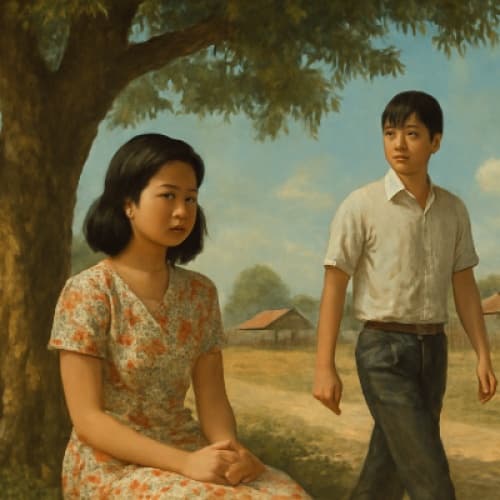

The next few days after the festival passed in a blur of routine, but Jessica couldn't shake the feeling of something new stirring within her. The encounter with Ah Peng at the temple replayed in her mind in quiet moments - his steady hand catching her elbow, the brief but meaningful smile, the calmness in his eyes. But she pushed it aside. Life in Kuching didn't afford her the luxury of daydreams, not at her age. There were expectations to meet, responsibilities to fulfil.
Jessica's small shop near the riverbank was as busy as ever. The air was heavy with the scent of fish and spices, the constant hum of the market surrounding her. She sold fabrics, small household items, and the occasional trinket to tourists passing through. It wasn't glamorous, but it was reliable. At 35, she had long since come to terms with her place in the world. Or at least, she thought she had.
Her mind often wandered to the future - one that felt increasingly distant as time passed. Most of the women in Kuching her age were already married, with children running through their homes. Some of them had once been her friends, but their lives had moved on while hers seemed to remain static. She had no husband, no family of her own. But she had her independence. Or so she told herself.
The Chinese community in Kuching was tight-knit, and traditions ran deep. There were unspoken rules, expectations that everyone adhered to - especially when it came to women. And Jessica, at 35, had become the subject of many quiet conversations. The elders at the market, the women who worked alongside her, all spoke of her with a certain pity. "Too old to marry," they would whisper, as if the fact were an undeniable truth. They'd say it with a knowing glance, as if her life was already decided for her, as though she had missed her chance.
But Jessica refused to let those voices consume her. There were days when she could drown them out with the work of her hands, with the rhythm of the shop and the familiar faces that came and went. Yet, when the evening quiet fell, and she sat alone under the mango tree, it was hard to ignore the ache that settled deep in her chest.
Ah Peng's life was not so different, though the expectations of him were different in nature. At 25, he was supposed to be building a future, carving out a life for himself. But as a chef at the British Club, he often found himself standing at the crossroads of two worlds: the old world of Kuching's colonial past, and the new world that was slowly being born. The British Club, once an exclusive space for British expatriates, had opened its doors to the local community in recent years, but it wasn't entirely welcoming. Ah Peng often felt like an outsider, though he had earned his place in the kitchen.
The club had acertain grandeur to it - its high ceilings, polished wooden floors, and largewindows looking out onto the river. But it also felt like a remnant of a timelong past, a time when Kuching was still a Crown colony, when British rule hungover the city like a distant shadow. Even now, in 1960, when independence seemed just on the horizon, there was still a sense of unease, a lingering uncertainty about what the future would bring.
Ah Peng dreamed of opening his own restaurant one day, but those dreams were often dismissed by those around him. His peers would laugh, telling him to stick to what he knew. "Don't get too big for your boots, Ah Peng," they would say, their voices laced with skepticism. "Know your place." But he couldn't help it. He had tasted something more in the world, something beyond the small kitchen where he worked. He had seen what the British could create, and he wanted to do more, to be more. But with the government's slow-moving changes and the constant tug of old traditions, it often felt like he was fighting a battle he couldn't win.
As he walked home from the club that evening, the city felt different. The streets were crowded, filled with the energy of a city caught between eras. The old colonial buildings stood side by side with new shops and cafes, and every corner seemed to hold a story about the past, a past that would soon be replaced by something entirely new.
And then there was Jessica, with her quiet strength and her unspoken longing. He had seen her a few times now, always under the mango tree, sitting alone in the evenings. He couldn't explain why, but there was something about her that stirred something deep inside him. She was like the city itself - caught between what was, and what could be.
Kuching in 1960 was a place of contrasts. The old colonial influence was still palpable, yet a new sense of independence was beginning to take root. Sarawak was still a Crown colony, with the British overseeing the affairs of the state, but the tide of change was inevitable. The political landscape was shifting, and the whispers of independence grew louder with each passing year. As the town evolved, so did its people - torn between maintaining the familiar rhythms of tradition and embracing the uncertain future ahead.
Jessica and Ah Peng both felt the weight of this transition. It was in the air, in the way people talked about the future, about independence. And though their personal struggles felt isolated, they were, in a way, reflections of the larger changes happening around them.