


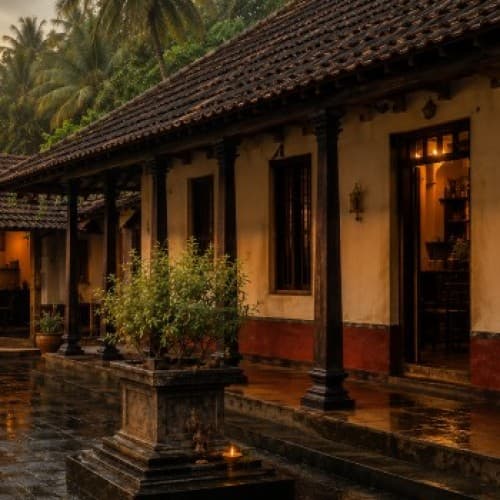

A few kilometres beyond Udupi town, in the small coastal village of Ambalpadi, where the lanes bend towards the sea and the cashew trees grow in slow, patient rows, stood the home of Ramakrishna Bhatta. It was a typical Karavali Brahmin house — long and low, with a sloping terracotta-tiled roof, white lime-washed walls, a broad verandah held up by old teak pillars, and a tulsi katte at its centre, where Phalguni lit a clay lamp every evening at dusk. Behind it lay the kitchen — the soul of the house — and behind that, the sea.
Ramakrishna Bhatta was a cook. He had been a cook for thirty years. His kitchen was his temple, his masalas his offerings, and his mortar — passed down from his mother — the only true heirloom he believed he possessed.
His wife Phalguni had come into this house as a bride seventeen years ago. She had lit the lamp at the tulsi katte every evening since. Their only son, Krishna, was fifteen now — old enough to carry the brass vessels for his father, young enough still to fall asleep with his head on his mother's lap when the rain came down hard.
The tide came in. The tide went out. Ramakrishna Bhatta cooked.
And then, one morning in the month of Aashada, a stranger appeared at the gate.