


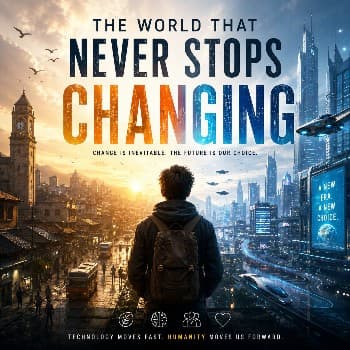

A few months later, Ethan joined a research program studying future technologies.
The scientists showed him projects that felt like science fiction.
Medical robots could perform surgeries with incredible precision. Smart glasses translated languages instantly. Artificial intelligence could create music, write books, and even design entire cities.
One day, Ethan visited a laboratory where engineers were developing advanced climate solutions.
"The world is changing because it has to," explained Dr. Maya, the lead scientist. "Our population is growing. Climate challenges are increasing. Technology helps us solve problems faster than ever before."
She showed him giant machines that removed carbon from the atmosphere and farms that grew food vertically inside skyscrapers.
For the first time, Ethan saw the positive side of rapid change.
Technology wasn't just making life easier—it was helping humanity survive and improve.
But there was another side.
Many traditional jobs were disappearing. Small businesses struggled to compete with automated systems. People worried about privacy as smart devices tracked nearly everything.
The faster the world moved, the harder it became to keep up.
Ethan realized that change itself wasn't good or bad.
What mattered was how people chose to use it.