


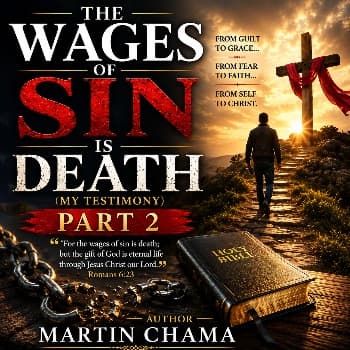

As the truth of Christ's finished work settled into my heart, I found myself reflecting on the journey that had brought me to this moment.
For decades, I had sincerely believed that salvation depended partly on Christ and partly on me.
I would never have expressed it that way, of course.
I spoke about grace.
I spoke about faith.
I spoke about God's mercy.
Yet beneath those words was a belief I had carried since childhood—that my acceptance before God ultimately depended upon my ability to live a sufficiently righteous life.
That belief explained why I had lived with so much fear.
Every time I became aware of a failure, my confidence disappeared.
Every time I heard a sermon about judgment, I questioned my salvation.
Every time I compared myself with God's perfect standard, I felt condemned.
Then Pastor Lovedale showed me a verse that removed all doubt.
"I do not set aside the grace of God: for if righteousness come by the law, then Christ is dead in vain."
The words were simple, yet powerful.
If righteousness could come through keeping God's law, then Christ died for nothing.
If it could come through religious devotion, then Christ died for nothing.
If it could come through human effort, then Christ died for nothing.
The conclusion was unavoidable.
Christ died because man could not save himself.
Christ died because righteousness could not be earned.
Christ died because sinners needed a Savior.
As I reflected on those truths, memories from different stages of my life came flooding back.
I remembered the frightened little boy sitting in Sunday School.
I remembered the teenager who responded to the gospel invitation at the crusade in Ndola.
I remembered the young man who repeatedly promised God that he would never sin again.
I remembered the deacon.
The elder.
The preacher.
The man who pointed others toward God's Kingdom while secretly fearing that he might never enter it himself.
For years I had been striving to achieve what God was offering freely through Christ.
Now I understood the difference.
Good works have an important place in the Christian life, but they are not the foundation of salvation.
They are the result of salvation.
A fruit, not a root.
For the first time, I clearly saw the gospel for what it truly is.
It is not God's invitation for sinners to save themselves.
It is God's announcement that Christ has already done what sinners could never do for themselves.
And that realization changed everything.