


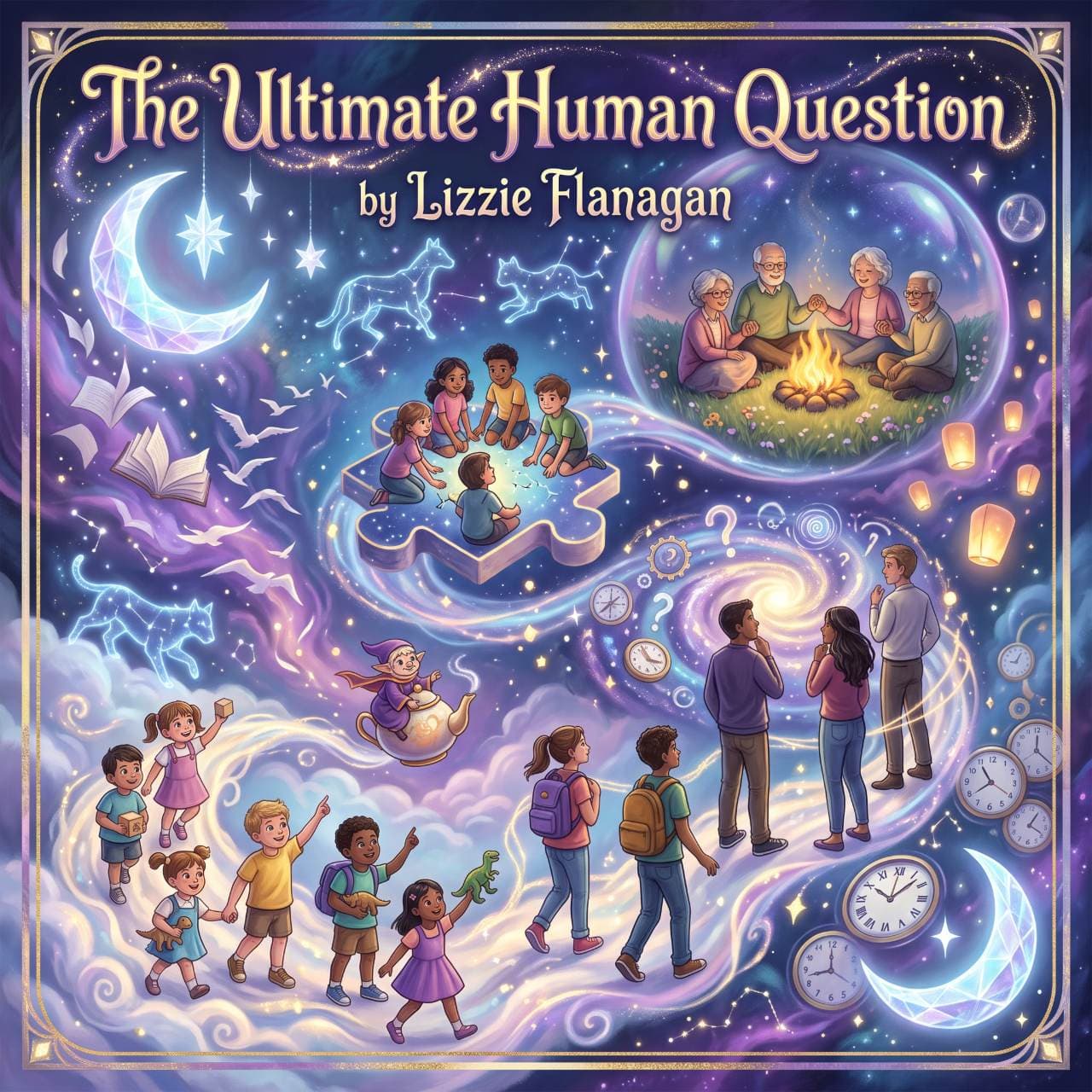

The basement of Priya's house smelled like anxiety and garlic. Her mother had made samosas, enough to feed a small army, or in this case, seven teenagers attempting to study for finals while simultaneously contemplating the collapse of their futures.
They were scattered across the floor like survivors of a shipwreck. Marcus lay on his stomach, his face illuminated by the blue glow of his laptop, scrolling through SAT prep questions with the enthusiasm of a man reading his own autopsy. Sophie sat cross-legged in the corner, painting her toenails black while simultaneously highlighting passages in The Great Gatsby with aggressive yellow strokes. Tyler had claimed the beanbag chair, his hair now shaved on the sides and long on top, wearing a hoodie that said "HUMAN RIGHTS ARE NOT DEBATABLE" in letters that had started to crack after too many washings. He was texting someone—someone with a name saved as a heart emoji, which the others pretended not to have noticed.
Emily sat at the desk, actually studying, because Emily had transformed over the summer into someone who cared, deeply and terrifyingly, about everything. Her eyeliner was still perfect, but now it was a weapon. She had opinions about intersectional feminism and the prison-industrial complex and whether the new Spider-Man was "actually a cop." She was dating a senior who drove a Subaru and worked at a co-op grocery store. She was exhausting and magnificent.
Oliver had grown into his glasses. He had contacts now, but he wore the glasses anyway because they made him look "more like himself," which was a sentence that would have confused his third-grade self. He was building an app in his spare time, something about carbon footprints, and he had already taken the SAT twice, scoring in the 99th percentile both times, which he mentioned exactly zero times because he had learned, finally, that nobody likes a genius who talks about it.
Jacob sat by the window, reading. He always sat by windows now, as if preparing for escape. He had stopped growing at six feet, which made him a landmark, a lighthouse, a thing to navigate by. Girls looked at him in hallways. He pretended not to notice. He was reading poetry now, Rilke, Mary Oliver, Ocean Vuong, dog-earing pages and copying sentences into a notebook with a cover that said "DO NOT READ" in Sharpie.
And Priya. Priya moved among them like a general, refilling bowls of chips, asking if anyone needed water, adjusting the lamp so Marcus wouldn't ruin his eyes. She had a 4.0 GPA, a part-time job at the library, and a secret she hadn't told anyone: she had started cutting herself in October, small precise lines on her thigh that she covered with STEMinist stickers and sheer force of will.
"Okay," Priya said, clapping her hands. "Actual studying now. Gatsby themes. Go."
"Money corrupts," said Emily, not looking up from her notes.
"Love destroys," said Sophie, blowing on her toenails.
"The past is a trap," said Jacob, still reading his poetry.
"Rich people are boring," said Tyler, finally looking up from his phone. "Like, actually. Has anyone ever noticed that? The richer they are, the more boring?"
"My dad says money gives you options," said Marcus. "He says if I don't get a scholarship, I'm going to community college, which he says is 'fine' but he says it like it's a diagnosis."
"Community college is fine," said Oliver. "It's actually statistically..."
"I know it's fine, Oliver. I just want... more."
They all wanted more. They wanted it with a hunger that kept them awake at night, scrolling through Instagram photos of kids at Stanford and Brown and Yale, kids who seemed to have figured out the algorithm for belonging. They wanted it until their stomachs hurt, until their teeth ground in their sleep, until they woke up at 3 AM wondering if they were wasting their potential or if they even had potential to waste.
"I saw Mrs. Deluca," said Emily.
The room went still. They were fourteen. They were too old for their elementary school teacher, too young to admit they still thought about her.
"Where?" asked Sophie.
"At the coffee shop. She asked if I remembered the question."
"Did you?" asked Tyler. He was sitting up now, alert.
"I told her I didn't have time for philosophy. I have three APs and a boyfriend and a job and I'm trying to get into a good school so I can get a good job so I can afford therapy."
She said it like a joke. Nobody laughed.
"What did she say?" asked Jacob.
"She said..." Emily paused. Her perfect eyeliner suddenly looked like armor that had cracked. "She said the question changes, but the asking matters. She said not to forget to ask."
"That's vague," said Priya. "That's boomer vague."
"She's not a boomer. She's Gen X."
"Same thing."
"It's not the same thing, Priya," said Oliver, and there was an edge in his voice they hadn't heard before. "Nothing is the same thing. That's the point. We're all spinning in our own orbits and sometimes we forget we're in the same solar system."
They looked at him. Oliver never raised his voice.
"Sorry," he said. "I'm tired."
"We're all tired," said Sophie. "I'm so tired I could sleep for a year. I'm so tired I forgot what being awake feels like."
"I think it's purpose," said Marcus suddenly. He sat up, his laptop sliding off the bed. "I think that's the answer now. Purpose. Having a reason. Because if you don't have a reason, then what are you doing? Just grinding? Just... producing?"
"Purpose is a capitalist construct," said Emily automatically, but her voice lacked conviction.
"Is it? Or is it the only thing that makes the capitalism bearable?" Marcus ran his hands through his hair. He had started styling it this year, spending twenty minutes in the bathroom with pomade, trying to look like someone who belonged. "My dad works sixty hours a week at a job he hates so I can have SAT tutors. That's his purpose. But what's mine? Getting a good score so I can get into a good school so I can get a job I hate so my kids can have tutors?"
"That's the trap," said Jacob. "The generational trap. The wheel."
"How do we break it?" asked Tyler.
"By choosing," said Jacob. "By actually choosing. Not just doing what we're supposed to do because we're scared."
"I'm scared," said Priya.
The admission fell like a stone into water. They all turned to look at her. She stood in the center of the room, a samosa in her hand, her braid perfect, her STEMinist shirt crisp, and she was shaking.
"I'm scared all the time," she said. "I'm scared I'm not smart enough. I'm scared I'm too smart and nobody will love me. I'm scared my parents spent their whole lives on me and I'll disappoint them. I'm scared I'll get into a good school and hate it. I'm scared I'll die without ever having done anything that mattered."
She put the samosa down. Her hands were trembling.
"I cut myself," she said. "Sometimes. When I can't sleep. Because the physical pain stops the... the other pain. The fear pain."
The silence was absolute. Then Sophie moved, scooted across the carpet on her still-wet toenails, and put her arms around Priya. Then Emily. Then Tyler, his heart-emoji phone forgotten on the beanbag. Then Marcus, and Oliver, and finally Jacob, unfolding himself from the window seat like a crane, tall and careful, and they were a pile of bodies, a heap of teenagers, holding each other in Priya's basement while the garlic smell settled around them like incense.
"Purpose is love," said Jacob, his voice muffled against Priya's shoulder. "That's what I think. Purpose is loving something enough to suffer for it. Loving people enough to show them your damage. Loving yourself enough to stop cutting."
"How?" asked Priya, crying now, finally, the tears she had held back for months. "How do you love yourself?"
"You don't," said Emily. "You just... you let other people love you until you believe it."
"That's terrible advice," said Oliver, but he was crying too. "That's clinically terrible advice."
"But it's true," said Sophie. "It's the truest thing."
They stayed like that until Mrs. Patel called down that there was chai and did they want any, and they untangled themselves, embarrassed now by their own vulnerability, wiping their faces and straightening their clothes and pretending they hadn't just performed a kind of group surgery on their collective soul.
But before they went upstairs, before they drank the chai and ate more samosas and returned to Gatsby and the SATs and the crushing weight of their potential\, Mrs. Deluca's question hung in the air, answered not with words but with presence.
What matters most?
This. The holding. The showing up. The refusal to let anyone suffer alone in a basement with STEMinist stickers and sharp objects.
The knowledge that they were, despite everything, still together.