


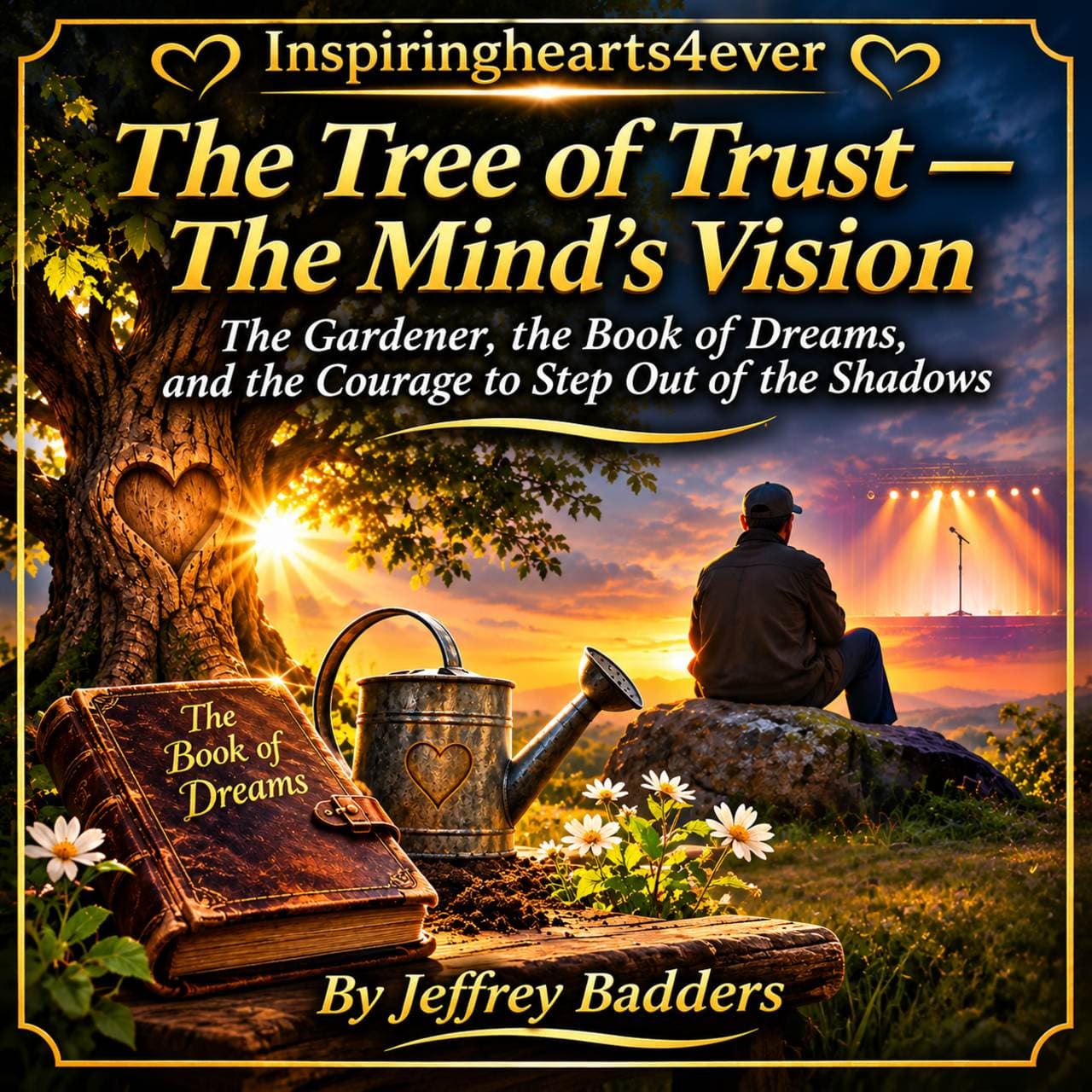
The Tree of Trust — The Mind’s Vision
The Gardener, the Book of Dreams, and the Courage to Step Out of the Shadows
By Jeffrey Badders
I have spent a great deal of my life thinking about the people who come into our lives and the people who leave. Some teach us. Some encourage us. Some hurt us. Some promise to stay and disappear when the storms arrive. Others enter as strangers and give us something we searched for all our lives.
In my mind, I have a name for the way I understand those relationships: the Tree of Trust.
I didn’t learn trust from a classroom. I learned it from life, from being a foster child, from watching people, from having to protect my heart, and from discovering that the most expensive investment a person can ever make is love.
Love can build you. Love can break you. And when you have invested years of yourself in another person, you can’t always measure what it cost you when that person walks away.
I was born on December 15, 1965. I came into the world as a ward of the state, and I was never adopted. I lived in ten different foster homes. I knew what it meant to carry my clothes in a trash bag and enter another unfamiliar house with different people, different expectations, and another atmosphere I had to learn to survive in.
As a child, I didn’t always have a choice about where I would go or who would be responsible for me. I learned to pay attention. I learned when to speak, when to be quiet, and when to depend on myself. I also learned to talk to God and to keep part of myself protected behind a shield.
That shield helped me through childhood. What I didn’t understand then was how long I would keep carrying it.
Learning to Read People
When I was around twenty to twenty-three years old, I used to spend hours at shopping malls watching people. I watched parents with children, couples walking together, grandparents with their families. I watched the ways people spoke to one another, how they made decisions, and how their emotions showed in ordinary moments.
Christmas was especially interesting to me. I would watch families shopping for gifts and sharing experiences I hadn’t known in the same way as a child. I wasn’t simply interested in what they were buying. I wanted to understand how people connected. What made one person feel loved? What made another feel ignored? Why did some people stay together while others walked away?
I became fascinated by the mind, the heart, and the soul. I was trying to understand people, but I was also trying to understand myself.
Over time, I came to believe that the greatest gifts aren’t always wrapped in paper. You can spend your life trying to keep up with the Joneses, collecting possessions and looking successful from the outside, and still feel empty inside.
I wanted something different. I wanted to build a temple of gold within myself: a library of memories, wisdom, knowledge, understanding, love, and experiences. Someday, when I am old and alone, I want to be able to reach into that library, take down one of the books of my life, and remember what I learned and who I loved.
But not every book in that library is easy to open.
The Soil, the Roots, and the Storms
When I meet someone, I think of planting a seed. Before I decide how much of myself to invest, I watch how that person treats others and how they treat me. I look for loyalty and, most of all, respect.
If you come to my table with loyalty and respect, I’ll have your back. I’ll make sure you have food in your mouth. You won’t go hungry if I can help it.
But a relationship can’t grow because one person does all the watering.
You plant a seed in the soil. You give it time, attention, and care. Roots begin to grow. Some people become leaves on your tree. They are there for a season, and then they fall away. Some seem like strong branches, but when the wind rises and the storms come, they break. Even a tree that has stood for years can fall.
The hardest thing for me has been watching someone leave during a storm when I was willing to stay and rebuild. I have watered other people’s gardens when they were tired. I have tried to help their trees survive. Yet there have been times when I needed someone to water mine, and they weren’t there.
I gave people second chances. Sometimes I gave third chances. I learned that you can’t heal a relationship by putting another Band-Aid over the same wound. Both people have to want to heal it. Both have to want to put the pieces of the picture together and place it in the frame.
If one person refuses, the other cannot finish that picture alone.
There is a reason people become part of our past. I don’t have to hate them. I don’t have to beg them to stay, either. If they want to leave, I let them go.
And then I return to being the gardener.
A tree takes a long time to grow and can be difficult to keep alive. A flower begins with a smaller seed. I can meet someone, plant a positive seed of love or encouragement in that person’s garden, and hope it continues growing long after we’ve gone our separate ways. Maybe one day that person will become a gardener, too, and plant something good in somebody else’s life.
That’s who I am. I will keep planting those seeds until the day I die.
But there is a question I’ve had to ask myself: Who waters the gardener?
The Flower Inside Me
I have watered my own flower for most of my life. Sometimes I wish someone would look at me and say, “He’s been doing this by himself for so long. Let him rest. Let somebody else water that flower for a little while.”
I want to believe someone can stand beside me without expecting something in return. I want to believe there are people who will stay through the storm instead of leaving when life gets difficult.
Yet the shield goes up almost automatically. I tell myself that nobody owes me anything. Nobody owes me success, money, love, or an opportunity. If I want something, I have to work for it. If it takes me longer than someone else, then it takes longer.
That belief helped me survive. It also made accepting help difficult.
At eighteen, I married a woman who was thirty-five. The marriage lasted one year. Looking back, I believe I was searching for a family, for connection, for a place where I finally belonged. When the marriage fell apart, I fell apart again.
I have nothing against her. I guess it just wasn’t right.
But that experience took me back to the formula I’d learned as a child: I’m on my own again. I have to take the wheel and drive my own life. I can’t expect someone else to pay my bills or carry my responsibilities. I spent roughly forty years thinking and living that way.
I worked. I kept moving. I learned to appreciate what I earned because I understood what it had taken to get there.
Still, the heart doesn’t become whole simply because a person knows how to survive.
The Place That Became Home
There is one part of my life that changed everything for me: hospice.
I’ve been a hospice aide for thirty-six years. I have met and cared for so many beautiful spirits. Some of the people who gave me the greatest feelings of love, respect, and appreciation were complete strangers when we first met.
As a child, I had wanted to give love and felt that it wasn’t accepted. In hospice, I found people who welcomed what I had to give. Many appreciated my presence. They wanted to be heard. They wanted dignity and respect. Sometimes they wanted someone to sit quietly beside them.
Hospice saved my life.
I don’t say that lightly. It gave me a place where the love inside me had somewhere to go, and where I often felt that love returned. It became my rock. When I felt alone or broken, it watered my flower. It kept me moving toward the next step, the next journey, the next mountain.
One patient shared words that have stayed with me. I remember the painful side of what they said: they would remember those who hurt them, those who were dishonest, those who betrayed them, and those who broke their heart.
But there was another side. They would also remember those who forgave them, loved them, stayed with them, and stood beside them at the end of life.
I carry that recollection with me. It tells me something about the Tree of Trust: the people who hurt us can leave deep marks, but so can the people who show up with love.
I remember patients asking me to pray with them. I remember patients asking me to hold their hands. Some told me, “You have the warmest hands.” I used to joke that maybe it was because I’m a fire sign. What mattered wasn’t the joke. It was knowing that my presence could bring comfort.
When I sat beside someone who was dying, I wasn’t trying to perform. I wasn’t trying to impress anyone. I wasn’t in the spotlight. I was listening to a person who wanted to be heard and seen.
That is where I have always felt most comfortable.
I rarely took sick time. When I was ill, I sometimes felt guilty because I knew patients depended on me. I would tell myself, “I can go home and get better. These people aren’t going to get better.” There were times I simply didn’t have the strength to care for them, and that hurt me. I had to recover, even when I wished I could be there.
I know that one day I’ll have to retire from hospice. I hope I can still volunteer, listen to stories, hold a hand, or offer companionship. But volunteering won’t be the same as working five days a week and caring for five or six patients a day. It won’t be the same as knowing their daily needs and being part of their care.
When I think of leaving, it feels like walking out of my home.
And that feeling takes me straight back to the foster child carrying a trash bag from one home to another. I know what it’s like to leave a place and enter an unfamiliar world. I know I will have to adapt, because I don’t want to spend that next chapter feeling alone.
The difference is that today I’ve built a home inside myself. I have the gold of those memories. I have my library. The people I cared for and the lessons they taught me will remain part of that home.
But there’s another book on my shelf that I haven’t opened.
The Book of Dreams
Since I was a child, including those days when I was locked in a dark room, I’ve carried a dream of showing the world who I really am. Today that dream includes writing books, sharing my life as an inspirational motivational speaker, and perhaps someday seeing my story become a movie.
I can picture a stage. I can picture the lights. I can picture myself telling people what I have learned about the heart, the mind, the body, and the soul.
But in that picture, I am often standing at the side of the stage, behind the curtain, watching someone else speak.
I ask myself, “Why can’t I go out there?”
And a voice inside me answers, “Because they earned it. You haven’t.”
No one taught me that rule. I taught it to myself.
I compare myself with people who went to college, who have more education, who speak with confidence, who seem polished and prepared. I never went to college. Sometimes I feel as though I’m walking out of a trash can and into a room full of people who are smarter than I am.
What if I freeze? What if I can’t find the words? What if people say, “Why should we listen to him?” What if my story doesn’t move anybody?
The world is going to talk. I know that. People will judge others until the end of time. But knowing that doesn’t make the fear disappear.
I don’t want to be a polished speaker pretending to be someone else. I want to be authentic. I want to stand before people as the man I am, with the life I’ve actually lived.
When I’m beside a hospice patient, I don’t worry about performing because the focus isn’t on me. I listen. Onstage, I would be asking people to listen to my story. That is the part that frightens me.
Sometimes I wonder whether my dream is only an illusion. I tell myself I’ll try in five years, or ten years. Maybe I’ll finally stand on a stage at seventy. Maybe it’ll be a church, a room full of people, or a street corner in Phoenix. I don’t need the fanciest stage. I just want the chance to try.
But then I picture the book of dreams sitting on the shelf inside me. I reach for it. I think I’m ready. And just before I open it, I put it back.
I keep telling myself that everybody else’s story matters more than mine.
I’ve spent years helping people with their dreams, planting seeds in their gardens, and listening to their hopes. I thought someday I would find time for my own. Now I realize that time isn’t something I can keep postponing forever.
I know it would put a hole in my heart to grow old and realize I never reached for that book again. Some of those dreams may even fade from my memory before I give them a chance.
I am getting older. I don’t have that much more time.
The Man in the Mirror
What would it mean if I finally stood in front of an audience and people genuinely listened?
I would feel valued, loved, and accepted. Those are the things I’ve wanted throughout my life. Not the fanciest car. Not the most money. Not the appearance of being more important than someone else.
My purpose has been to inspire, encourage, empower, and enlighten people’s souls. I know that purpose because I’ve lived part of it through hospice and through the people I’ve met.
But I believe there may be another half of my purpose waiting beyond the comfort zone I’ve been afraid to cross.
I would welcome someone who offered constructive criticism, someone who could help me become a better writer, a better speaker, and a better person. I don’t need someone to tell me I’m perfect. I need someone who believes I can grow.
And I need to remember something I’ve told others: you don’t always have to walk through the darkness alone. There are people who can be a light for you, too. Someone may stand beside you. Someone may water your flower. Someone may believe in you while you are still learning to believe in yourself.
I haven’t solved everything. I haven’t found a way to make the fear disappear. I still have days when the book stays on the shelf and the stage looks far away.
But I know what I would tell anyone who feels unimportant, unloved, or unaccepted: Your story is just as important as anybody else’s. You have a heart. You matter.
When you’re going through a storm, the trials and errors of your life may teach you something, or they may become lessons you can one day share with someone else. Never disguise your spirit for anyone. Never take your voice to the grave.
And I have to hear those words myself, not just offer them to everyone else.
Maybe that’s the most difficult part of the Tree of Trust. I’ve learned how to recognize who deserves my trust, how to keep planting flowers after people leave, and how to build a home inside myself. Now I have to learn to trust the man I see in the mirror enough to let him try.
I know what it means to live a purpose that gives other people comfort. I don’t yet know what will happen if I step through that curtain and speak. I may stumble. I may discover I need more practice. I may learn something I couldn’t have learned while standing in the shadows.
But I won’t know if I never try.
I don’t have to pretend that I’m fearless. I do have to decide whether I will let fear write the last page of the book inside me.
There is a time in life when we must become uncomfortable to discover something we haven’t yet lived.
I am still the gardener. I am still the man who listens. I am still the foster child who learned to carry his own belongings and find his way into unfamiliar places. I am still the hospice aide who has been changed by the love of strangers.
And I’m still the man looking at a book of dreams on a shelf, wondering when he’ll finally take it down.
What is your purpose on this Earth? I know part of mine. What is yours?
Don’t fake it until you make it. Faith it until you make it.
Author’s Note — A True-Life Testimony
This story is based on my lived experiences and personal reflections. It is not a claim that I have already overcome my fears or fulfilled my dream of speaking onstage. The words I attribute to patients are shared from my recollection. My journey is still unfolding.
Written collaboratively by Jeffrey Badders with AI writing and editorial assistance.