


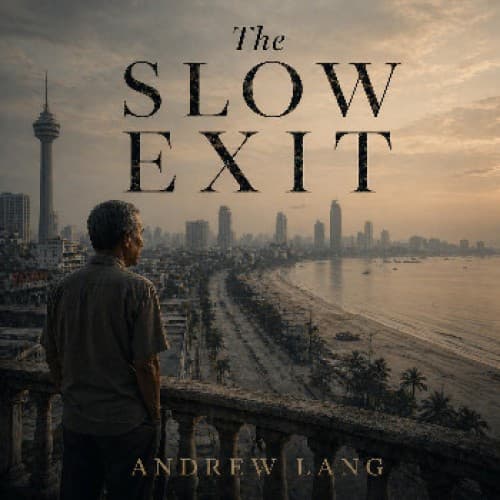
She stands on the platform at Bang Sue Central Station, now converted into a processing center. Government workers usher in the newly relocated citizens—some dazed, some bitter, some numb. Her name is Arthitaya, but people call her Tia. She stood on the platform at Bang Sue Central Station with one bag, light in weight but heavy in memory.
She's holding one small government-issued suitcase. It’s full of sterilized memories: a faded photo, a bracelet, a bag of dried herbs from her old home. Everything else was left behind in the Red Zone—a part of the country no longer serviced by transport, energy, or water.
“Zone B-19,” the official said, without looking up. “You’ll receive ration instructions on your Housing Tab.”
Tia doesn’t respond. Her eyes scan the huge, high ceilings of the station. She remembers when it was filled with families, tourists, sound. Now it’s quiet, efficient. A sorting machine for human residue.
She had lived her entire life in the north, in the hills of Loey where the mornings came with fog and the nights brought the smell of earth and burning wood. Her house, modest and crumbling at the edges, had stood for three generations. She had buried her mother behind it. Planted turmeric in the soil there. All of it gone now, since they declared it a Red Zone in 2082. Unsustainable. No power. No services. No future.
She followed the painted lines on the floor, joining a slow-moving line of people with the same hollow stare. No one spoke. No one needed to. Everyone had lost something, and no one was going to get it back.
Outside the station, the sky was a flat grey and the air smelled like wet metal. Government buses stood waiting, their lights flickering in synchronicity. An automated voice echoed from a nearby tower: “Maintain your zone clearance. Report housing issues through your Tab. Together, we sustain.”
The bus ride to Din Daeng took only fifteen minutes, though it felt like no time at all. The roads were clean, too clean—sanitized, deserted. Trees stood in perfect rows. Drones skimmed low above the rooftops, pausing occasionally to scan or observe.
The Living Zone stretched from Nakhon Pathom in the west to Sattahip in the east, a long strip of compressed infrastructure hugging the Thai Gulf. Everything outside it—nearly the whole country—had been designated Non-Operational. Only agricultural sectors remained active, managed by rotating teams and machines. Cities beyond the Zone were just names now. Coordinates on old maps.
Tia’s new building was Block 6, a forty-story slab of concrete and faded glass, identical to the blocks on either side. Inside, the corridors buzzed with dim fluorescent lights. Motion sensors flicked them on one by one as she walked. The walls were scuffed but orderly. It smelled like bleach and rust.
Her unit was on the thirty-second floor. One room. A kitchenette with a water ration unit, a fold-out bed, a small screen mounted on the wall, and a balcony that overlooked a city still pretending to function.
She didn’t unpack. Just sat on the edge of the bed and stared at the screen. It played a government feed: images of rice fields, children learning in classrooms, smiling families holding ration cards.
“We thank you for your sacrifice,” the voice said. “Zone consolidation is the path to national strength.”
She turned it off.
Later, as night crept through the broken skyline, Tia stepped onto the balcony. The air was thicker now. The lights below were scattered, uneven, like a pattern half-remembered. In the distance, she could see the Chao Phraya River, but it looked dull, as if the water had forgotten how to reflect.
Somewhere above, a drone passed with a gentle hum. Somewhere below, someone was crying behind a door that wouldn’t open.
She reached into her bag and pulled out a single photo. It was bent at the edges, faded in the middle. Her old house. A wooden stilt frame, with mist rolling in behind it and a crooked clothesline out front. She stared at it for a long time. It was the only thing she had managed to keep.
In Loey, the mornings had been slow and soft. She remembered the sound of birds and the smell of garlic frying. Now, everything hummed and blinked and waited for instruction. Everything watched.
She didn't cry these days. She was done with crying.