


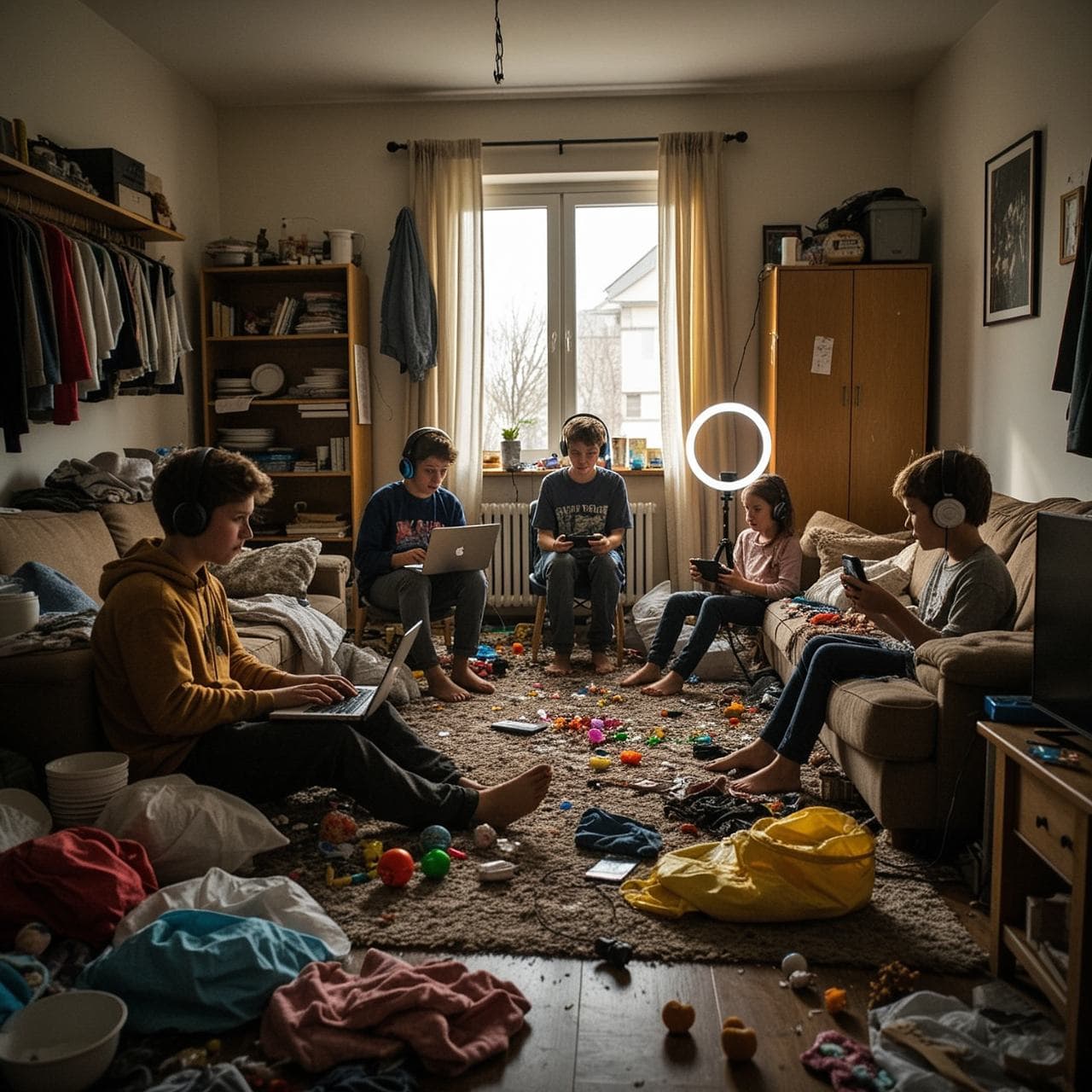

It started with a skateboard.
Of course it did. Phoenix had decided, at age fourteen, that they wanted to "learn to skate" because it was "aesthetic" and "vintage" and "gave major 90s vibes." They had bought a board with their influencer money (which was apparently real, much to my surprise) and had been practicing in the driveway.
Then they tried to kickflip.
Then they were on the ground.
Then there was screaming.
By the time I got outside, Morgan was already there, filming (of course), while Phoenix clutched their ankle and made sounds that I can only describe as "distressed influencer."
"Are you okay?" I asked.
"I think it's broken!" Phoenix wailed. "I think I need surgery! I think I'm going to die!"
"You're not going to die," I said, Gen X pragmatism kicking in. "It's probably sprained."
"But it hurts! It hurts so much! I have a low pain tolerance! I'm very sensitive!"
"We're going to the hospital," I announced.
"Not the hospital!" Morgan said. "Hospitals are expensive! We should try holistic care first. I know a reiki master who—"
"They're not getting reiki. They're getting an X-ray."
"But the energy healing—"
"The X-ray."
We loaded Phoenix into the car, still filming ("This is content, Dad, this is real content"), and drove to the emergency room.
At the hospital, the generational differences became a symphony of dysfunction.
My mother met us there, having been alerted by Nova who had used the iPad to FaceTime her ("Grandma, Phoenix is dying!"). She arrived with a bag of home remedies: arnica gel, Epsom salts, and a bottle of whiskey "for the pain."
"You don't need X-rays," she announced. "In my day, we just walked it off. If you can walk, it's not broken."
"I can't walk!" Phoenix said. "I can't even stand!"
"Then it's broken," my mother said, as if this were obvious.
"That's not how medicine works," I said.
"It's exactly how medicine works. If you can walk, it's a sprain. If you can't, it's broken. We didn't need fancy machines to tell us that."
"We're getting the fancy machine," I said.
In the waiting room, the drama continued. Phoenix was posting updates to their story ("In the ER, send good vibes #injury #skateboarding #aesthetic"). Morgan was researching "natural alternatives to X-rays" because she was worried about radiation. Dakota was lecturing about the American healthcare system and how it was "a for-profit nightmare designed to bankrupt the working class." Atlas was playing on their iPad, unconcerned. Nova was crying because everyone else was upset. And Jennifer was filling out paperwork with the efficiency of someone who had done this too many times before.
When the doctor finally saw us—a harried Millennial who looked like he hadn't slept in days—the real fun began.
"So," the doctor said, looking at Phoenix's ankle. "What happened?"
"I was skateboarding," Phoenix said. "Trying to express myself through movement."
"You fell," I translated.
"I had a gravity-related incident," Phoenix said.
The doctor looked at me, then at Phoenix, then at the crowd of family members in the room. "Okay. Well, let's get an X-ray."
"I don't want an X-ray," Phoenix said. "I read that the radiation can affect your aura."
"Your aura," the doctor repeated.
"Yes. I need to protect my energy."
"Phoenix," I said. "Get the X-ray."
"But Dad—"
"Get the X-ray or I'm taking away your phone."
This was the nuclear option, and Phoenix knew it. They relented, but not before asking the doctor if they could "set an intention" for the healing process and if the hospital had "crystal therapy options."
The doctor looked at me with eyes that said "is this a joke?" and I looked back with eyes that said "I wish it were."
The X-ray revealed a sprain, not a break. Phoenix was relieved ("I knew my crystals were working") and disappointed ("A break would have been better content").
But then came the treatment plan.
The doctor recommended rest, ice, compression, elevation—the standard RICE protocol.
My mother recommended "whiskey and a tight bandage."
Morgan recommended "CBD oil and acupuncture."
Dakota recommended "examining why we as a society prioritize physical productivity over healing."
Phoenix recommended "documenting the journey for my followers."
And Nova recommended "kisses and ice cream."
In the end, we went with the doctor's recommendation, supplemented by Morgan's CBD oil (which was actually just expensive olive oil, but placebo effects are real), and my mother's whiskey (for me, not Phoenix).
But the real revelation came that night, when Phoenix couldn't sleep because of the pain.
I found them at 2 AM, crying quietly in the living room.
"What's wrong?" I asked. "Is it the ankle?"
"No," Phoenix sniffed. "It's... it's everything. The ankle is just... it's the thing that broke. But I feel like everything is broken. Like I'm broken."
I sat down next to them, this child of the internet, this Gen Z enigma who communicated in memes and monetized their existence, and I saw something I recognized: the Gen X despair, the Millennial anxiety, the universal fear that we are not enough.
"You're not broken," I said.
"How do you know?"
"Because I'm Gen X. We're professional broken people. And you don't have the credentials yet."
Phoenix laughed, a wet, surprised sound. "That's... that's not helpful."
"It's very helpful. It's perspective. You're sixteen. Everything feels permanent. But it's not. The ankle will heal. The feelings will shift. The content will... whatever content does."
"Engage?" Phoenix suggested.
"Sure. That."
They leaned against me, and I remembered that underneath all the generational differences, underneath the TikTok and the trauma-processing and the constant performance, they were just a kid. A kid with a sprained ankle and a confused heart, like every kid before them.
"Thanks, Dad," they said.
"Don't mention it. Literally. Don't post about it. This is just between us."
"No content?"
"No content."
"That's very Gen X."