


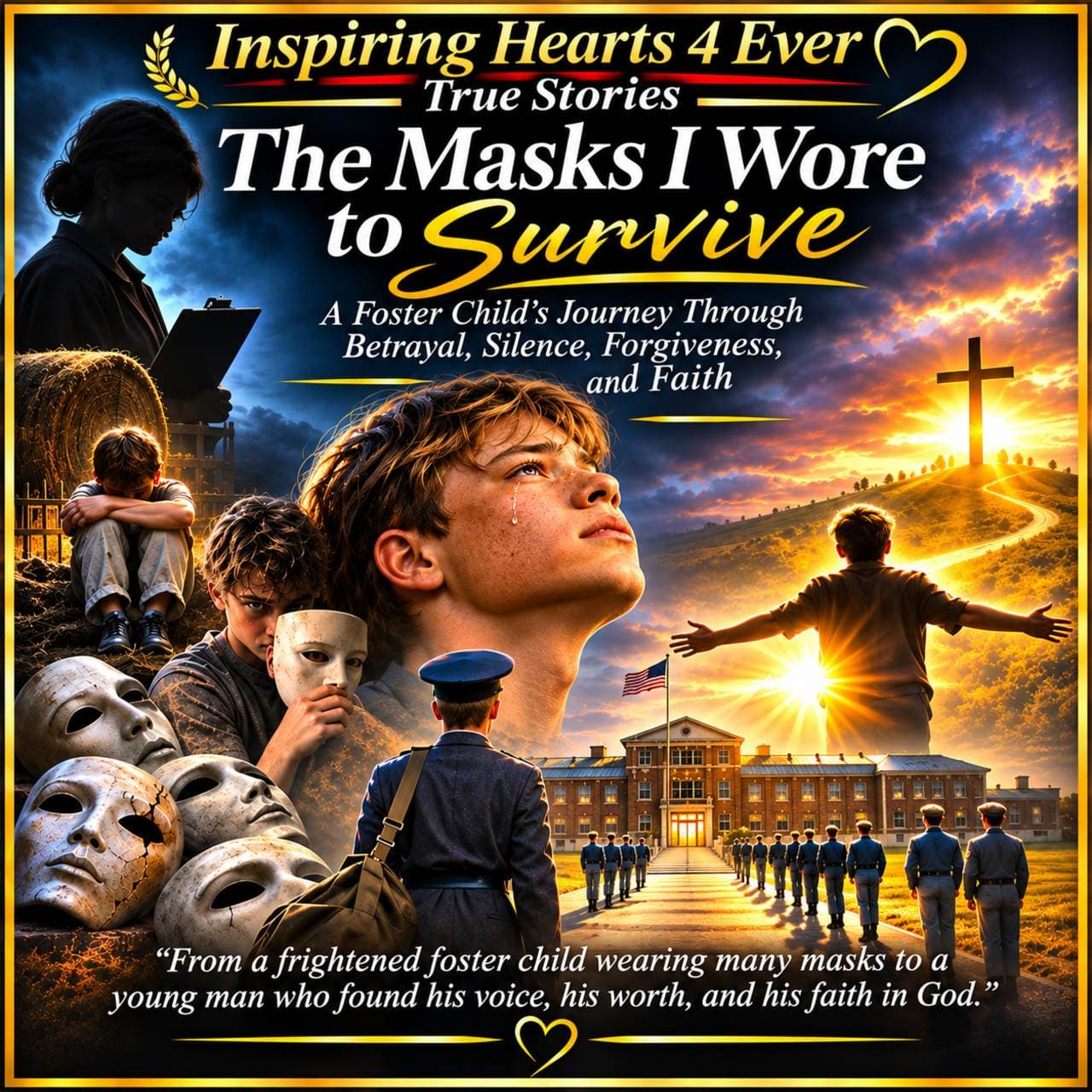
THE MASKS I WORE TO SURVIVE
A Foster Child's Journey Through Betrayal, Silence, Forgiveness, and Faith
Inspiring Hearts 4 Ever — A True-Life Testimony
The Boy Behind the Mask
There comes a time in your life when you look back at the child you once were and wonder how that child survived everything that happened to him.
I have asked myself that question many times.
Not because I believe I was stronger than everybody else.
Not because I had all the answers.
And certainly not because I understood what was happening to me.
I was just a boy.
A boy who wanted to be loved.
A boy who wanted to feel protected.
A boy who wanted somebody to understand him without having to explain every painful thing he had experienced.
But throughout my childhood, I learned something that would follow me for the rest of my life.
Sometimes the people who are supposed to protect you are the very people you have to protect yourself from.
And sometimes the only person you believe you can trust is yourself.
I had already experienced things that no child should ever have to experience.
I had known what it was like to be locked in a dark room.
I had known what it was like to be afraid.
I had learned to be quiet.
I had learned to watch people.
I had learned to recognize changes in their behavior because sometimes knowing when to speak and when to remain silent could make all the difference.
Those lessons didn't come from a classroom.
They came from my childhood.
And by the time I was fourteen or fifteen years old, I had already learned more about fear than I ever wanted to know.
But another experience was waiting for me.
An experience that would affect the way I trusted people, the way I understood love, and even the relationships I would have as an adult.
It involved someone who was supposed to be looking out for my welfare.
A Kansas state social worker.
And for a long time, I didn't know how to tell anybody what was happening.
The Visits
I was living with a foster family on a farm in Kansas.
The social worker would come around approximately twice a month.
To the outside world, it may have looked like an ordinary visit.
A state employee checking on a foster child.
Someone whose responsibility was supposed to include making sure that child was being treated properly.
But what happened during those visits was anything but ordinary.
She would pick me up in the afternoon.
We would leave the foster family's home.
And she would drive down a dirt road near some large hay bales.
That was where she began doing inappropriate things to me.
I was fourteen or fifteen.
I didn't understand what I was doing.
But she knew what she was doing.
There is a difference.
An adult has a responsibility to protect a child, not take advantage of that child's confusion, vulnerability, or inability to understand what is happening.
I was not being protected.
I was being abused.
And I remember feeling as though I was nothing more than a toy.
Something another person could use for whatever gratification she wanted.
I didn't know why she was doing it.
I still don't know.
I have wondered about that question many times throughout my life.
Was there something happening in her own life?
Had she experienced abuse herself?
Was there something happening in a relationship?
Was it simply about gratification?
I don't know.
And I refuse to pretend I know.
What I do know is that I was a child.
And what was happening was wrong.
The Threat
One thing I remember clearly was the warning.
She told me that if I told anybody, I would be in a lot of trouble.
Think about what those words can mean to a child who has already spent years being afraid.
When you're young, you don't always know what adults can or cannot do.
You don't understand all the rules.
You don't understand the law.
You don't understand what protection is supposed to look like.
You only understand that someone with authority over your life has told you something terrible will happen if you speak.
So you remain quiet.
That's what I did.
I kept it to myself.
I didn't know what the consequences would be if I told somebody.
I had already learned, from my younger childhood, that silence could sometimes feel safer than speaking.
And now I was using that same lesson again.
I would return to the foster home after those visits and feel some sense of safety because I was no longer with her.
But I knew something else.
In approximately two weeks, she would come back.
And the terror would begin again.
It was like living with a nightmare that had a schedule.
Everyday life on the farm could seem normal.
There were ordinary days.
Ordinary routines.
But somewhere inside my mind, I knew another visit was coming.
I didn't want to go.
I didn't want to experience those things again.
Yet I didn't know how to make them stop.
So I followed the rules.
I stayed quiet.
And I carried another mask.
The Masks We Wear
Throughout life, people wear many different masks.
Sometimes we wear them because we want others to think we're happy.
Sometimes we wear them because we don't want anyone to know we're hurting.
And sometimes we wear them because we're afraid of what might happen if somebody sees the truth.
I learned about those masks when I was very young.
I could be standing in front of somebody while carrying something inside that they knew nothing about.
I could be quiet, and they might think I was simply shy.
I could withdraw into myself, and they might not understand why.
I could become upset, and somebody might see the behavior without seeing the pain underneath it.
That's one of the hardest things about being a child who has experienced abuse.
People may see what you're doing.
But they don't always understand what you're going through.
I didn't know how to explain everything.
And sometimes I didn't even want to try.
I had already experienced abuse in my younger years.
Now, as a teenager, I was facing another experience that made me question the people who were supposed to protect me.
I didn't trust anybody.
But I knew I could trust myself.
And I trusted God.
Throughout my childhood, I had also found comfort in my imaginary friend.
Those were parts of my inner world that helped me endure experiences I didn't understand.
When the outside world felt frightening, I went back inside myself.
I became quiet.
I became withdrawn.
I didn't want to be seen.
I didn't want to do much of anything.
I just wanted the experience to end.
When Silence Was No Longer Enough
Eventually, I reached a point where I couldn't keep living that way.
I remember telling myself something very simple.
This is not right.
I didn't deserve what was happening.
I didn't want to go through it anymore.
And I finally told my foster family.
They were shocked.
That's what I remember about their reaction.
I don't want to invent words they said or actions they took that I can no longer recall.
But I remember their shock.
And I remember that eventually I was assigned a different social worker.
The woman who had abused me was removed from my life.
For the first time in a long time, I could think about the future without expecting another visit from her.
I felt peace.
Peace within my heart.
Peace within my mind.
Peace within my soul.
I remember feeling that I would never have to see that person again.
That I would never have to experience those horrible things with her again.
It was almost as though somebody had handed me a clean slate.
I wanted to start over.
I wanted to wash those memories away.
But there is something I have learned about painful experiences.
Just because the experience ends doesn't mean every feeling connected to it disappears.
The person may be gone.
The visits may stop.
The danger may no longer be standing in front of you.
But the memories can remain.
And sometimes those memories follow you much farther into life than you ever expected.
The Boy Nobody Completely Understood
After my foster family learned what was happening, I withdrew even further into myself.
I kept to my own world.
I didn't want to be around people.
I was quiet.
I was shy.
And sometimes I was simply sad.
So sad that I didn't know what to do with it.
I didn't necessarily show that sadness in ways other people could understand.
There were signs.
Sometimes I acted out.
Sometimes I rebelled.
But the people around me didn't fully understand how deeply the experience was affecting me.
I don't say that because I felt betrayed by my foster family.
I didn't.
I felt misunderstood.
There's a difference.
I wanted somebody to understand that the way I was behaving was connected to what I had experienced.
I wasn't simply trying to make trouble.
I wanted out.
I wanted to leave that situation behind.
I was tired of the terror.
I was tired of feeling trapped.
I was tired of carrying something that I never should have been forced to carry.
I remember saying that I didn't want to be there anymore.
And eventually, that situation led me before a judge.
But before I tell you about that day, there is something else I want you to understand.
Something that began long before I entered that courtroom.
Learning to Read People
When I was a child, I learned to read people.
I watched their reactions.
I watched how they behaved.
I learned that sometimes it was better to think before speaking.
Sometimes it was better to remain quiet.
And sometimes understanding another person's behavior could help me decide how to respond.
That ability didn't develop because I was trying to become an expert in human behavior.
It developed because I was trying to get through life.
I had to learn how to adapt.
How to maneuver through unfamiliar situations.
How to recognize when something might be wrong.
Those lessons stayed with me.
Years later, when I became a hospice aide, I discovered how important it was to understand the person in front of me.
In hospice, you cannot simply assume that everybody thinks the way you do.
You have to pay attention.
You have to understand what someone may be experiencing.
You have to consider how that person reacts before deciding how you should respond.
That understanding has helped me throughout my career.
But its beginnings go back much farther.
Back to childhood.
Back to the times when I had to learn to understand people because I didn't always know whether I could trust them.
I would never tell another child that abuse is necessary to learn wisdom.
It isn't.
What happened to me should not have happened.
But I can look back and recognize that I developed certain ways of understanding the world while trying to survive it.
And eventually, I learned to use some of those lessons to help other people.
What Love Was Supposed to Mean
Throughout my childhood, I struggled to understand love.
I knew one thing.
If somebody truly loved you, they shouldn't be abusing you.
That seemed simple to me.
But I had experienced situations where the actions of adults didn't match what love was supposed to mean.
So I began thinking about love differently.
Love is a choice.
You choose how you treat another person.
You choose whether to respect them.
You choose whether to protect them.
And if somebody says they love you while choosing to abuse you, that doesn't make the abuse love.
I learned that lesson early.
But I also learned something else.
Everybody experiences love differently.
What makes one person feel loved might not make another person feel loved.
You could give somebody a hug.
You could tell them you love them.
And you might believe you've given them everything they need.
But what if that person doesn't experience love that way?
What if they need something different?
What if they need to feel understood?
What if they need somebody who will listen?
What if they need to know that someone has their back?
Those were the things I wanted.
I didn't need fancy cars.
I didn't need beautiful houses.
I didn't need expensive gifts.
I wanted to feel loved.
Respected.
Valued.
Protected.
Understood.
And I wanted that love to be sincere.
Not something offered for a moment and forgotten the next day.
Not instant gratification.
Something real.
Something that could grow.
The Garden of Love
I have often thought about love as a garden.
A garden doesn't bloom simply because somebody walks past it and says it looks beautiful.
It needs care.
It needs attention.
It needs someone willing to help it grow.
That's what I wanted in my life.
I wanted somebody to plant a seed in that garden of love within me.
I wanted that seed to grow into a flower.
And I wanted to continue watering that flower throughout my life.
Not because I needed somebody else to create my worth.
But because I wanted to experience a kind of love that recognized the person I truly was.
The boy who had been hurt.
The boy who had learned to remain quiet.
The boy who sometimes struggled to trust.
The boy who wanted to feel safe within himself.
As I grew older, that desire stayed with me.
I went through many trials and errors in relationships.
Sometimes I found it difficult to explain what I needed.
Sometimes the other person had their own understanding of how love should be expressed.
They might believe they were showing me love in the right way.
But I didn't always understand or accept that way.
I wanted to be loved for who I was.
Not simply according to what somebody else believed I should need.
And I will tell you something that isn't easy to admit.
It is still difficult for me today.
The Memories That Followed Me
Some experiences don't stay neatly in the past.
Sometimes they return when you least expect them.
For me, the abuse I experienced as a teenager affected my ability to trust people.
It affected relationships.
It affected intimacy.
There have been times when memories of what happened played in my mind like a movie.
And those memories brought back feelings I wished I could forget.
Sometimes I felt dirty.
Not because I had done something wrong.
I was a child.
But because the experience itself had left me with feelings that were difficult to explain.
And sometimes those feelings contributed to relationships falling apart.
I don't share that because I want sympathy.
I share it because there may be somebody reading this who understands exactly what I'm talking about.
Somebody who has experienced abuse and wondered why certain situations still affect them years later.
Somebody who wants to love another person but struggles to explain what makes them feel safe.
Somebody who has forgiven the person who hurt them but still carries memories of what happened.
Forgiveness and healing are not always the same thing.
You can forgive someone and still have difficult days.
You can move forward and still remember.
You can build a life and still have parts of your past that are hard to talk about.
I know that because I've lived it.
Looking at Both Sides
As I grew older, I began thinking about the woman who had abused me.
I wondered what had happened in her life.
Had somebody abused her when she was younger?
Had she experienced something difficult in a relationship?
Was there some other reason for her behavior?
I don't know.
Those are questions, not answers.
And whatever her circumstances may have been, they would not justify what she did to me.
But eventually, I decided to forgive her.
For me, forgiveness meant recognizing that I couldn't spend the rest of my life trying to solve questions I might never be able to answer.
I could acknowledge what happened.
I could acknowledge the harm.
And I could decide how I wanted to live moving forward.
I didn't want to become somebody who treated others the way I had been treated.
I didn't want to carry cruelty into somebody else's life.
I wanted to do something different.
I wanted to give love.
And that decision began with learning to love myself.
The Young Man in the Mirror
I remember looking in the mirror when I was young.
And what I saw was a young man.
Not simply a frightened child searching for somebody to love him.
A young man beginning to understand that he had choices about the person he wanted to become.
I told myself that if I was going to love people, I had to show gratitude to this dark world.
And it had to start with me.
I couldn't control whether everybody accepted the love I offered.
Some people would.
Some people wouldn't.
But I could continue trying.
I could plant a positive seed in somebody's heart, mind, and soul.
I could try to place a flower in their garden.
Maybe that flower would bring them comfort.
Maybe something I said or did would make a difference.
Maybe they would never tell me.
That wasn't the point.
The point was to keep trying.
I had learned that if nobody was going to love me the way I needed, I could still choose to show love.
But first, I had to love myself.
That was my foundation.
You have to love yourself before you can truly offer the love you want to give others.
And when I began discovering that love within myself, I began understanding that my life could be about more than what had happened to me.
It could be about what I chose to do next.
God Was There
There is something else I want to tell you.
Throughout my childhood, there were times when I felt completely alone.
Times when I didn't understand why things were happening.
Times when I didn't know whom to trust.
But I believed in God.
And as I grew older, my understanding of that faith became stronger.
I came to believe that even during the times when I felt alone, God had been with me.
He had been there in the beginning.
And I believe He will be with me in the end.
That doesn't mean I believe God wanted me to be abused.
I don't believe a child has to suffer abuse to deserve love or to discover a purpose.
What it means is that I found a way to hold onto my faith despite what happened.
I could look back at the little boy locked in a dark room.
I could look back at the teenager sitting alone with memories he didn't know how to explain.
And I could say that, through it all, I believed I was not truly alone.
That belief helped me continue searching for God's plan.
I didn't know where my life was going.
I didn't know I would eventually spend decades helping people through hospice.
I didn't know how many relationships I would experience or how many lessons I would still have to learn.
I only knew I wanted to become someone who could offer others the love and understanding I had spent so much of my childhood searching for.
The Day I Removed a Mask
Eventually, I found myself sitting before a judge.
I was there because of the circumstances surrounding my foster placement and my desire to leave.
And I told my story.
The social worker who had abused me wasn't there.
But I was.
And for once, I was speaking about what had happened.
I remember feeling relief.
It was as though I no longer had to wear that particular mask.
Throughout my childhood, I had worn so many.
The quiet mask.
The shy mask.
The mask that made everything look normal.
The mask that kept people from knowing how much I was hurting.
And now I was taking one off.
That takes courage.
People sometimes think courage means never being afraid.
But I have learned that courage can mean telling the truth after spending years being afraid of what might happen if you speak.
I felt that I was heard.
But I also felt there were unanswered questions.
Questions nobody seemed willing to answer.
Why had this happened?
Why had somebody in a position of responsibility been able to hurt me?
Why had I spent so much time afraid to tell anybody?
And what was supposed to happen now?
I didn't receive every answer I wanted.
So I told myself something.
I'll figure it out down the road.
I didn't know when.
I didn't know how.
But I knew my life wasn't finished.
The Decision
At that hearing, the authorities discussed two possible placements.
A detention center.
Or a military academy.
I want to be clear about something.
I wasn't given a choice between them.
The decision-makers explained what each environment might involve.
They told me they had weighed the options.
And they believed military academy was in my best interest.
They said I needed structure.
They believed a detention center might provide structure too, but that it could take longer.
So they decided to place me in a different environment.
A military academy.
They described it as a clean slate.
Another opportunity to start over.
But I wasn't sitting there thinking about how wonderful everything was going to become.
I wasn't celebrating some great escape.
I was thinking about what might happen next.
What would I have to endure?
Would I be entering another cage?
Would I have to learn a whole new set of rules?
Would I have to figure out when to speak and when to remain quiet?
Once again, I was going somewhere unfamiliar.
An unknown land.
And once again, I would have to rely on the lessons I had learned throughout childhood.
Observe.
Think.
Adapt.
Understand the people around me.
And be careful about how I reacted.
I didn't know what military academy would eventually teach me.
I didn't know that years later I would look back and recognize the value of the discipline, character, integrity, and structure I encountered there.
At that moment, I was simply a young man being sent into another unfamiliar chapter of life.
The Goodbyes
Before I left, I said goodbye to my foster family.
I remember that.
But I didn't know what else to say.
I didn't feel betrayed by them.
I felt that they hadn't fully understood how deeply the abuse had affected me.
There had been signs.
Moments when I acted out.
Moments when I withdrew.
Moments when I was so sad that I didn't know what to do with myself.
But I hadn't always shown what was happening inside.
And they hadn't fully seen it.
Sometimes I think about how many children are living that way right now.
Children who appear quiet.
Children who seem withdrawn.
Children whose behavior changes.
Children who are called difficult or rebellious without anybody understanding what they may be experiencing.
I cannot tell you what every child is going through.
But I can tell you what happened to me.
And I can tell you that sometimes the pain a child carries is much greater than what the outside world can see.
When I said goodbye, I was leaving behind a chapter of my life that had changed me.
But I wasn't leaving behind every memory.
Those would take much longer to understand.
The Questions That Followed Me
When I turned eighteen, I contacted the State of Kansas because I wanted to pursue criminal charges against the social worker.
I remember being told that the statute of limitations had expired.
I couldn't understand that.
I was eighteen years old.
I was trying to speak about something that had happened to me as a child.
And I was being told, as I remember it, that too much time had passed.
I also remember being told things that left me with even more questions.
According to my recollection of those conversations, officials spoke about other children who may have been abused and about allegations they said could not be proven.
I remember being told that the woman had been demoted or reassigned and eventually transferred out of state.
I cannot independently verify those explanations today.
I can only tell you what I remember hearing and how those conversations affected me.
I wondered how someone could get away with something like this.
I wondered why my testimony didn't seem to be enough.
I wondered why I had been told that I couldn't pursue the matter.
I felt dirty.
Disrespected.
And left with unanswered questions.
Those feelings stayed with me.
But I also knew I couldn't spend every day of my life waiting for somebody else to explain everything.
I had to continue living.
I had to keep learning.
And I had to decide what I wanted to do with the life in front of me.
What I Would Tell That Boy Today
If I could stand face-to-face today with the fourteen- or fifteen-year-old boy I once was, I know what I would tell him.
Always keep your guard up.
Always think before you react.
Sometimes you have to go through the storm to find the light and love in God.
I would want him to know that he didn't deserve what happened.
I would want him to know that being abused didn't make him dirty.
I would want him to understand that his worth wasn't determined by the actions of somebody who had hurt him.
And I would want him to remember the promise he made while looking in that mirror.
To love himself.
To continue showing love.
To plant something positive in another person's heart, mind, and soul whenever he could.
Because that boy was going to experience more challenges.
He was going to make mistakes.
He was going to struggle with trust.
He was going to have relationships that didn't work out.
He was going to carry memories that sometimes returned when he wished they wouldn't.
But he was also going to discover things about himself.
He was going to learn.
He was going to grow.
And he was going to spend much of his adult life trying to offer others the dignity, respect, understanding, and comfort that had mattered so much to him as a child.
The Mask I Finally Took Off
I have lived long enough to understand that removing the masks we wear is not always something that happens in a single moment.
Sometimes you remove one mask and discover another underneath.
Sometimes you tell part of your story and realize there are other parts you still struggle to explain.
Sometimes you forgive somebody and discover that forgiveness doesn't automatically erase the memories.
And sometimes you spend years learning how to accept love in a way that feels sincere to you.
I am still learning.
I don't pretend to have everything figured out.
But I know this.
I was a child who wanted to be protected.
I was a teenager who wanted to escape abuse.
I was a young man who wanted to understand what love was supposed to feel like.
And I became an adult who continued searching for ways to love himself and show love to others.
I don't know why that social worker did what she did.
I don't know whether every question I have carried will ever receive an answer.
But I know that what happened to me was not my choice.
What I chose to do with the rest of my life was something I could begin deciding for myself.
And when I think back to that young man leaving his foster home, saying goodbye, and preparing to enter an unfamiliar military academy, I don't see somebody who had all the answers.
I see somebody who was still learning how to live.
Still trying to understand people.
Still discovering his own worth.
Still believing God had not abandoned him.
And still hoping that somewhere along the road, the love he had spent so much of his life searching for could begin growing within him.
Like a seed.
Like a flower.
Like a garden that deserved to bloom.
Don't fake it until you make it. Faith it until you make it.
---
Author's Note — A True-Life Testimony
This story is based on my personal memories and experiences as a foster child in Kansas. It describes childhood sexual abuse, the emotional effects that followed, my recollection of conversations with state officials, and the beliefs I developed about love, forgiveness, and faith.
The events and conversations are presented from my memory and perspective. Statements attributed to officials reflect what I remember being told, not independently verified findings. Some details and exact wording from decades ago are no longer available to me, and I have chosen not to invent them.
This chapter ends as I prepare to enter military academy. That next part of my journey is told in my separate story, A Fighting Chance Was All I Ever Wanted.
Written collaboratively by Jeffrey Badders with AI writing and editorial assistance.
The foundation is built through discipline. The legacy is created through action.
The darkness built the foundation; our actions bring the legacy into the light.