


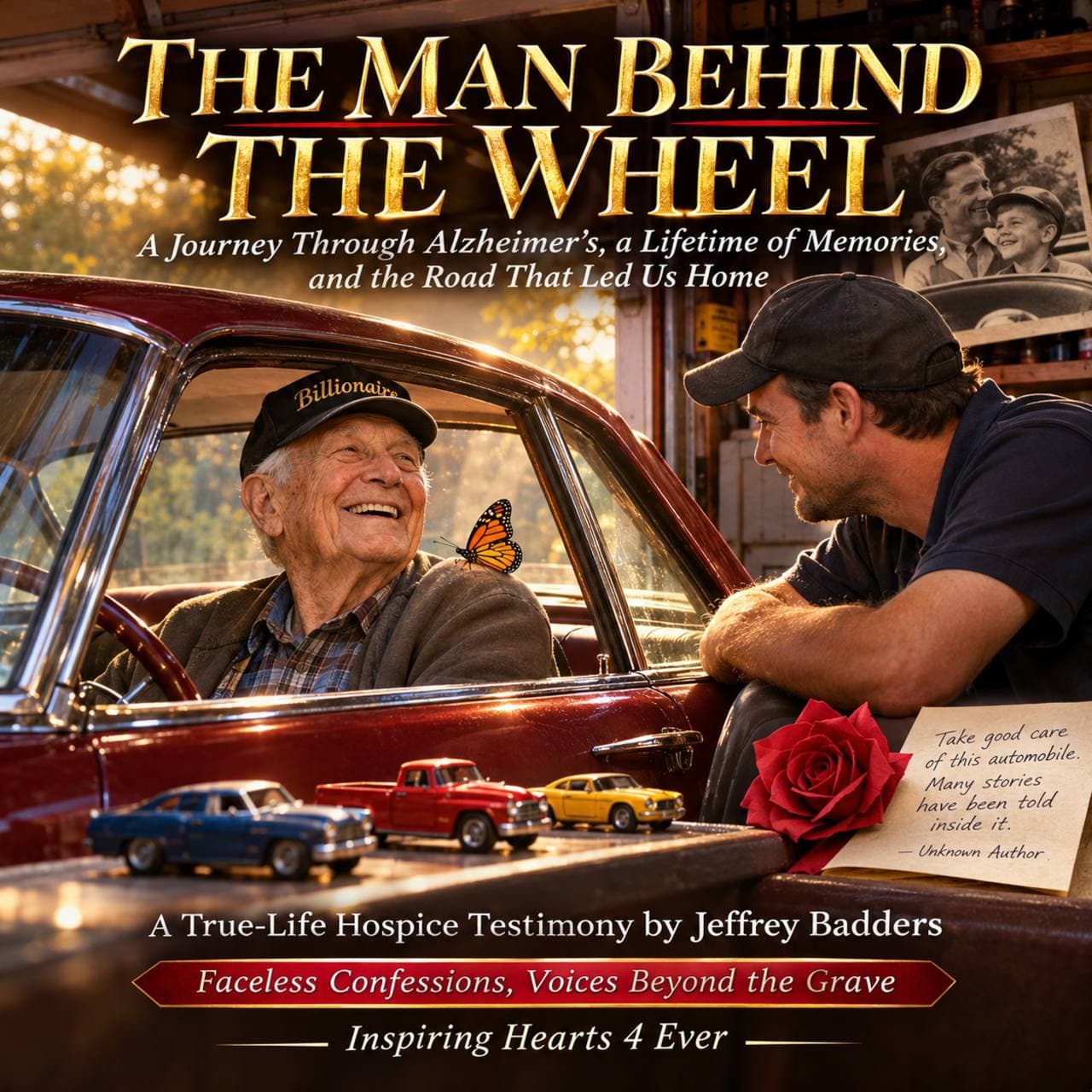

THE MAN BEHIND THE WHEEL
A Journey Through Alzheimer's, a Lifetime of Memories, and the Road That Led Us Home
A True-Life Hospice Testimony by Jeffrey Badders
Faceless Confessions, Voices Beyond the Grave
His father gave him a choice when he was a boy.
He could walk down the road kicking a can, or he could drive down that road and drive himself through life.
He never forgot that lesson.
Decades later, when Alzheimer's had taken so much from him, he would still tell me, “I've got to stay in motion. I've got to keep driving.”
For approximately two years, I helped him do exactly that.
What I didn't realize when our journey began was that the man I was helping would also remind me of the importance of staying in motion in my own life.
The Weekend Job
During the week, I worked full-time as a hospice aide. On weekends, I took care of a gentleman who had spent much of his life in the automobile business.
His family's business represented generations of hard work and dedication. But when I entered his life, I wasn't there to learn about his financial accomplishments or public reputation.
I was there to help him live his life.
His family had a cherished older automobile that held a special place in his heart. Sometimes we sat inside it out in the sunshine. Other times, we sat together in the garage.
That car became the place where he told me the story of his life.
He remembered riding beside his father as a boy, drinking Coca-Cola and listening to his father teach him about automobiles, business, and life.
He respected his father deeply.
One of the memories that touched me most was his father's lesson about walking or driving down the road.
When he shared that memory, I began thinking about myself at sixteen years old.
During that period of my life, I was involved with drugs and alcohol. I had not discovered my identity, and I didn't have a clear direction.
In a way, I was that young man kicking a can down the road.
I was moving, but I wasn't going anywhere.
When I finally began changing my attitude, making different decisions, and taking responsibility for my life, I began to discover who I could become.
My life started unfolding in a more beautiful direction.
Here I was, sitting beside a gentleman living with Alzheimer's, listening to a lesson his father had taught him many years earlier. That lesson still had meaning, not only in his life but also in mine.
During our two years together, he occasionally asked me about my life. I shared some of my struggles with him, particularly during the earlier part of our time together.
But I never told him everything.
He already had enough going on in his own world. I didn't want to bring additional emotional baggage into it.
My time with him wasn't about making my story more important than his.
It was his opportunity to be heard.
The Time Capsule
As his Alzheimer's progressed, I noticed that he could sometimes remember riding beside his father as a child, yet struggle to remember something we had discussed only minutes earlier.
Sometimes he told me the same story many times.
I listened.
I thought about how someday I might want someone to sit beside me and listen to my story. I wanted to give him that same opportunity.
There were times when he became emotional while remembering his life. To me, it was almost as though he was watching a movie inside himself.
I allowed those moments to unfold without rushing him. When he had had enough, we would get out of the car.
I began thinking of that car as a time capsule.
It was a place where he could revisit the memories that were still available to him.
There was much more to this gentleman than the automobile business. He had traveled widely and supported charitable causes, including efforts to help people experiencing homelessness and provide educational opportunities for others.
The man I came to know was kindhearted and outgoing.
Watching his condition gradually deteriorate was difficult. I couldn't reverse what was happening to him, but I could give him my time, patience, dignity, and respect.
Sometimes it took him a long time to put together just a few sentences.
I was grateful that he could still share them.
A Butterfly on His Shoulder
While he was still physically able, I tried to give him opportunities to enjoy life outside his home.
We went to the zoo, rode the train, watched the animals, and enjoyed ice cream. We visited shopping centers, went out to eat, and took rides together.
One of my favorite memories was a little field trip I took with him and his wife.
We visited a butterfly attraction, ate together, and walked into a large room filled with butterflies.
Then one of the butterflies landed on his shoulder.
He was so excited.
That was one of those moments I will never forget.
On another occasion, I took him to a museum filled with musical instruments. He enjoyed singing, although he had never played an instrument himself.
He was fascinated by the instruments on display, and we took many pictures during our visit.
Then there was the day of the billionaire hat.
We were at a shopping center when we came across a hat with the word “Billionaire” written on it.
I have a picture of him wearing that hat with a big smile on his face.
We went and had some yogurt, talked, and watched the people passing by. He enjoyed watching people.
As his condition progressed, I had to supervise him more closely. Sometimes he wanted to wander into different places, and I would gently hold his hand and redirect him.
I tried to remain calm and patient.
When he felt safe, he would open up.
I couldn't prevent the changes taking place inside him, but I could continue nurturing the parts of his life that brought him happiness.
And that was what I tried to do until the end.
The Little Things That Belonged to Him
One of the most important things I learned about this gentleman was that he had a particular way of doing things.
He liked his toast buttered a certain way. He wanted a particular amount of sugar in his coffee. He enjoyed blueberries and other familiar foods.
These were routines he had followed for fifty or sixty years.
Why should I come into his home and change them?
I wasn't there to make him adjust to my preferences.
I was there to help him maintain the familiar parts of his own life.
For someone experiencing increasing confusion, those little routines could still be meaningful.
I paid attention to what he liked and how he preferred things to be done.
It wasn't about me.
It was about him.
I have also learned throughout my hospice career that we must take people seriously when they express discomfort or pain.
We are not living inside their bodies. We cannot assume that we understand what they are experiencing better than they do.
Their concerns deserve attention, compassion, and communication with the appropriate healthcare professionals.
Respecting someone means listening to more than just their memories. It also means listening to what they are experiencing today.
A Different Automobile
Eventually, our outings became more difficult.
He needed a walker, and our automobile rides were no longer practical.
But he still talked about wanting to drive.
He still wanted to stay in motion.
When he was able, I encouraged him to walk short distances with his walker. When the weather was nice, I took him outside in his wheelchair.
I told him I would keep him in motion.
We simply had a different automobile now.
His wheelchair.
I joked that I didn't know how long the engine behind that wheelchair was going to last, but I would do my best.
He chuckled.
I pushed him many blocks through the neighborhood. As we traveled along, he would begin telling me more stories about his life.
And I listened.
As long as he was moving, he seemed happy.
His father's lesson about walking or driving down the road still meant something to him.
The vehicle had changed.
His desire to stay in motion had not.
It didn't matter what vehicle he was in. The vehicle that was most important was his spirit.
The Smallest Automobile Dealership
Eventually, even our wheelchair outings became too difficult.
That was when we began spending more time at the table with his Hot Wheels collection and his car puzzles.
He had collected those little cars for years.
We lined them up on the table and pretended we were running a car dealership.
I would bring my little car into his imaginary dealership and tell him I was interested in trading it for another one.
He would begin negotiating with me.
I remember him joking about having a good deal on his car lot. When I showed interest in one of his cars, he reminded me that I wasn't going to get it for free.
I told him I didn't have any money and asked whether he could work with me.
He would hesitate, smile, and continue negotiating.
Even with the difficulties he was experiencing, parts of his natural salesmanship were still there.
He had charisma. He had spent a lifetime developing his talent, and I could still see glimpses of it as we played with those little cars.
I remember the big smile on his face.
I cannot tell you exactly what he was thinking, because I didn't know.
But I could see that smile.
We spent many hours with those little cars and puzzles. I helped him whenever he needed assistance, and I tried never to rush him.
Our imaginary dealership wasn't about making money.
It was about giving him an opportunity to participate in something that had been meaningful throughout his life.
The car salesman was still there.
I simply needed to meet him where he was.
The Woman Beside Him
His wife was a wonderful person.
During those two years, I also witnessed how difficult it was for her to watch the man she loved gradually deteriorate.
I helped her prepare Christmas dinner twice. She taught me things about cooking, and we shared some laughter.
Sometimes, when her husband was sleeping, we watched Hallmark movies together.
I remember jokingly asking her when one of those movies was finally going to end.
She told me that when they kissed, that was when the story ended.
But there was another Hallmark movie that I will never forget.
It was about an older couple who had shared a close relationship. The husband died, leaving his wife without the man who had been her rock.
As we watched, she made a statement that stopped me.
As I remember her words, she said, “I know he's going to die. But am I going to die inside?”
I didn't know what to say.
I sat there feeling numb.
Here was a woman who understood what was happening to her husband. She knew that his life was coming to an end, but she was also facing the uncertainty of what her own life would become without him.
It was a deeply sad moment.
I have never forgotten it.
Two Flowers to Water
After that conversation, I began looking at my responsibilities differently.
I realized that I was no longer watering just one flower.
I had two flowers to water.
As her husband's condition deteriorated further, a hospice team became involved in his care. I continued spending my weekends with them.
Sometimes I prepared meals for his wife. I remember making lemon chicken, which she enjoyed. Other times, I made spaghetti or prepared breakfast in the morning.
These were simple things that I could do.
I listened when she wanted to talk and tried to maintain a peaceful environment.
I couldn't take away the grief she was experiencing.
I couldn't tell her how she should feel or how she should prepare herself for what was coming.
But I could give her companionship, practical assistance, and the opportunity to experience those difficult days in her own way.
Sometimes helping a family means recognizing that the person who is dying is not the only person who needs support.
There is another heart in the room.
And that heart deserves attention, too.
Learning to Enter Another Person's World
When I began working with people living with Alzheimer's in 1990, I didn't understand everything I understand today.
I remember an early experience involving a farmer who had spent much of his life being independent and making his own decisions.
I was trying to help him take a shower.
Instead of slowing down and understanding his situation, I attempted to take control. I told him what needed to happen, and he became extremely upset.
He pushed me against the bathroom mirror.
That experience taught me an important lesson.
I needed to change my approach.
Over the years, I learned to become more patient, to speak gently, and to pay attention to how each person responded to my assistance.
With some people, offering two simple choices worked better than presenting several options at once.
Would you prefer this or that?
I learned that I didn't always need to explain everything at once. Sometimes it was better to give someone time to process what I was saying.
By the time I entered this gentleman's life, those experiences had helped shape the way I approached my work.
I respected his routines. I tried to understand his preferences. I listened to his stories, even when he repeated them.
I wasn't trying to force him to understand everything about my world.
I was making an effort to understand his.
The Red Paper Rose Inside the Automobile
Near the end of his life, his body had declined considerably.
He was losing weight, eating very little, and becoming increasingly dependent on assistance.
His wife was struggling with the demands of caring for him while facing difficulties of her own.
Sometimes I stayed overnight before going to my regular hospice job the following morning.
During that final period of his life, I went out to the garage and sat inside his cherished automobile one more time.
I wrote a little note and made a red paper rose.
There was an opening in one of the interior door panels of that car. I placed the note and the rose inside.
As best I remember, the note asked whoever might discover it someday to take good care of that automobile.
Many stories had been told inside it.
They were the stories of the man behind the wheel.
I signed the note:
Unknown Author.
If that automobile is ever sold and someone discovers what I left behind, I want them to understand that there was a great deal of love inside that car.
There were tears, sweat, hard work, and memories representing generations of a family's life.
Building a business over generations requires dedication. This gentleman had carried that business through his lifetime.
But the memories I treasured most were not about his financial success.
They were about a little boy riding beside his father, drinking Coca-Cola, learning about life, and discovering the direction he wanted to travel.
They were about a man who never forgot his father's lesson.
And they were about the privilege I had of sitting beside him while he remembered.
Our Final Goodbye
I remember feeling in my heart that one particular weekend would be our last together.
He was receiving oxygen, and I could hear the changes in his breathing that I recognized from my years of hospice work.
I believed his time was drawing near.
His wife was in another room when I went in to speak with him.
Although I couldn't know exactly what he could hear or understand, I wanted to speak to him with the same respect I had given him throughout our journey.
I held his hand.
As I remember my farewell, I told him that we had been on a journey together for a long time, but sometimes in life, a journey must come to an end.
I told him something I have said to many of my patients over the years.
“If I never see you again, thank you for telling me the story of your life. Thank you for those beautiful memories we had. And most of all, thank you for your generous time. Good luck on your journey in life.”
Then I walked out of the room.
I went to his wife and gave her a red paper rose of her own.
This was a different rose from the one I had hidden inside the automobile.
I wished her the best and told her how sorry I was that she was going through such difficult times.
I wanted that rose to represent something meaningful.
My heart, my mind, and my soul.
I left that weekend.
He passed away that same weekend.
Our journey together had reached its final chapter.
It was time for me to put another book back on the shelf.
But the memories inside that book would remain with me.
What Does It Mean to Be Rich?
Throughout my life, I have thought about what it means to be successful and what it means to be rich.
When I reach the end of my life, I hope my wealth will also be measured in something else.
How many people did I encourage when they wanted to give up?
How many people did I help when they were struggling?
How many people experienced kindness, dignity, and respect because I entered their lives?
I want to leave an imprint on people's hearts, minds, and souls.
Someday, I may be the person who needs someone to sit beside me.
I may need someone to hold my hand, reassure me, and listen to the story of my life.
I hope someone will.
Before You Reach the End of the Road
When we are children, we often can't wait to grow older.
Then we turn eighteen. Before we know it, we are thirty, and eventually we find ourselves approaching sixty.
Life moves quickly.
There comes a time when we begin to realize that there isn't as much fuel left in our tank as there once was.
That is why I encourage people not to postpone the opportunity to spend time with someone they love.
Ask your parents about their childhoods.
Ask them about their dreams, their struggles, their accomplishments, and the people who helped shape their lives.
Listen while they are still able to tell you.
Throughout my hospice career, I have met people who finally had the opportunity to sit down and tell their stories near the end of their lives.
They had spent years working, raising families, facing challenges, and pursuing their dreams.
Sometimes they had never found the time to share those experiences.
Their stories mattered long before they reached the end of their lives.
We don't have to wait until someone is dying to recognize that.
An Unknown Land
If someone you love is living with Alzheimer's, I would encourage you to make an effort to understand their individual world.
Be patient. Speak gently. Give them time to respond.
When appropriate, come down to their eye level and communicate calmly.
Try offering simple choices when too many options seem overwhelming.
Pay attention to familiar routines, preferences, and activities that still bring them comfort.
If they welcome your touch, holding their hand may provide reassurance.
And when they express pain, fear, or discomfort, take those concerns seriously and seek appropriate support.
Find something they still love, even if it fits on a table.
For the gentleman in this story, that something was a collection of miniature automobiles.
For another person, it might be music, photographs, gardening, or a favorite meal.
Every individual has a different story.
They may be traveling through what I call an unknown land, but we can still offer companionship as they travel through it.
We may not be able to change their destination.
We can, however, help make the journey less lonely.
The Man Behind My Own Wheel
That gentleman's father taught him to stay in motion.
Many years later, he shared that lesson with me.
Today, as I continue pursuing my own dreams, I understand the importance of continuing to move forward, create, and discover what I am capable of becoming.
One of my personal sayings is:
“Time is money and the rent is due. Every day.”
To me, that is a reminder not to waste the opportunities life continues to give me.
But success also requires understanding who you are.
If you are going to make something of your life, it starts with you. You have to discover your identity and begin building your own blueprint.
The gentleman I cared for had traveled many miles before I entered his story.
I was privileged to accompany him through some of his final miles.
I will remember the automobile in the garage, the butterfly on his shoulder, the billionaire hat, the miniature car dealership, and the smile on his face.
I will remember his wife and the question she asked while watching that Hallmark movie.
And somewhere inside an older automobile, there may still be a red paper rose and a note waiting to be discovered.
Perhaps someday someone will read that note and realize that the automobile they are sitting inside once held something more valuable than its engine, its craftsmanship, or its monetary worth.
It held the memories of a man's life.
Every person you meet has a story that belongs to them.
Even when their abilities change, their dignity remains.
The next time someone wants to tell you about their life, will you take the time to listen?
Will you sit beside them and ride along?
Because someday, you may be the one behind the wheel, hoping someone will ride along and listen.
Don't fake it until you make it. Faith it until you make it.
---
Author's Note — A True-Life Testimony
This story is based on my personal experiences and recollections as a hospice aide. Conversations and the note placed inside the automobile have been reconstructed or paraphrased from memory. Identifying information has been withheld to respect the dignity and privacy of the patient and his family.
My observations about Alzheimer's reflect my personal and professional experiences and are not intended as medical advice. Every person living with Alzheimer's has individual needs, abilities, and preferences.
Written collaboratively by Jeffrey Badders with AI writing and editorial assistance.
Inspiring Hearts 4 Ever
Real Stories. Real Life. Real Inspiration.