


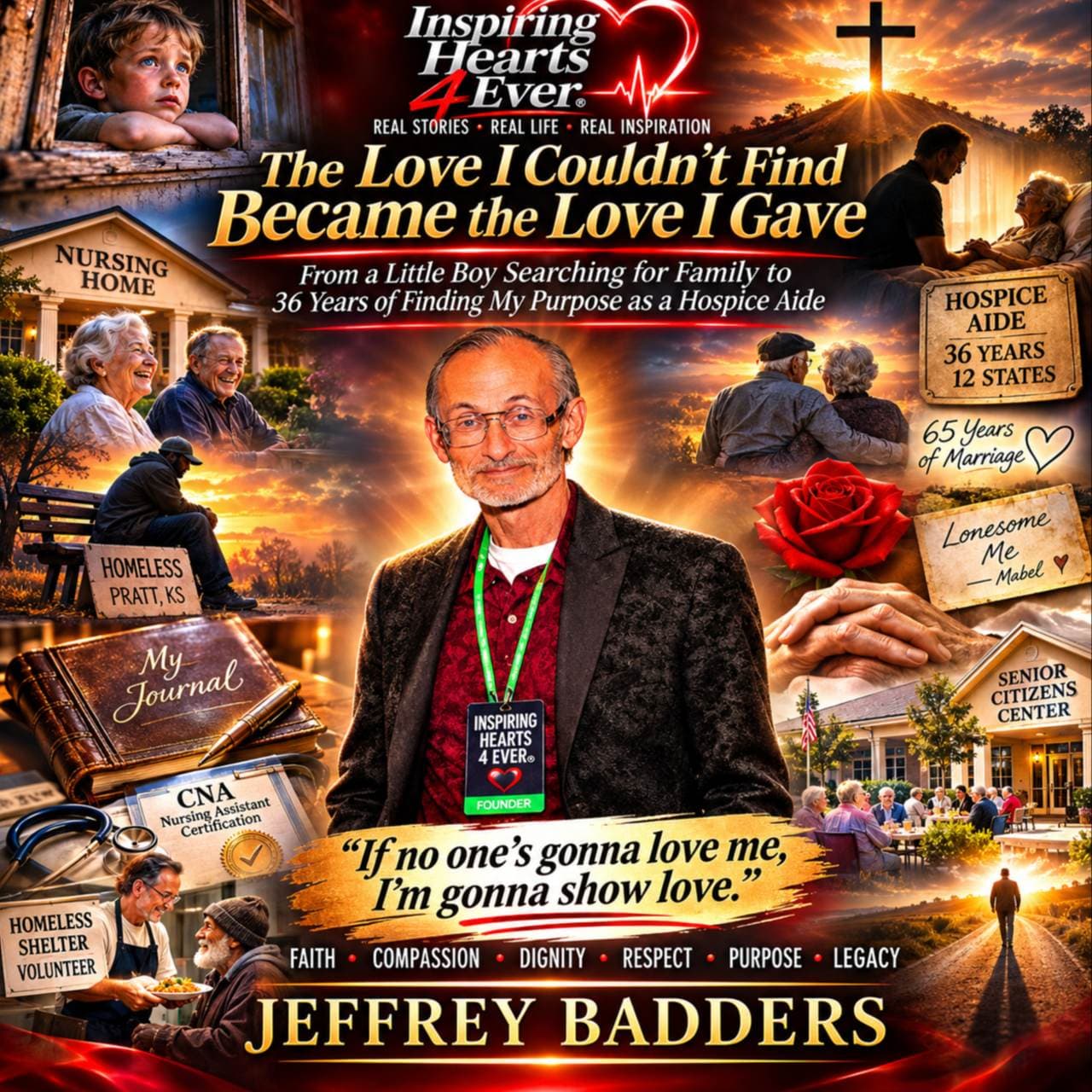
The Love I Couldn't Find Became the Love I Gave
From a Little Boy Searching for Family to 36 Years of Finding My Purpose as a Hospice Aide
“If no one's gonna love me, I'm gonna show love.”
I never imagined those words would become such an important part of my life.
When I was a little boy growing up in foster homes, I wanted something that seemed so simple.
I wanted to be loved.
I wanted to be accepted.
I wanted somebody to believe in me, invest in me, and appreciate me for who I was.
I didn't know then that one day I would spend 36 years as a hospice aide, walking alongside patients and their families during some of the most difficult moments of their lives.
And I certainly didn't know that through those people, I would find something I had searched for throughout my childhood.
A family.
Not a family connected to me by blood.
A family connected to me through love.
But before I discovered that purpose, I had to learn something about myself.
I had to learn that I mattered, too.
Walking Into Another World
I was approximately 22 or 23 years old when I began volunteering at a nursing home in Concordia, Kansas.
Walking into that nursing home was like stepping into another world.
I was meeting people from different generations, with different beliefs, values, morals, and experiences.
I began understanding that I couldn't expect everyone to see life the way I did.
If I wanted to make a difference in their lives, I needed to enter their world.
I needed to listen.
I needed to respect their experiences.
And most importantly, I needed to accept them for who they were.
I met a woman named Nurse Mo.
She had served as a Navy nurse for approximately 30 years and had grown up on a farm.
She had a way of teaching me things about life that went beyond anything I could have learned from a textbook.
One lesson she shared stayed with me.
Before you can take care of someone else, you have to learn to take care of yourself.
You have to love yourself.
You have to be yourself.
Because your life matters just as much as the life of the person you're helping.
She also encouraged me to take off the mask and let people see who I really was.
That was important to me.
For so much of my childhood, I had struggled to understand who I was and whether I belonged anywhere.
Now I was meeting people who were showing me that I didn't have to pretend to be somebody else.
Sometimes Nurse Mo and I played cards.
I would tease her and ask, “Are you playing with the full deck?”
She would chuckle.
One time, I even put ketchup on my finger and pretended I had cut myself.
She immediately wanted to help me.
That was Nurse Mo.
Her instinct was to take care of somebody.
And I was learning from her.
Not only about nursing.
About humanity.
The Woman Who Signed Her Card “Lonesome Me”
There was another woman I met at the nursing home.
Her name was Mabel.
Mabel was a sweet, humble woman with a beautiful spirit.
I remember spending time in the activities room where residents would tap balloons into the air as a form of light exercise.
It might not sound like much to somebody on the outside.
But when I watched those residents enjoying themselves, something happened inside me.
I felt happy.
I felt an excitement that came from knowing I had helped put a smile on somebody's face.
Mabel especially enjoyed those moments.
But eventually, she became ill.
She couldn't participate the way she once had.
I would visit her room before leaving.
Sometimes she would ask me, “Jeffrey, is it my time? Is it my time?”
I tried to comfort her with a little humor.
“No, it's not your time. They haven't even built the house. They haven't dug the hole.”
During her final months, I would sing “Goodnight, Sweetheart, It's Time to Go” before leaving.
Then, approximately a week before she passed away, she gave me a card.
She thanked me for putting a smile on her face.
But she also told me that deep inside her heart, there was a very lonely place.
She signed the card:
“Lonesome Me.”
I never forgot that.
Here was a woman who could smile and participate in activities, yet still carry loneliness deep inside.
It reminded me that you never really know everything another person is carrying.
Sometimes the people who smile need someone to listen just as much as anybody else.
I lost that card during my moves over the years.
But I never lost what it meant to me.
After Mabel died, I would still picture her enjoying the activities with the other residents.
In my heart, I felt she was near.
And I learned something that has stayed with me ever since.
A person's life may come to an end, but the love they shared, the memories they created, and the imprint they left on our hearts, minds, and souls can live on forever.
At that time, I didn't know I would eventually become a hospice aide.
I was simply learning to love people.
And without realizing it, I was also learning how much I needed that love myself.
Remembering the Park Bench
My desire to help people wasn't limited to the nursing home.
I also volunteered at a homeless shelter.
There was a personal reason for that.
I knew what it felt like to be homeless.
There had been a time in my life when I slept on a park bench in Pratt, Kansas.
I had struggled with drugs and alcohol.
I had reached a point where I needed to look at my life and ask myself where I was going.
I couldn't keep living in the same cycle.
I had to change my mindset.
I had to change my direction.
I had to reconsider the people I was surrounding myself with.
And I had to become responsible and accountable for the choices I was making.
I went back into what I call my survival toolbox.
That toolbox wasn't something I carried in my hands.
It was everything I had learned from the battles I had survived.
I began making different choices.
I stepped away from drugs and alcohol.
And I returned to my relationship with God.
I used to describe it this way:
I took God off the shelf and started walking that path again with Him.
I realized that if I wanted my life to change, I had to be willing to take action.
I told myself:
If no one's going to believe in you, believe in yourself.
If no one's going to invest in you, invest in yourself.
If no one's going to accept you, accept yourself.
And if no one's going to love you, love yourself.
If no one's going to help you, help yourself.
Those lessons didn't make my past disappear.
But they helped me understand that I still had choices about my future.
And when I entered that homeless shelter, I remembered what it was like to feel lost.
I wasn't there to judge anybody.
I was there to listen.
Sometimes People Don't Want to Be Fixed
At the homeless shelter, I met people who trusted me enough to share parts of their lives.
I remember a couple who were struggling with serious personal difficulties involving addiction and the circumstances of their lives.
I listened to their stories.
I could see sadness.
I sensed shame.
But I wasn't there to tell them that I had all the answers.
Sometimes people don't want you to fix them.
Sometimes they just want to talk.
They want somebody to hear them.
They want to feel seen.
They want to know that their lives matter.
So I listened.
And I gave them dignity and respect.
I learned that every person walks a different road.
Everybody has their own experiences, choices, beliefs, and challenges.
I often think about shoes.
Everybody has shoes.
But there are people whose shoes you could never stand in.
So why judge somebody else's journey when you have your own life to understand?
I wanted to plant a positive seed in people's hearts, minds, and souls.
A seed of love.
A seed that might continue growing within them long after our conversation ended.
I couldn't control what they would do next.
But I could control how I treated them while I was there.
The Birthday I Had Been Waiting For
Later, I began volunteering at a senior citizens center.
I helped older adults with errands and things they needed.
At first, I did it without charging anything.
Eventually, when I needed to make a living, I began accepting small amounts of money for helping people.
Sometimes someone would offer me a home-cooked meal.
Sometimes they would give me gas money.
But what I valued most wasn't the money.
It was what those older adults taught me.
I learned about their generations.
Their values.
Their ethics.
Their beliefs.
Their experiences.
And something else happened.
They began showing me appreciation.
They made me feel like I had value.
I remember one birthday in particular.
When I was a child, I had invited people to a birthday celebration.
Nobody showed up.
That memory stayed with me.
But years later, at the senior citizens center, people came to celebrate my birthday.
And I felt something I had wanted for so long.
Love.
Respect.
Acceptance.
Appreciation.
I remember thinking that it might have been the best birthday I had ever experienced.
All my life, I had wanted that feeling.
And after all those years, I finally experienced it.
I began telling myself something different about who I was.
I have value.
I should appreciate the things I've done and the battles I've won.
And when I lay my head down at night, I need to remember that I'm worthy of who I am.
For a little boy who had spent so much time wondering whether he belonged, that was a tremendous change.
I was beginning to believe in myself.
And that confidence helped me take another step.
The Day I Passed
After volunteering and helping people privately, I realized that if I wanted to help people professionally and earn a living, I needed training.
I enrolled in a nursing assistant certification class at the nursing home where I had volunteered.
I was stepping outside my comfort zone.
I didn't know exactly what the future held.
But I knew I wanted to try.
And I remember the day I passed.
I thought about all those times in my life when I hadn't had mentors to guide me.
All those times when I had to learn things on my own.
And now I had accomplished something.
I had earned my certification.
I could hardly believe it.
But inside, I felt something I hadn't always felt before.
Now I'm on the right road.
I had learned that I could cross the comfort zone and discover something new.
And I didn't feel as alone anymore.
People had begun accepting me.
They had shown me love.
They had helped me develop the confidence to trust myself.
I was moving forward.
Room One, Bed Two
Becoming a certified nursing assistant introduced me to another world.
I learned many different things.
I knew how to help people.
But there was something that bothered me.
There were so many patients who needed attention.
And I had only so much time with each person, day and night.
I wanted to reach out to more people.
I wanted to learn about their lives.
I wanted to understand their journeys.
But there were call lights to answer and responsibilities to complete.
Sometimes it felt like all I knew was that somebody was in room one, bed two.
I didn't want people to become room numbers to me.
They were human beings.
They had stories.
They had families.
They had feelings.
And I wanted to know who they were.
When I couldn't spend much time with a patient, I made sure to give them something that I believed was essential.
Dignity. Respect. Privacy.
I might not have been able to stay as long as I wanted.
But I could still treat that person like they mattered.
After approximately a year and a half, however, I began questioning whether I was using my full potential.
Eventually, I decided to quit.
I gave my two weeks' notice.
My supervisor asked me why I wanted to leave.
She told me the patients liked me.
I explained that I didn't think I was cut out for the work.
I wanted more than answering call lights.
I wanted to know the people I was helping.
I wanted to spend meaningful time with them.
And then she said something that changed the direction of my life.
She told me she had known me for more than a year and a half.
She had noticed something about me.
And now that I was planning to leave, she wanted to tell me what she thought.
She believed I would make a great hospice aide.
In hospice, she explained, I could spend time with patients one-on-one.
I could get to know them.
I could help them through a different stage of life.
I thought about what she said.
And I wrote about it in my journal.
Maybe this was the path God wanted me to follow.
Maybe this was my purpose.
But there was still a question inside me.
Could I do it?
Crossing Into the Unknown
I started applying for hospice aide positions.
And I understood that hospice was going to be a different world.
There would be patients.
Families.
Nurses.
Supervisors.
Different emotions.
Different responsibilities.
Different challenges.
I understood that people in nursing homes would eventually reach the end of their lives, too.
But hospice focused on caring for people facing life-limiting illnesses and supporting their families through that experience.
Some patients would have time to tell their stories.
Others might become too weak to speak.
And sometimes, near the end, a person might experience a final rally and find the energy to share something important.
I began thinking about what a privilege it would be to hear those stories.
I thought about the people who had listened to me.
Nurse Mo.
The older adults at the senior citizens center.
The people who had shown me that I mattered.
And I thought about what I could offer someone else.
My time.
My attention.
My compassion.
My willingness to listen.
I told myself that if I didn't have the courage to cross the comfort zone and try something new, I would never know what was waiting for me.
And if I returned to the past I had worked so hard to leave behind, I could end up farther down a road I didn't want to travel.
So I chose to keep moving forward.
I couldn't see the entire road.
But I was willing to take the next step.
The Family I Finally Found
I cannot remember the name of that first hospice organization.
But I can remember what 36 years of hospice work have meant to me.
I remember the people.
I remember the families.
I remember the love.
And I remember discovering something I had been searching for since I was a foster child.
Acceptance.
Throughout my childhood, I had wanted people to believe in me.
I had wanted people to invest in me.
I had wanted to feel loved for who I was.
And through hospice, I began receiving that love.
Patients and families appreciated what I did for their loved ones.
They trusted me.
They accepted me.
They showed me kindness.
And I realized that family didn't always have to mean people who were related to me by blood.
Sometimes family could be the people who welcomed you into their lives during moments when they needed you most.
I told myself:
“If no one's gonna love me, I'm gonna show love.”
And when I started showing love in hospice, my whole life changed.
The love I had been searching for began coming back to me through the people I served.
They became my family throughout my life.
They still are my family.
And in my heart, they always will be.
Sixty-Five Years of Marriage
Over the years, hospice taught me lessons I could never have learned from a classroom alone.
One experience in San Diego has stayed with me.
I had been caring for a gentleman for approximately six to eight months.
He was a kind man.
His wife was kind, too.
They had been married for around 65 years.
Think about that.
Sixty-five years of sharing a life.
I had come to know them during the time I cared for him.
One morning, I was reviewing the patient updates.
I saw that a nurse had visited around four o'clock in the morning.
The gentleman wasn't doing well.
His family was present.
I arrived at approximately seven o'clock.
His wife met me at the door.
I went into his room.
And when I looked at him, I became concerned that he had passed away.
His body and lips appeared blue.
I checked for signs of breathing and a pulse, and we used a pulse oximeter.
From what I observed, I believed he had died.
But I was a hospice aide.
I was not the nurse responsible for making that determination.
I knew I needed to contact my supervisor so the appropriate nursing assessment could take place.
I told his wife that I needed to speak with my supervisor.
She wanted to know why.
I repeated that I needed to make that call.
I had not told her that her husband was dead.
I stepped outside and explained my observations to my supervisor.
I told my supervisor that I needed someone to come out.
Then I went back toward the door.
And something happened that I will never forget.
His wife began screaming.
“He's not dead! He's not dead!”
She slammed the door in my face.
I was stunned.
I went back to my car and contacted my supervisor again.
I asked why that had happened.
My supervisor reminded me that this woman and her husband had shared approximately 65 years together.
They were best friends.
And now she was facing the possibility of losing him.
Her emotions had overwhelmed her.
My supervisor reassured me that I had taken the appropriate steps and that a nurse would come to handle what needed to be done.
That experience taught me something important.
A family can be respectful and appreciative throughout the months you're helping them.
But when their loved one reaches the final stage of life, their emotions can change dramatically.
There can be fear.
Denial.
Anger.
Confusion.
Grief.
There are responsibilities, decisions, actions, and reactions happening all at once.
And you have to understand what those people are going through.
You cannot judge them.
You have to listen.
You have to remain composed.
You have to try to comfort them while respecting your professional responsibilities.
Because their loved one may be dying right in front of them.
And that takes a toll on their heart, mind, and soul.
I learned that sometimes the most important thing you can offer is your presence.
Stay with them when you appropriately can.
Support them.
Don't make them feel as though they have to walk that journey alone.
That is something I have carried throughout my hospice career.
The Pain I Carried Home
There was another part of hospice work that I struggled to understand.
Sometimes I felt so connected to a patient that I experienced what seemed like their pain inside myself.
I didn't know how to explain it.
At times, I even questioned whether something was wrong with me.
But over the years, I continued having those experiences.
I felt deeply connected to the people I was helping.
I sometimes described it as being in sync with their spirit.
I cannot explain exactly why I experienced those feelings.
I can only tell you what they felt like to me.
And after difficult days, I needed somewhere to put those emotions.
So I returned to something that had helped me since childhood.
My journal.
When I was a little boy, writing was one of the ways I knew how to release the pain I carried.
There had been times when that pain felt like it was putting a hole in my soul.
Writing helped me express what I couldn't always say aloud.
And years later, after caring for hospice patients and supporting families through grief, I continued using my journal.
I would write about the pain.
I would take a deep breath.
And I would remind myself to be thankful.
Thankful for the good times.
Thankful for the bad times.
Not because the bad experiences were easy.
But because everything I had lived through helped shape the person I had become.
I was learning that my past didn't have to decide the direction of my future.
The little boy who had carried so much pain had grown into a man who wanted to bring compassion into other people's lives.
And the journal that helped me express my childhood pain continued helping me through the emotional challenges of hospice.
What I Would Tell That Little Boy
Sometimes I think about the little boy I once was.
The little boy who wanted someone to love him.
The little boy who wanted to feel accepted.
The little boy who didn't always have a mentor to show him which road to take.
If I could speak to him today, after 36 years of hospice work, I would tell him something.
Show the world, with humility and quiet confidence, who you are.
Don't let the world tell you who you're supposed to be.
Because you know who you were meant to become.
Not everybody is going to be a moment in your book of life.
Some people will be there for a chapter.
Some will be there for only a moment.
And some will leave an imprint on your heart that lasts forever.
But regardless of how long somebody is part of your journey, remember to show love, kindness, and respect.
Never give up.
Never give in.
Never disguise your spirit.
And never take your voice to your grave.
Because your story matters.
Your experiences matter.
And there may be somebody somewhere who needs to hear what you've learned.
The Legacy I Want to Leave
When people remember me, I don't need them to remember how much money I made.
I don't need them to remember whether I was popular.
I don't need them to remember what kind of education I had.
I want them to remember the love.
I want them to remember that I believed I was brought into this world to inspire, encourage, empower, and enlighten people's souls.
I want them to remember that I believed everybody had a special, unique gift to offer this world in their own unique way.
You have a gift.
I have a gift.
And nobody else can live your life exactly the way you can.
My philosophy has always been to give back to the generations that helped bring me to where I am today.
Those older generations taught me lessons about life that I still carry.
They showed me kindness.
They showed me acceptance.
And they helped me discover my own worth.
I wanted to give that same love back.
I wanted to plant a positive seed in another person's heart, mind, and soul.
A seed of love that could continue growing within them.
I wanted people to know that life isn't simply about being rich, well educated, or popular.
Life is about challenges.
Lessons.
Gratitude.
Love.
Memories.
And being true to yourself and others.
When I think about the people I have met during my hospice career, I don't think of them as just patients or families.
I think of them as people who allowed me to become part of their journeys.
They let me into their homes.
They trusted me during difficult moments.
They gave me the opportunity to show compassion.
And in return, many of them gave me something I had spent my childhood searching for.
Love.
Acceptance.
Belonging.
Family.
I spent so many years wondering where I belonged.
And through hospice, I discovered a place where I could give something meaningful of myself.
I didn't find my purpose by pretending to be somebody else.
I found it by learning to be myself.
And if there is one final lesson I want to leave behind, it is this:
“The best gift that you could ever give yourself is just be yourself, because everyone else is unique and different, and everyone else is taken.”
The little boy who once searched for love grew into a man who chose to give love.
And somewhere along that journey, I found the family I had been looking for.
Not through blood.
But through the hearts, minds, and souls of the people who allowed me to walk beside them.
And after 36 years, that family is still part of my life.
That is my purpose.
That is my gratitude.
And that is the legacy I want to leave.
Don't fake it until you make it. Faith it until you make it.
---
Author’s Note — A True-Life Testimony
Written collaboratively by Jeffrey Badders with AI writing and editorial assistance.
This story is a nonfiction account based on Jeffrey Badders' personal memories, experiences, and reflections. AI assistance was used to organize, draft, and edit the narrative; it did not independently witness or verify the events described. Dialogue and personal recollections reflect Jeffrey's testimony. Some identifying details are omitted to respect the privacy and dignity of patients, families, and others.
The foundation is built through discipline. The legacy is created through action.
The darkness of my past helped build the foundation of who I became, but it was the actions I chose to take that brought my legacy into the light.