


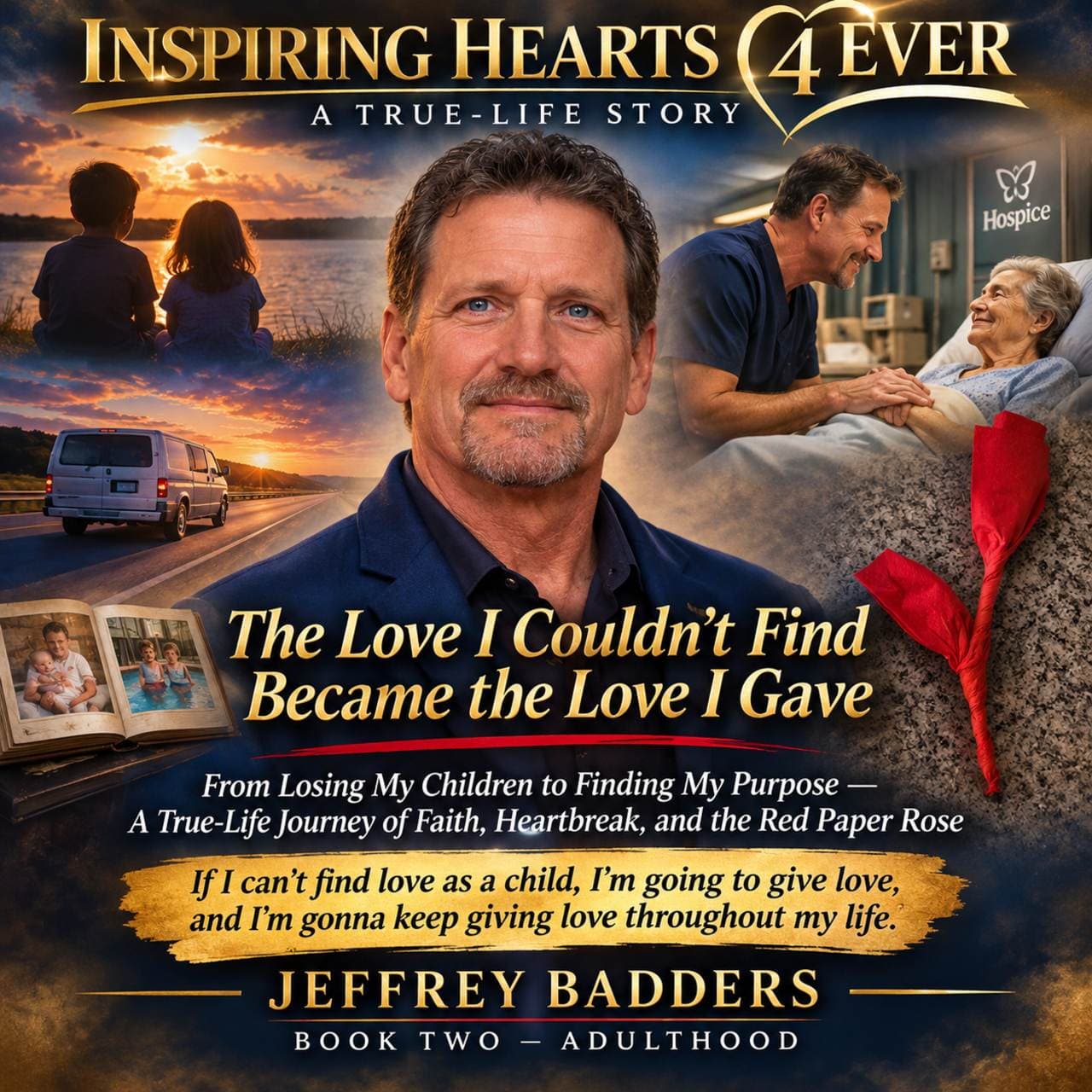
The Love I Couldn't Find Became the Love I Gave
From Losing My Children to Finding My Purpose — A True-Life Journey of Faith, Heartbreak, and the Red Paper Rose
By Jeffrey Badders
Inspiring Hearts 4 Ever — Book Two: Adulthood
---
“If I can't find love as a child, I'm going to give love, and I'm gonna keep giving love throughout my life.”
I didn't know how much those words would eventually mean to me.
As a little boy growing up in foster care, I spent years hoping someone would adopt me. I wanted someone to love me, care for me, and make me feel like I belonged somewhere.
Every new home was like pulling the handle on a slot machine.
You gave everything you had, hoping this time things would turn out differently.
But nobody adopted me.
I grew up knowing what it felt like to be alone. I knew what it felt like to search for light in the darkness. I knew what it felt like to want somebody's arms wrapped around me.
And when I became a man, I thought perhaps I could give my own children the childhood I never had.
But life was about to teach me lessons I never imagined.
The Toolbox I Carried
After my earlier marriage ended, I spent a lot of time questioning my direction.
Was I on the right road?
Was I going to take another detour?
Did I have the right mindset, the right vision, or even the potential to become the man I wanted to be?
I had ideas. I had determination. I had discipline and dedication.
But I didn't know how to put everything together.
One night, lying in bed, I started thinking about the people I had met throughout my life.
I remembered a trucker who had taught me something important.
Think before you react. Don't make decisions with your emotions. Make decisions using the choices and resources you have in life.
Then I remembered Mr. Hauser.
“Your attitude affects my behavior and my behavior affects your attitude.”
I started realizing that I already had a toolbox filled with lessons from people who had crossed my path.
Maybe it was time to start using those tools.
Because life wasn't going to stop while I figured everything out.
The rent was due every day.
And I had to keep moving.
Another Chance at Family
I was still working at Dillons when someone from my past recognized me walking down an aisle.
He was the manager of the Mexican restaurant where I had once worked, back when I lived at that little purple motel.
We talked about life and what had happened since we last saw each other.
Eventually, he invited me over to the restaurant for a meal and a conversation.
I went.
That visit introduced me to members of his Italian family, including a younger sister.
We started talking, getting to know each other, and eventually dating.
She lived in Belleville, Kansas, while I was in Salina. We talked on the telephone and sometimes met halfway.
Eventually, I invited her to move into my little one-bedroom apartment.
And when I say little, I mean little.
You opened the back door, and there was a bed, a refrigerator, and a bathroom.
That was practically everything.
It was attached to a larger house, but it was our place.
Later, we moved to Belleville.
We began building a life together, and eventually we had two children.
Our son, Devin Allen Badders.
And our daughter, Tristan Nicole Badders.
I remember holding those babies against my chest.
I could feel the warmth of their little bodies and their heartbeats as they rested.
There were photographs of me holding them, smiling.
There were memories of the children playing in a little backyard pool, splashing water and jumping up and down.
Those were moments I hadn't experienced in my own childhood.
I wanted to give my children the best life I could.
But I was still learning how to be a father.
And I didn't have parents who had taught me how.
Trying to Build Something From Nothing
I worked hard to support my family.
At one point, I bought a large riding lawn mower and a weed trimmer and started mowing lawns for ten dollars a lawn.
I especially enjoyed helping elderly people, sometimes giving them discounts.
It wasn't a huge business, but I built something of my own.
Then I became interested in nursing.
My girlfriend's mother worked in a nursing home, and she helped me find an opportunity.
The facility offered to pay for my certified nursing assistant training if I agreed to work there for six months.
I accepted.
I eventually worked at Belleville Healthcare Center and a Lutheran nursing home in Belleville.
I worked different shifts, sometimes from two in the afternoon until ten at night, and sometimes overnight.
On weekends, I still had my mowing jobs.
I had a family to support.
But something was missing.
I cared about the patients, yet sometimes the work felt like going from room to room, answering call lights, and completing tasks.
I wanted to know the person behind the room number.
Who were they?
Where had they been?
What had they experienced?
What was their life story?
I wanted to give them my time, love, dignity, and respect.
But I wanted to know them as human beings, too.
I didn't realize how important that desire would eventually become.
The Night My Confidence Disappeared
I decided to explore another possibility.
Emergency medical services.
I enrolled in an EMT course and spent approximately two months attending evening classes, from five until ten.
I was proud of myself.
I had never had a college education, and here I was learning something new.
I passed the written examination.
For a moment, I thought maybe this was my calling.
Then, about a week before I was supposed to complete my clinical examination, something happened at home.
My son Devin had a seizure.
I had just been learning about seizures in class.
But when I saw my own child in that condition, I panicked.
My mind froze.
All those lessons and all that training seemed to disappear.
I called 911.
The fire department came and examined him. I remember being told that he had experienced a grand mal seizure and that overheating might have contributed because we had the heat turned up too high during the winter.
The responders advised us to stay with him that night.
I stayed beside my son with the night lamp on.
Sometimes I looked at him and cried.
I remember looking in the mirror and asking myself:
Why couldn't I have done something for my own son?
I had spent two months studying. I had passed the written examination. I had believed I could become a good EMT.
But when my own child needed help, I panicked.
I felt ashamed.
My emotions were everywhere.
And then my childhood started coming back to me.
I remembered being the little boy who had nobody to rescue him.
Now I was a father, and I felt like I had failed my own child.
I began questioning whether I was even cut out to be a parent.
I had never been taught those lessons growing up.
Maybe I didn't have what it took.
I never completed the EMT clinical examination.
That dream disappeared.
Looking back today, I sometimes wonder whether God had another calling waiting for me.
But I didn't know that then.
The Day My Children Entered Foster Care
Eventually, my relationship began falling apart.
We separated, and I moved into a room in a large house.
I continued working two jobs.
The court ordered me to pay two hundred dollars a month in child support for my two children.
I had rent to pay, child support to pay, and everyday responsibilities.
So I worked.
And worked.
And worked.
I was exhausted much of the time, but I cherished the opportunities to see Devin and Tristan.
At one point, we sat together at a Pizza Hut buffet.
Later, we arranged for the children to spend weekends with me. I had a clean, safe place where they could stay.
But problems were developing in their mother's life.
She had become involved with a boyfriend across the street, and there were problems involving drugs and alcohol.
I began noticing things that concerned me about the children's care, including diaper rash.
Then one weekend, after I picked up the children, I discovered a burn on my daughter's arm.
I learned that her mother's boyfriend had burned her with a cigarette.
I took my daughter to the hospital.
The hospital documented the injury.
I also took a photograph of her burned arm.
Then Child Protective Services became involved.
My children were placed in foster care.
I knew what foster care was like.
I had lived that life.
And now my own children were entering it.
The Courtroom
Eventually, the foster parents caring for Devin and Tristan wanted to adopt them.
I had to go to court.
The night before, I wrote in my journal.
I kept thinking about everything I had lost throughout my life.
What was I losing now?
How much more could I lose?
When I arrived in the courtroom, their mother wasn't there.
I was sitting there with my attorney.
He explained that I would have to sign away my parental rights and that I would no longer have contact with my children.
I broke down.
I knew I hadn't been a perfect parent.
But I had worked hard.
I had tried to provide for my children.
I had wanted them to have a better childhood than I had experienced.
And now I was sitting in a courtroom facing the loss of my own children.
I asked the judge if I could come forward and speak.
He gave me permission.
I told him about my childhood.
I explained that I had grown up in foster care, without parents, moving through different homes, religions, and cultures.
I told him how heartbreaking it was to be losing my children.
And I explained that when I became a father, I had never wanted my children to grow up the way I did.
The judge paused.
He told me he was sorry to hear about what I had experienced.
But he believed it was in the children's best interests to remain with the foster parents who wanted to adopt them.
I signed away my parental rights.
Their mother wasn't sitting there beside me.
I felt alone.
I felt heartbroken.
I felt like a failure.
When I returned home that night, I cried.
I had spent my childhood wishing someone would adopt me.
And now I had lost my own children through adoption.
The Photo Album
When I moved out of the home I had shared with my girlfriend, there was one possession I took that meant more to me than anything else.
The photo album.
She was devastated when she discovered I had taken it.
But I wanted those photographs because they held the memories of my children.
I didn't care about the material things.
I wanted the pictures.
I wanted to remember Devin and Tristan.
There were baby pictures.
Photographs of me holding them against my chest.
That big smile on my face.
Pictures from when they were newborns.
Memories of the backyard pool, the splashing water, and their happiness.
And there was the photograph of my daughter's burned arm.
Sometimes, when I was alone in my room, I would open that album and look through it.
I remembered the warmth of my children resting against me.
And I remembered my own childhood.
I had wanted to give them everything I never received.
But I had learned something painful.
When you start on your own with nothing, it's very hard to build something.
I didn't know what the future would hold.
But I wasn't going to throw away those memories.
I kept the photo album.
And I took it with me into the next chapter of my life.
What eventually happened to that album belongs to another part of my journey.
The White Van and the Unknown Road
After leaving Belleville, I continued working as a CNA and eventually began traveling for medical staffing.
I worked assignments at nursing homes and hospitals throughout Kansas, helping facilities that needed additional staff.
I had a white Chrysler Touring van.
I removed the seats and put a bed inside.
That van became part of my new way of life.
I traveled from assignment to assignment.
And on the nights when sadness returned, I would pull out that photo album.
I would look at the pictures of Devin and Tristan.
Sometimes I thought about the life I had imagined for us.
Sometimes I questioned whether that had been God's plan after all.
But those pictures helped keep the fire inside me burning.
The next morning, I got up.
Discipline.
Determination.
Dedication.
The Three D's.
I knew pain.
I had endured it throughout my childhood, just as people everywhere endure their own painful experiences.
I knew what it felt like to search for light in the darkness.
And I knew I couldn't stop living.
At times, my work took me near Clyde, Kansas, only about ten minutes from where my children were living with their adoptive parents.
I knew the legal restrictions on contacting them while they were minors.
I wasn't going to put them in that situation or risk legal trouble.
It hurt.
It hurt a lot.
But I respected those restrictions.
I never saw my children again.
And I kept moving.
I wasn't praying for God to erase my pain.
I was praying for another opportunity.
Another open door.
A chance to fulfill my life.
I didn't know where that door would lead.
The Door That Changed My Life
Eventually, my journey brought me to Lincoln, Nebraska.
And there, an opportunity opened that would change the direction of my life.
Hospice.
I had already worked in nursing homes, and I knew how to care for patients.
But hospice was different.
In many healthcare settings, you were helping people maintain their health so they could continue living.
In hospice, you were caring for people approaching the end of life.
They and their families were facing something different.
I couldn't walk into that environment with the same mindset.
I wasn't there to rescue someone from death.
I was there to care for them.
To listen.
To show dignity.
To show respect.
To be present.
And suddenly, I began discovering something I had been searching for throughout my life.
Purpose.
Passion.
And eventually, peace within my heart, mind, and soul.
I had spent years wanting to know the people I cared for, not simply answer their call lights.
Now I could listen to their stories.
I could learn about their lives.
I could sit beside them and make them feel valued.
The outside of a person doesn't define who they truly are.
The real person is on the inside.
Some of the people I cared for were physically frail.
But their spirits were beautiful.
And I began to understand that my work was about much more than completing a task.
The Red Paper Rose
Long before I became a hospice aide, I had worked at a Mexican restaurant.
I cooked there and eventually learned to bartend downstairs.
I listened to customers talk about their problems.
Men and women would sit at the bar and share things happening in their lives.
While I listened, I sometimes played around with the napkins.
One day, I figured out how to make a paper rose.
I kept making them.
And years later, when I began working in hospice, that little skill became something special.
My trademark.
I would make a red paper rose out of a napkin and give it to a patient.
I would explain:
“This is my heart, mind and soul. You're just as important as anybody else.”
I wanted them to feel seen.
I wanted them to feel heard.
I wanted them to know their life mattered.
Sometimes they smiled.
Sometimes they showed happiness.
Sometimes they didn't react at all.
And sometimes I would joke with them.
“Whatever you do, do not water it, because I want it to grow.”
It was a little bit of humor during a serious time.
But that rose represented something important to me.
It wasn't about Jeffrey Badders.
It wasn't about being recognized.
It was about making an impact in another person's life.
Over the years, I made a lot of red paper roses.
And I carried another tradition with me.
Whenever I walked away from a patient, I would say:
“If I never see you again, good luck in your journey in life.”
Because I knew there was always a possibility that I wouldn't see that person again.
That was one of the hardest things about hospice.
You got to know people.
You listened to their stories.
You cared about them.
And eventually, you had to say goodbye.
The Lessons People Leave Behind
Throughout my hospice career, patients shared things with me that stayed in my heart.
Some wished they had taken more time to discover who they really were.
Some wished they had pursued their own dreams instead of spending their lives building somebody else's.
Some wished they had taken better care of their health.
Some wished they had forgiven people, including their parents.
Others wished they had simply been themselves instead of trying to become someone different to gain acceptance.
Not every patient shared those thoughts.
But some did.
And I listened.
I learned that when people approach the end of life, the things they remember aren't always the things they accumulated.
Sometimes they remember who forgave them.
Who helped them.
Who showed up.
Who stayed beside them.
And who was there at the end.
I had spent my own life searching for love and acceptance.
And now I was meeting people who were teaching me what mattered most to them.
The Family I Never Expected
Something happened to me through hospice that I never expected.
I found a family.
Not the traditional family I had dreamed about as a little boy.
Not a mother and father who finally came to adopt me.
Not a wife or girlfriend who could fill every empty place in my life.
It was different.
It was the patients and the families I met throughout my career.
People who welcomed me into their lives.
People who respected me.
People who appreciated the care I gave their loved ones.
Over the years, I met thousands of family members and cared for many patients.
They became like brothers, sisters, grandparents, aunts, uncles, and friends to me.
People who had once been complete strangers made me feel accepted.
They showed me that I mattered.
And I gave them what I had always wanted someone to give me.
Love.
Kindness.
Respect.
Dignity.
I had made a decision long ago.
If I couldn't find love as a child, I would give love.
And I would keep giving it.
Through hospice, I found the acceptance and appreciation I had searched for throughout my life.
I felt at home.
I didn't want to stop.
The work became a calling that I carried with pride.
Thirty-six years later, after caring for people across twelve states, I am still a hospice aide.
And I have never forgotten where that journey began.
The Little Boy, the Photo Album, and the Rose
Sometimes I think about that little boy who spent his childhood hoping somebody would take him home.
I think about the young father sitting alone with photographs of Devin and Tristan.
I think about that white van traveling across Kansas.
The nights when I opened the photo album.
The mornings when I got up and kept moving.
And I think about the red paper roses I have handed to people during their final journey.
For years, I wondered what my purpose was.
I wondered whether I had the right tools.
Whether I had the right mindset.
Whether I was traveling the right road.
I didn't know that something I learned while folding a napkin behind a bar would one day become a symbol of the love I gave to others.
I didn't know that the work I was searching for would become the place where I finally felt accepted.
And I didn't know that caring for people who were approaching the end of their lives would help me discover how I wanted to live my own.
I couldn't change my childhood.
I couldn't undo the pain of losing my children.
And I couldn't bring back the years that were gone.
But I could decide what I would do with the life still in front of me.
I could keep giving love.
I could keep showing up.
I could keep treating people with dignity and respect.
And I could keep walking beside them.
If I could sit beside that little boy I once was, I would tell him:
“Sometimes we go through life alone, but always remember, God's there. So when you feel lost and nowhere to go, drop to your knees and ask the Lord to show you the road.”
Because sometimes the road you never imagined traveling becomes the road where you discover your purpose.
And sometimes the family you've spent your whole life searching for is waiting in a place you never thought to look.
I found mine in hospice.
And I found a reason to keep giving love.
But somewhere along that journey, I was still carrying a photo album filled with memories of two children I never stopped remembering.
And that album had another chapter waiting for me.
One I could never have imagined.
---
Author's Note — A True-Life Testimony
This story is based on the real-life experiences, personal memories, and testimony of Jeffrey Badders. It is a nonfiction account of his journey through childhood, adulthood, family loss, and the discovery of his calling in hospice care.
The emotions, experiences, and lessons shared are drawn from Jeffrey's own testimony. AI assistance was used for writing, organization, grammar, and editorial presentation only. AI did not independently witness these events, and no fictional events have been intentionally added to the testimony.
Some dialogue is presented from Jeffrey's recollection rather than from a contemporaneous transcript. His reflections about faith, family, and personal purpose represent his own beliefs and experiences.
Written collaboratively by Jeffrey Badders with AI writing and editorial assistance.
Inspiring Hearts 4 Ever — True-Life Stories.