


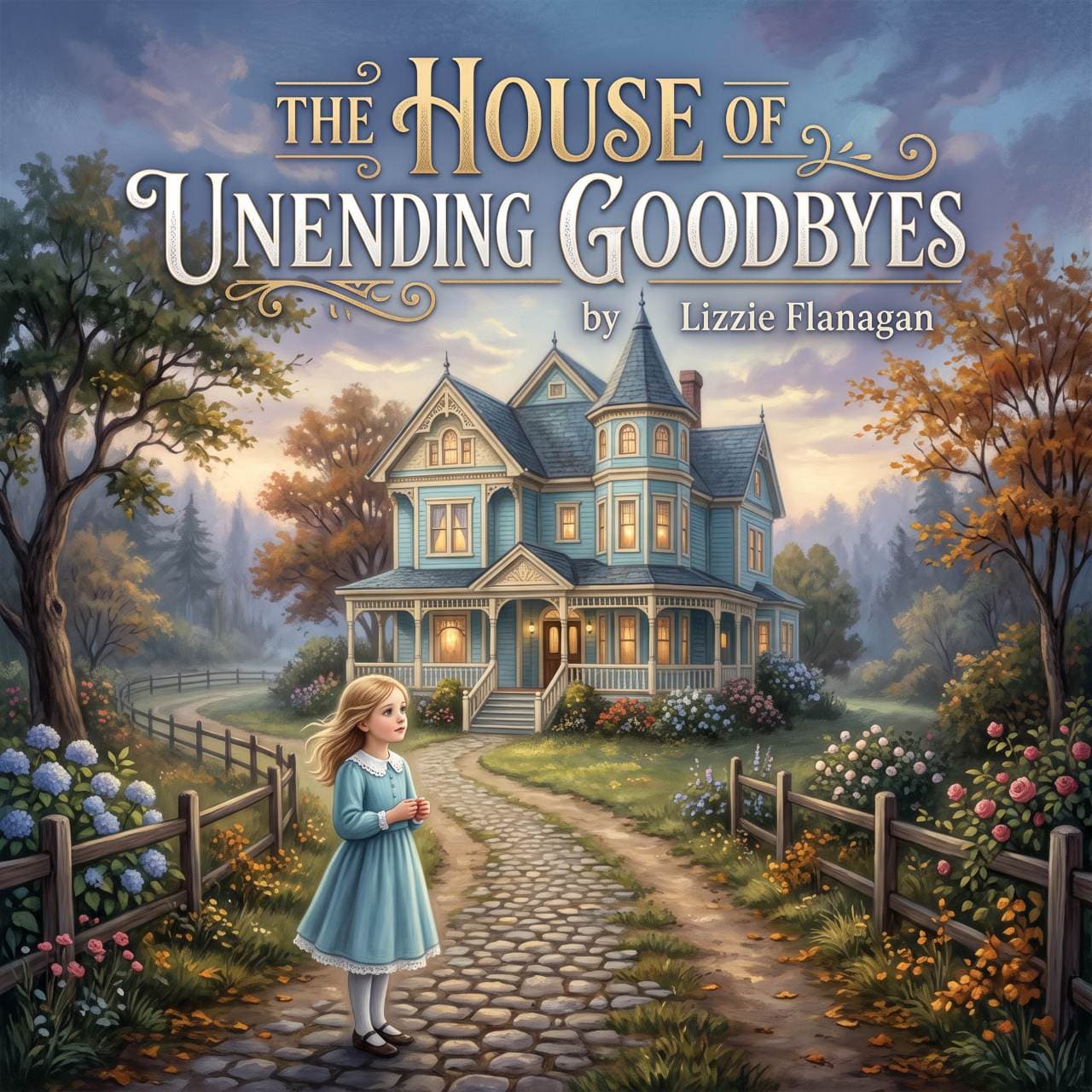

By 1860, the house had grown to accommodate fifteen children. It had sprouted new wings, new towers, new impossible spaces that defied geometry. It sat at the end of the lane, visible only to those who needed to see it, and Irene moved through it like a small god, collecting, comforting, keeping.
But the house was more than just shelter. Irene was learning that. The house was memory made manifest. Every room contained not just the needs of its occupant, but their history, their culture, their faith.
Thomas's room still had the fireplace, the quilts, the window full of butterflies. But it also had the scapular he had worn when he died, now hanging on the wall, blessed and re-blessed by the house's impossible grace. It had a crucifix carved from wood that remembered being a tree. It had a small altar where Thomas could pray, if he chose, though his prayers had changed over the years, becoming less about doctrine and more about conversation with something vast and loving.
Sarah's room had the books, yes, but it also had a Torah scroll that the house had provided, written in perfect Hebrew by no human hand. It had a menorah that burned with light that needed no oil. It had a map of Kaifeng on the wall, and a family tree that Sarah had constructed, tracing her lineage back through centuries of Chinese Jews.
Annabelle's room had become a library, floor-to-ceiling shelves holding every book she had ever wanted to read. She had given up on her letters to her parents—she had accepted that they had gone to the light without her, that she had waited too long—but she had not given up on learning. She studied theology, philosophy, science. She tried to understand what the house was, why it existed, what rules governed it.
And Irene's room... Irene's room was a museum of grief. It contained her mother's hairbrush, still smelling of lavender. Her doll with the porcelain face. Her quilt with the star pattern. But it also contained objects she had collected from the other children: Sarah's first book, Thomas's scapular, Annabelle's abandoned letters. She was building a shrine to loss, to waiting, to the belief that if she held onto enough memories, she could somehow force the universe to give her mother back.
The house allowed this. The house encouraged it. The house fed on memory, on longing, on the desperate need to hold onto what was gone.
But the house also had its own memories. Irene discovered this one day when she wandered into a room she had never seen before, on a floor that shouldn't exist.
The room was empty except for a mirror. But when she looked into the mirror, she didn't see herself. She saw the house as it had been, centuries ago, millennia ago. She saw other children, from other times, wearing clothes she didn't recognize, speaking languages she didn't know.
She saw a Roman boy, dead of fever, waiting for his centurion father. She saw a medieval girl, dead of plague, waiting for her mother who had died beside her but gone somewhere else. She saw children from every era of human history, all waiting, all collected by someone like her, someone who had taken on the burden of being the guardian of the threshold.
The house was old. Older than Christianity, older than Judaism, older than any recorded history. It had existed as long as children had died before their time, as long as love had outlasted death. And it had always had a Collector.
Irene wasn't the first. She wouldn't be the last. She was part of a chain stretching back to the dawn of humanity, a chain of lost children who had chosen—or been chosen—to help other lost children find their way home.
This knowledge should have comforted her. Instead, it terrified her. Because if she was part of a chain, then she was replaceable. And if she was replaceable, then her suffering, her waiting, her desperate hope of reunion—all of it might be meaningless.
She ran from the room. She didn't go back. But she couldn't forget what she had seen.