



The twentieth century brought death on an industrial scale.
In 1918, the influenza came, and it brought children to the house in waves. Irene collected them by the dozen—boys and girls who had died in army camps, in cities, in rural farms, their lungs filling with fluid, their bodies burning with fever.
They came confused, frightened, sometimes angry. They came from every background, every faith, every social class. The flu didn't discriminate. It took the rich and the poor, the faithful and the faithless, the innocent and the not-so-innocent.
Irene organized the house like a hospital, like a school, like a home. She assigned the older children to mentor the younger ones. She created routines—meals that didn't need to be eaten but provided comfort, lessons that didn't need to be learned but gave structure, games that passed the endless time.
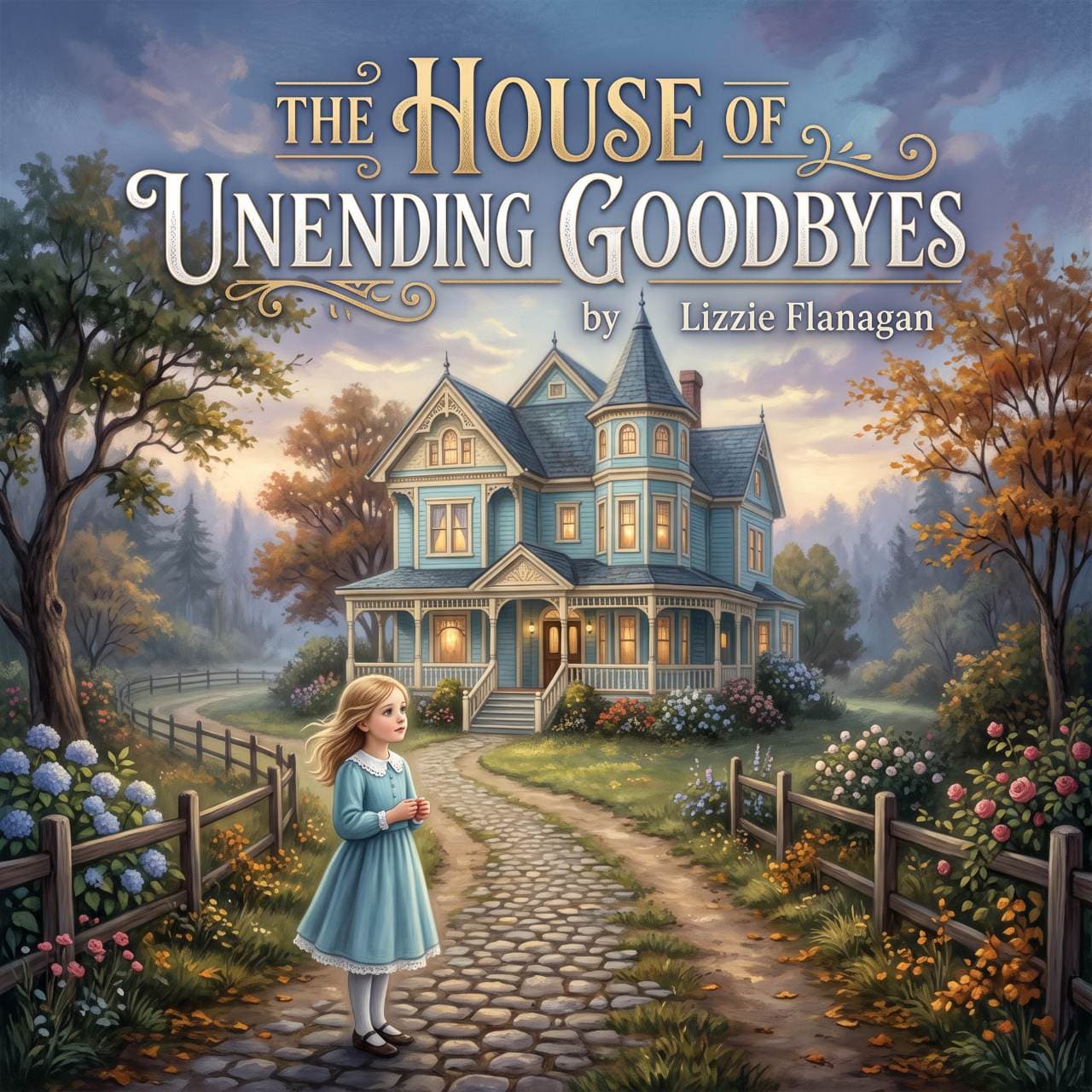
By 1920, there were over a hundred children living in the blue Victorian. The house had grown to accommodate them all—a sprawling mansion that defied physics, with towers and basements and gardens that extended into impossible distances.
And the house was filling with memories. Not just the memories of the children, but the memories of the world they had left behind. There were rooms that contained the trenches of World War I, the suffrage movement, the jazz age that the children would never experience. There were objects that remembered being part of the world: a toy soldier from the Christmas Truce of 1914, a suffragette's sash, a phonograph that played music that had never been recorded.
Irene moved through it all like a small deity, collecting, comforting, keeping. She was still seven in appearance, but she was ancient in experience. She had been waiting seventy-three years. She had collected hundreds of children. She had watched generations of parents arrive, old and gray and broken, had facilitated hundreds of reunions, had sent hundreds of souls into the deeper light.
And still she remained. Still she waited. Still she searched the meadow-windows for a glimpse of her mother, for some sign that Catherine Whitmore had waited for her somewhere, somehow, in the light beyond.
"You're hiding something," Maria told her one day in 1925. Maria had arrived in 1918, one of the flu children, wise beyond her years, perceptive in ways that came from facing death slowly, watching it approach over months of illness.
"What do you mean?" Irene asked.
"From yourself," Maria said. "You're keeping a secret even from yourself. That's why you can't leave. That's why you never fade. You're holding onto something so tightly that it's become part of your soul. Until you let it go, you'll be here forever. The house will keep you forever."
"What secret?" Irene asked, though she felt a coldness in her chest, a recognition.
"I don't know," Maria said. "But I think it has to do with your mother. With why she didn't come here. With why you're so afraid to go to the light without finding her first."
Irene didn't answer. She went to her room—the room she had kept for seventy-eight years, the room with the window seat and the star-quilt and the doll with the porcelain face—and she sat in the dark (though the house had no real dark, only a soft twilight) and she thought about her mother.
Catherine Whitmore had died demented, confused, her mind gone. What if... what if she hadn't recognized the path to the house? What if she had wandered in the gray spaces, lost, unable to find her way? What if she was still out there, waiting for Irene to find her, to collect her, to bring her home?
The thought was terrifying. The thought was paralyzing. If her mother was lost, then Irene could never stop searching. Never stop waiting. Never go to the light herself, because the light might take her away from her mother forever, might separate them for eternity.
But if her mother had gone to the light... if she was safe, whole, waiting there... then Irene's search was futile. Her waiting was pointless. Her entire existence as the Collector was based on a lie she had told herself: that she was helping others, when really she was avoiding her own fate. Avoiding the possibility that her mother had moved on without her. That she had been forgotten.
The realization broke something in Irene. Or perhaps it broke something open.
She went to Annabelle, found her in the tower room where she had been for over eighty years.
"I know why you can't leave," Irene said. "And I know why I can't either."
Annabelle looked up from her writing—she still wrote letters, though she never sent them, hundreds of thousands of words addressed to parents who had long since moved on.
"Tell me," Annabelle said.
"We're not waiting for them to find us," Irene said. "We're waiting for permission to forgive ourselves. We think we died because of something we did wrong. Some mistake we made. Some sin we committed. And we think... we think if we wait long enough, if we help enough other children, if we become good enough, pure enough, then they'll forgive us. Then we can forgive ourselves. Then we can go home."
Annabelle's face crumpled. "I ate bad berries," she whispered. "The day before I got sick. My mother told me not to, she said they would give me a stomachache, but I was hungry and I ate them anyway. And then I got sick, and I died, and I've always thought... I've always believed..."
"It wasn't the berries," Irene said. "It was appendicitis. It would have happened anyway. You didn't cause your own death."
"But I disobeyed," Annabelle sobbed. "I disobeyed and I died and I never got to say I was sorry. I never got to tell her I should have listened. I've been waiting for her to tell me it's okay. To tell me she forgives me. But she won't come. She won't come because she's angry. Because I disobeyed and I died and I ruined everything."
"She's not angry," Irene said, and she knew it was true, she felt it in the deepest part of her being. "She's not angry, Annabelle. She went to the light. She's been waiting for you there. She doesn't need an apology. She just needs you to come home."
"But what if you're wrong?" Annabelle asked.
"What if I'm right?" Irene countered. "What if we've wasted eighty years waiting for forgiveness that was already given? What if the only person who hasn't forgiven us... is us?"
They held each other and cried light-tears, and the house shook around them, and for the first time in nearly a century, Irene felt something shift. Something change. The chains that had bound her began to loosen, not because the waiting was over, but because she finally understood what she had been waiting for.
Not her mother. Not forgiveness. But herself. Her own permission to let go. To move on. To be at peace.