


The corn loves the heat.
Maybe that's why it grew so tall that year.
That year the sun beat down on us like a merciless master, keeping our heads bent beneath the sweltering oppression. Step outside for a moment and the sweat would start running down your back, drying up in the heat of the sun before the trickles could even make their way all the way down.
I drove slow and steady down the road, coasting over potholes while plumes of dust billowed out behind me. Normally I was not such a careful driver - I liked to speed down those roads until the fields on either side of me were nothing but a green and yellow blur - but this day I had delicate cargo in the front seat.
I reached my arm out as I crossed a particularly deep pothole, keeping the casserole dish in place.
Mrs. Orson, who lived on the farm just down the road, was another one of our town's widows. She was a shut-in, rarely leaving the old farm. And so, Father had taken it upon himself to cook for her at least once a week, usually cooking up a large casserole like the one that now occupied my passenger seat. It was our Christian duty, he told me - being the hands and feet and all of that. The bible had said to care for the widows and orphans, and Williford was chock full of widows. Orphans, on the other hand - well, I was the only one of those I could think of. And Father had already fulfilled his calling of caring for me.
I turned off the main road onto the long dirt driveway that led up to Mrs. Orson's house. The pale blue farmhouse sat bleakly at the end of the drive, empty fields stretching out around it on all sides. Why an old woman would want to live in a place like that all by herself was beyond me; even if she did have a teenager bringing her casseroles every week or so.
I climbed out of my truck, then shut the door with my knee while I balanced the heavy casserole dish with both hands.
The sun was blindingly bright. It shone off the white trim on the windows so intensely that I had to nearly shut my eyes against it. Already the sweat was dampening my forehead, beading across my skin. I made my way to the front door, feeling as though I'd walked a mile.
I balanced the casserole in one arm as I rapped on the door. It always took Mrs. Orson a minute or two to reach the door, and the moments ticked by painfully under the blazing sun. Finally I heard the soft tapping of footsteps from within, and a few moments later the door squeaked open.
"Afternoon, Mrs. Orson," I said.
"Oh dear, it's you," she said, swinging the door open wider, "come in out of that sun."
I gratefully obliged, stepping inside the dim coolness of the entryway. She led me through the living room, past the muted noise of the T.V. and the dull whomp, whomp of the ceiling fan, and into the small kitchen. She moved slowly, taking mincing steps and keeping one hand against the wall to help her keep her balance. She had a walker, but I had never once seen her use it.
"I feel bad, you coming all this way in this weather," she said, crossing the kitchen to the cabinets on the far side.
"Oh, it isn't so bad," I said.
"It's hotter than the eyes of hell," she replied with a scoffing noise, "here; let me get you some lemonade."
She moved slowly, taking two glasses from the cabinet and removing a pitcher of lemonade from the fridge. As she poured the drinks with shaky hands, she continued;
"I remember a summer like this, back in sixty-two. One of our cows died - just dropped dead. We almost left that year; that was before the crops started growing again."
I had been raised on the legend of Williford. I could recite in detail the story of how the town, once barren and brown, had miraculously been healed. How old farmer Henke had gone out to his field one morning in late June and spied the first healthy green shoot sprouting from the dead earth. How the town had rejoiced as the fields grew lush and green, as though God himself had breathed the breath of life into the soil, like Adam on the sixth day of creation. Though I had heard it a hundred times, it still struck me when one of the old people would speak of it; it had become such a myth of the town, it was hard to believe there were some who had lived through it.
I sipped my lemonade and looked out the window. The sun glimmered off of the soybean field, the light shimmering across the gently rippling leaves as over the surface of water.
The sight sent a shiver of dread down my spine.
I couldn't explain it; for the past few months I had been visited by this feeling, this dull unease that sat in the pit of my stomach and made my knees go weak. It was the feeling of looking into a darkening sky and seeing the thunderheads piling so high that it looks as though they might devour the earth. It was the sense of something creeping around the corner in a darkened hallway, the fear of dreams that has no reason yet still grips you like an icy hand.
And like a summer storm, the feeling would pass and leave me standing in the sun, wondering what could have frightened me so.
(((0)))
I was late that evening coming home.
I had errands to run in town, and I had taken my time, moving slow beneath the stubborn heat. When I pulled the truck into the drive, the sun had just set, and the cool violet air of twilight was like a breath of heaven. Above heaps of silvered clouds the moon was rising, white as sunlit snow and not quite full. The chorus of frogs and insects rose raucous in the air, drowning out the crunch of my boots across the gravel as I made my way to the front door.
The smell of brewing coffee and the baying of an old hound dog greeted me as I stepped inside. The hound dog was Old Moses - Moe, as we had come to call him - another stray my father had taken in years ago. The coffee was a ritual as expected as the setting of the sun.
"You're back late." Father commented as I stepped into the kitchen, stopping to scratch Moe behind the ears.
"Sorry," I said, "I lost track of time."
He poured himself a cup of coffee and sat down at the kitchen table, his bible and notebook laid out in front of him. I followed suit, the smell of the decaf Folgers comfortingly familiar. I splashed milk in my cup before joining Father at the table.
I watched him in silence for a few moments. His hair had been gray for as long as I had known him, but lately I had noticed how much deeper those lines around his eyes had become. He had always seemed immortal to me, outside of time somehow. Maybe that was why I had never been able to bring myself to call him anything more comfortable than Father - he seemed more important than that, more commanding of esteem.
But lately, I had begun to realize he was as much a man as anyone else. Maybe it was the rash of funerals over the past few years, the loss of so many of our old men that had made our old women into widows. I had no real family outside of Father; the thought of him growing old and dying filled me with a dread that I couldn't quite describe. I realized, as I stared into my coffee, that I hadn't given much thought about what I would do when Father was gone - it was too terrible to think much about.
"Something on your mind, son?"
Father's voice broke me out of my dark musings, and I met his gaze across the table.
"No," I lied, "not really."
He folded his hands in front of him on the table, his gaze unwavering.
"I have a feeling you aren't being quite truthful," he said. I shrugged, tracing the curve of my mug with my thumb. There was no getting out of a conversation if Father deemed it important - that much I knew.
"I've just been thinking about my mother lately," I said, the half-truth coming easy. After all, she had been on my mind; the anniversary of my abandonment was only days away. It had been nearly fourteen years exactly when she had disappeared, leaving me at the mercy of this town.
Father folded his notebook closed and there was a quiet grief in his eyes when he looked up at me.
"I wish I could tell you why she left," he said to me, "but there are some questions we'll never know the answer to this side of heaven. But you know I love you like my own; that's enough, isn't it?"
"Of course it is," I answered with a weak smile.
I patted Moe's head as I finished my coffee.
I didn't like telling lies to Father, even if they were small ones.
(((0)))
It was the next night when I was jolted out of sleep, the strangled cry too distinct for me to believe that I had dreamt it.
Moe had heard it too. From his place at the foot of my bed, he had lifted his head and pricked his ears forward. A low growl rumbled in his throat, a sound I rarely heard coming from the gentle-natured dog. A shaky panic had risen in my chest, and I threw the covers off as I scrambled out of bed.
I headed down the hall, fumbling with the light switch. The door to Father's room was flung open; I ran to the doorway and peered inside, but it was empty.
I made my way downstairs, with Moe at my heels, his head swiveling while he whimpered nervously. At the bottom of the stairs, I froze. The front door had also been flung open, and the sounds of night insects wafted in on the swells of warm summer air. The screen door swung freely, creaking on its hinges.
Moe's ears perked at the smell of the outdoors, and he loped out the open door. I shook myself from my paralysis and followed, though more cautiously.
The humid night air engulfed me as I stepped outside; a slight breeze stirred, and here the insect song was nearly loud enough to drown my dark thoughts.
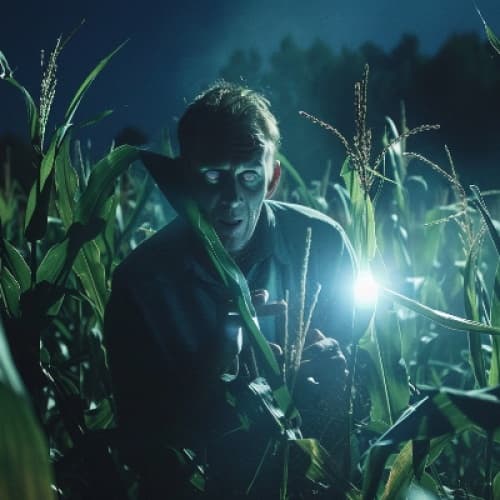
I scanned the driveway as I stepped down off the front steps, searching for any sign of Father. The moon, nearly full now, illuminated the world in its cold white glow. I looked to my right, towards the corn field; and there I saw him.
His back was towards me as he faced the corn. His arms hung limply at his sides, and his head was tilted upwards, as though he were searching for something above the yellow tassels. I called to him, but he didn't answer. A clammy fear crept up my gut as I forced myself to move towards him; I wished I had Moe's comforting presence to steady me, but the dog had disappeared somewhere into the night.
I approached him carefully, my hand outstretched. Just before I reached him, I had the sinking thought that maybe I was in a dream; in my mind's eye, I saw him turning to face me, only instead of my father it would be some hideous dead thing, a skull's face dripping half-decomposed flesh, white teeth grinning through a mask of rank decay.
Still I touched him.
As soon as my fingertips brushed his shoulder, he spun towards me.
No corpse's face greeted me; though that would have been only a few shades less startling. It was my father, but in that moment, I didn't recognize him. His face seemed hollowed out, as though the moonlight had carved canyons into every dip and recess. His eyes shone starkly from their sockets, and in them was the haunted, half-feral expression of a panicked animal. Those eyes fixed on me - and suddenly softened.
"Elias," he said, exhaling sharply, "you surprised me."
I looked in the direction he had been staring towards; but all I saw was the corn, swaying slightly, the moonlight reflecting off of the slick green leaves.
"What are you doing out here?" I asked, "I thought I heard someone screaming."
A shadow seemed to pass over his face.
"It must have been a bad dream," he told me.
"But why - "
"You should go back to bed, Elias."
I had always been an obedient child. Part of it came from my nature, partly from my need to impress, to earn my place in a life that wasn't my birthright. But even had this not been the case, I believe in that moment that I would have had the same reaction, that I would have nodded my head and done as he told me.
I did not question him further.
I didn't take my eyes off him, either.
As I made my way back to the house, calling for Moe, I watched Father in my peripheral.
He didn't move.
He simply stood, as though planted there, as though, like the corn, he had taken root in that damp, moonlit soil.