


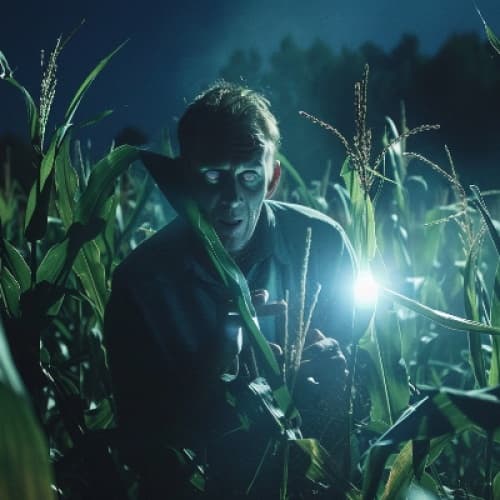

There's a certain kind of horror that can only be found down country roads.
Maybe it's the emptiness.
Those long, seemingly endless highways cutting across miles of uniform landscape, clouds piling up across a vast horizon, climbing tall into a sky that seems bigger - heavier somehow - than it would in a place where hills or buildings broke up the view. The bleakness of driving at night, endless black on all sides of you with only the shrill cries of cicadas to remind you that life exists outside of you, only the cold glow of your dash lights to keep you company as you fly through the featureless dark.
For me, it's always been the corn.
If you've ever stood at the edge of a corn field in late summer, when the slightest wind makes the rows whisper like a thousand murmuring tongues - you might know what I mean. To stand on the edge and look out at the miles of swaying, oscillating green, is like standing on the edge of the sea. Like the sea, it seems to go on forever.
And like the sea, you can never say for certain what it hides.
(((0)))
I sat in my usual spot on Sunday morning, in the front pew, offset a bit to the left. This was the best seat in the church, in my opinion; close to the organ, so I could feel the music swell when Mrs. Hancock began to play the hymns, and when the sun rose higher halfway through the service, the stained glass painted the floor in a dazzling kaleidoscope of colored light. And of course, it gave me a clear view of Father as he preached.
There are some men who are born to be preachers; my father was one of these men.
You would think I would be tired of listening to sermons, being a preacher's kid, and I'll admit sometimes my mind would wander as I sat among the faithful those Sundays. Even so, even after all those years of sitting and listening, there were still days when I found myself caught up in the sermon.
It must have been his fervor; he had a passion and a fierceness about him as he would shout the word from his humble wooden podium, a power that could make the beams of the small chapel shake.
Sometimes I believed he could have called fire from the sky.
And many times, even if the message wasn't new, even if it were something I had heard a dozen times before, I would find myself leaning forward with my gaze rapt on that man, whispering my soft amens as the rest of the congregation shouted.
Today was one of those days.
Father stood tall at the pulpit, holding his red bible in one hand.
"Let me tell you, I know we've got some bad times in this country," he said, his southern Tennessee drawl as thick and sweet as honey, "and I know it's doom and gloom every time you turn that radio on, every time you flip on the television. And I know it's some hard times now, but you know what else I know?"
He waited a beat, setting the thick bible down on the podium with a dull thump and gripping the sides of the stand with both hands.
"What I know," he continued, "is that God has got this. You think He can't handle a country in ruin? He's been dealing with ruined countries for the past two thousand years. You think he can't handle our struggle, our poverty? How many hungry did Jesus feed with those loaves and those fishes?"
A soft murmur rumbled through the congregation and a few hands clapped.
"And if you need another miracle to prove that the Lord provides, then look no further than this town, amen?"
The amens were repeated, with scattered whoops and hollers as more hands joined in the clapping. Now my father raised his arms, his voice rising as well.
"When this town was on its knees, when the corn wouldn't grow and the wells had run dry, God did not forsake us. And when we called out to him, did he answer?"
The congregation whooped with an exuberant 'yes'.
"Now they say the corn grows itself in Williford, amen?"
I found myself clapping now as the energy continued to swell.
"Did He not say that He would feed us like the birds and clothe us like the flowers of the field? And does He not keep His promises?"
More clapping, more amens, more energy rising like thermal columns pushing clouds into the sky.
The congregation stood, and I rose with them.
(((0)))
On the front steps of the chapel, the sun beat down in all its fury, making me sweat through my gray suit jacket. The old people lingered, standing in the doorway and under the shade trees. Kids, freed from the confines of the pews, ran in frenetic circles and shrieked with delight in whatever game they were playing. I felt a hand on my arm, and turned to see Mrs. Bennet standing beside me. Gray and recently widowed, she was one who had been here since before the shade tree that we stood beside had been planted.
"Your father gave a wonderful sermon today, didn't he?" She said.
"He always does," I replied. She gave my arm a nudge.
"One day it will be you up there, Elias," she told me, "that's what I think."
"Oh…I don't know about that."
"I can see it," she insisted, in the knowing way of old women, "there's a light inside you; don't keep it hidden."
She smiled up at me, but suddenly her expression changed as something caught her eye.
"Caleb James!" she called across me, "You get out of that corn right now, you hear?"
I turned and followed her gaze to the corn field which stood to our right, just on the edge of the church property. Eight-year-old Caleb had tucked himself between the corn rows and was giggling with his friends as he peeked at them from between the green leaves. His laughter stopped at the sound of Mrs. Bennet's sharp command, and I saw his face blanch as she began stomping towards him.
"You get out of that field right now," she told him, as he scrambled to free himself from the tightly growing stalks, "you get lost in there, you won't ever find your way out. Just ask Elias."
I shuddered at the memory.
I had been the boy's age - eight or nine - playing a similar, silly game with my friends.
Only I had gone much deeper.
I remembered the moment I had realized that I was lost. How I had walked a few feet in one direction, confident that I was near the exit - only to find that I had plunged deeper into that sea of corn.
It had been late summer, the stalks reaching far above my head. I had called out, but no one had heard me; the only answer I received was the rustle of the stalks, the sound of a hundred thousand voices whispering in a language I didn't know.
I had pressed onward.
Corn is sharp - many people don't know that. But as I continued onward, running blindly through the rows, the edges of the leaves left small cuts all up and down my arms. Every time I thought I saw a break in the field, and thought that I must have reached the end, I was met with more rows and rows of corn.
It was hours later, in the cool of twilight, when they finally found me.
"Isn't that right, Elias?" I heard Mrs. Bennet say, jolting me out of my memories.
"Sorry?"
"Isn't that right? It's dangerous in the corn."
"Yeah…yes, it is. You need to stay out of there, Caleb."
I heard shoes on the pavement behind me, and knew they were Father's. Even his footsteps were comforting in their confidence, sure and direct and commanding respect.
"Are we ready to go, son?" He asked, laying a hand on my shoulder.
"We were just warning these kids not to get themselves lost in the cornfield," Mrs. Bennet explained with a laugh, but Father didn't laugh with her. His eyes scanned the field, the lines of his forehead deepening as he squinted against the bright sun. It was as though he were searching for something. The muscles of his jaw twitched, like he was holding back words he couldn't say. But he swallowed them down and turned back to me.
"Let's get home, Elias," he said.
I followed him to the car, but I couldn't shake the strange feeling that had come over me as I had watched him looking out over the field. Father hadn't said a word, but I could feel that something was wrong. There was something on the horizon, creeping closer like the ripples of the breeze across the cornfield. Something dark was coming.
I just didn't know it yet.