



Faceless Confessions, Voices Beyond the Grave
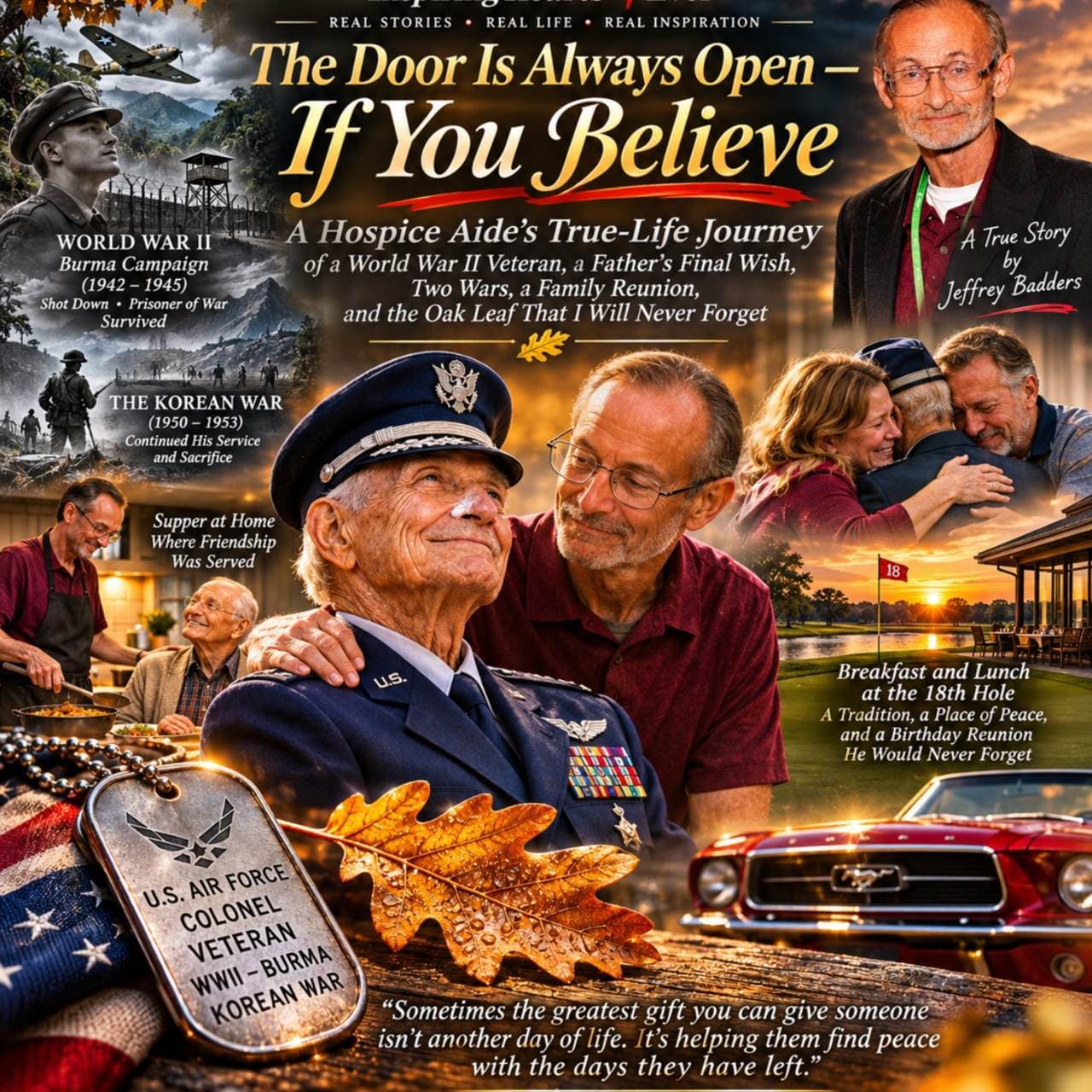
The Door Is Always Open — If You Believe
A True-Life Testimony by Jeffrey Badders
“Sometimes the greatest gift you can give someone isn't another day of life. It's helping them find peace with the days they have left.”
I have spent many years working as a hospice aide, and throughout those years, I have met people from all different walks of life.
Some were wealthy. Some had very little.
Some had families surrounding them, while others faced their final journey with very few people by their side.
But there is something I have learned.
When someone reaches the final chapter of their life, the things that once seemed so important can begin to lose their meaning.
The money.
The possessions.
The accomplishments.
The titles.
Sometimes, what matters most is something that cannot be purchased.
Love.
Forgiveness.
A familiar hand.
And knowing that someone is there when you need them most.
In 2008, while working full-time as a hospice aide for Hospice of the Valley in North Scottsdale, Arizona, I met a man who would teach me something about all of those things.
For this story, I will call him John.
I only knew him for approximately one month.
But that one month gave me memories I will carry for the rest of my life.
And it all began with a newspaper advertisement.
A Man Who Needed Someone
At that time in my life, I was lonely.
I had my work, my little apartment, and my faith in God.
I didn't have everything I had once dreamed of having.
But I had discovered something about myself.
When I was helping someone else, I felt a sense of purpose. I felt appreciated. I felt like my life had value.
Maybe part of that came from my childhood.
I had spent much of my childhood searching for love, kindness, and acceptance.
As an adult, I discovered that sometimes the very things you spend your life searching for are the things you can offer another human being.
So even though I already worked full-time, I would sometimes take private assignments on the weekends.
One day, I came across an advertisement in the newspaper.
That advertisement eventually brought me to John's home.
John lived in a beautiful place in North Scottsdale, overlooking the 18th hole of a golf course.
He had accomplished a great deal during his lifetime.
He had served in two wars, traveled the world, and retired as an Air Force colonel.
But when I met him, what stood out to me wasn't his military rank or the beautiful home.
It was his personality.
John was humble.
He was sincere.
He could be happy one moment and emotional the next.
But in the time I knew him, I never remember him being angry.
He appreciated the little things people did for him.
And he made me feel welcome.
We began spending Saturdays together.
Sometimes we watched college football.
Sometimes we talked about his life.
And sometimes, simply being there together was enough.
Breakfast at the 18th Hole
John had a tradition that he loved.
Breakfast at the country club overlooking the 18th hole.
He had been going there for many years.
He told me he had followed that Saturday routine for perhaps twenty or thirty years.
People knew him there.
They respected him.
He had his familiar place to sit, and when he came in, people treated him kindly.
His breakfast was simple.
Eggs over easy.
Two strips of bacon.
Toast.
And coffee.
Sometimes we went there for lunch, too.
The country club was where John enjoyed his breakfast and lunch.
It was a place where he felt comfortable.
A place where he had spent many mornings looking out at the golf course near his home.
I didn't know it then, but that familiar place would eventually become the setting for one of the most emotional experiences of my hospice career.
At first, though, we were simply two people spending time together.
John had lived a long life.
I was younger, and I knew I could never completely understand everything he had experienced.
But I could listen.
And listening was something I believed he needed.
Supper at John's Home
But supper was different.
Supper was at John's home.
That was when I did the cooking.
John would sometimes joke that he didn't know how to cook, but if I knew how to cook, he would eat it.
And John liked his food.
Sometimes I prepared chicken-fried steak with mashed potatoes and gravy.
Other times, I cooked chicken, fresh green beans, and vegetables.
Those evenings at his home gave us time to sit together, enjoy a meal, and talk about his life.
I remember something John told me that touched my heart.
“Jeffrey, since you're cooking, you will always have a place at my table.”
Those words meant more to me than John probably realized.
Because when I was a child, there were times when I was hungry.
And I wasn't invited to what I call the table of love.
There were times when I needed someone to care, and that care wasn't there.
Now here was this elderly man telling me I would always have a place at his table.
He was giving me something I had spent years searching for.
A feeling of belonging.
He wasn't just offering me a place to eat.
He was making me feel welcome.
And I wanted him to feel that same kindness from me.
The Book of His Life
One Saturday, John brought out a family photo album.
To me, that album was more than a collection of pictures.
It was his book of life.
Every photograph represented a moment that could never be lived again.
He showed me pictures from his childhood.
He talked about his parents.
He told me about the home where he grew up, near railroad tracks.
And he remembered an old oak tree outside the house.
That oak tree became one of the most meaningful parts of our conversations.
John told me his father was a religious man.
He remembered seeing his father kneeling in prayer beneath that tree.
Eventually, his father brought John there, too.
Father and son knelt together.
They prayed.
And John remembered that when he felt sad or alone, he could return to that place and pray.
There was something about that memory that touched me deeply.
Because when I was a little boy, I had my own place of comfort.
It wasn't an oak tree.
It was an imaginary campfire with God.
During some of the darkest moments of my childhood, I imagined sitting by that campfire, where I could feel protected, loved, and less alone.
John and I had lived completely different lives.
But listening to him describe that oak tree reminded me of the comfort I had searched for as a child.
John once told me that during difficult times, he carried that oak tree inside him.
He described it as armor in his mind.
Something that felt like stone.
He talked about facing battles and believing that his enemy could not break that stone.
I didn't always understand exactly what he meant.
And I didn't pretend that I did.
He was an elderly man remembering experiences from a lifetime I had never lived.
My responsibility wasn't to interpret every memory for him.
It was to give him the freedom to share it.
Two Wars, Many Medals, and the Price He Paid
As we continued looking through the album, John began talking about his military career.
He had joined the military when he was young.
Over the years, he traveled around the world, served for more than thirty-five years, and eventually retired as a colonel in the United States Air Force.
John told me he had served during two major conflicts.
The first was World War II, including the Burma Campaign, which took place between 1942 and 1945.
The second was the Korean War, which took place between 1950 and 1953.
During World War II, John told me, he had been shot down while serving in the Burma Campaign and became a prisoner of war.
He had also survived being shot down on another occasion during his military service.
These were experiences that had stayed with him throughout his life.
There were times when those memories overwhelmed him.
I remember one occasion when he became so emotional that he couldn't continue.
He apologized and told me there would be other days to share more of his life.
So we closed the album.
I didn't push him.
I didn't ask him to relive something he wasn't ready to talk about.
We simply left those memories where they were for the moment.
Later, John chose to open the album again.
He had many military medals and decorations.
He was proud of his service, but he told me something that has stayed with me.
Those medals were symbols.
They represented what he had accomplished.
But as he approached the end of his life, they weren't what mattered most to him.
What mattered most was something he couldn't find among those medals.
His family.
John had a son and a daughter.
He had spent so much of his life devoted to his military career that his relationships with his children had suffered.
He talked about the decisions he had made.
The opportunities he had missed.
The times he had chosen duty, assignments, and advancement instead of being present with his family.
He had believed he was building a future and a legacy for them.
But now, near the end of his life, he could see what those choices had cost.
I remember him acknowledging the defeat and failure he felt about how he had treated his family.
Here was a man who had survived the dangers of World War II.
A man who had been shot down and held as a prisoner of war in Burma.
A man who had also served during the Korean War.
A man whose military career had brought him recognition, medals, and the rank of colonel.
Yet, near the end of his life, he was carrying a different kind of battle inside his heart.
The regret of losing precious time with his children.
He wanted another chance.
He wanted to see his son and daughter again.
And he wasn't sure that would ever happen.
The Postcard
Inside that family photo album was a postcard.
His daughter had sent it approximately ten years earlier.
It contained an address.
John had kept it all those years.
He told me that he had wanted to reconnect, but he felt ashamed.
He didn't know how to begin.
And as time passed, the distance between them remained.
I looked at that postcard and thought about what it represented.
Ten years.
Ten years of separation.
Ten years of missed conversations.
Ten years in which a father and his children had continued living their lives without being together.
John told me that seeing his children again would be his dying wish.
I didn't promise him I could make that happen.
I couldn't.
I didn't know his children.
I didn't know what they had experienced.
I didn't know whether they would want to see him.
But I believed something.
Sometimes in life, a door remains closed because nobody has reached for the handle.
And sometimes, even when you don't know what will happen, you have to find the courage to try.
I told John that the door could remain open.
There was still a possibility.
And somewhere inside my heart, I began asking myself a question.
What could I do?
How could I help this man find the closure he wanted?
And how could I do it before time ran out?
A Letter Written With Hope
Approximately two weeks before John passed away, he was resting in his bedroom.
The family album was in the living room.
I went to the album and found that postcard.
I made a decision.
I wasn't going to tell John what I was planning.
I didn't want to give him a promise that might never become reality.
I wanted to try.
And see what happened.
I had a habit of writing in my journal and spending time in prayer.
During this experience, I prayed that somehow his children might respond.
Then I wrote a letter to the address on the postcard.
I introduced myself.
I explained that I was helping their father during the final part of his life.
I told them he had a wish.
He wanted to see his children one more time.
But I was careful about something.
I wasn't going to judge them.
I hadn't lived their childhood.
I didn't know what it had been like to grow up with a father who was often away.
I couldn't tell them how to feel about the decisions he had made.
And I wasn't going to demand that they forgive him.
All I could do was explain what I had witnessed.
Their father was getting older.
His health was declining.
He regretted the time he had lost with them.
And he wanted to see them before he died.
I asked whether they might consider traveling from the East Coast to Arizona.
I offered to meet them at the airport.
I gave them my contact information.
I explained that John had kept the postcard in his album for ten years.
It was one of the things he still had connecting him to his children.
I told them that their father had a birthday coming up.
I wanted to celebrate it with him at the country club where he had spent so many Saturday mornings.
And I hoped they might consider being part of that celebration.
I wasn't asking them to forget the past.
I was asking whether there might be room for one more moment together.
I sent the letter.
And then I waited.
I kept reminding myself that the door was open.
There was a possibility.
But I didn't know whether anyone would walk through it.
John Wasn't Ready to Give Up
During that time, John's health continued to decline.
He became weaker.
Eating became more difficult.
But John didn't want to give up.
He would sometimes joke about all the things he had survived.
Being shot down.
Being shot.
A car accident.
And other dangerous experiences during his lifetime.
Somehow, he had made it through them.
He talked about having multiple lives.
And even now, when his body was becoming weaker, he wanted to keep fighting.
John decided to pursue a feeding tube.
He spoke with his doctor, and the procedure was approved.
He asked me a question.
“Jeffrey, will you go to the hospital with me?”
He wanted me there when they placed the feeding tube through his nose.
I told him yes.
I would be there.
At the time, I was still working full-time for Hospice of the Valley.
I explained that I had an emergency in my personal life and needed a day off.
They gave me the day.
And I went to the hospital to be with John.
I held his hand.
I wanted him to know he wasn't facing that experience alone.
The feeding tube helped for a while.
But eventually, his condition continued to worsen.
I could see that the time we had together was becoming shorter.
And I still didn't know whether his children would come.
The Phone Call
Then one evening, around eight o'clock, I received a telephone call.
It was John's daughter.
She thanked me for what I had done for her father.
She thanked me for writing the letter.
And then she told me something I had hoped and prayed to hear.
They were coming.
They were going to be there for his birthday.
And they wanted to be there for him at the end.
I became emotional.
I cried.
I thought about my own childhood.
There had been times when I needed love and didn't receive it.
Times when I wanted someone to show up for me.
Times when I wanted to feel important to another human being.
And somewhere along my journey, I had made a decision.
If I couldn't find the love I was searching for, I would give love to people who didn't feel loved in this world.
Now, here I was.
A man who had spent much of his life searching for belonging was helping an elderly father reconnect with his children.
I couldn't change John's past.
I couldn't give him back the years he had missed.
But perhaps I could help him experience something beautiful with the time he had left.
Preparing the Birthday Surprise
I had already spoken with people at the country club about arranging something special for John's birthday.
They knew him.
They knew his familiar table.
And they understood that his health was declining.
I made arrangements for the celebration.
I planned to gather supplies on Friday and have things ready when I returned on Saturday.
His children traveled to Arizona the night before.
John didn't know what I had arranged.
By then, he was very fragile.
He was using a wheelchair.
He still had the feeding tube through his nose.
But he wanted to return to the place he loved.
The country club.
The 18th hole.
The view he had enjoyed for so many years.
He might not be able to eat his usual breakfast.
But he wanted to see that beautiful place again.
And I wanted him to have that experience.
The Birthday He Would Never Forget
It was Saturday morning.
Approximately ten o'clock.
I brought John to the country club in his wheelchair.
We went to his familiar place near the large doors overlooking the 18th hole.
He could look out toward the golf course, where he had spent so many mornings during his retirement.
I remember thinking about birthdays from my own life.
As a child, I once invited people to a birthday celebration, and nobody came.
But I also remembered a birthday celebration that senior citizens had given me in Concordia, Kansas.
They had made me feel appreciated.
They had made me feel that I mattered.
Those memories were with me as I prepared to celebrate John's birthday.
His son and daughter were waiting behind the large wooden doors.
John didn't know they were there.
I stepped away to speak with them.
I wanted them to understand how important this moment could be.
I asked them to be present with their father and show him love during the time they had together.
Then I returned to John.
He was looking out at the golf course.
I told him it was another beautiful day.
He agreed.
But he also spoke about the reality that someday he wouldn't wake up again.
I reminded him that he had awakened that morning.
He had another day.
Another opportunity to enjoy a moment of life.
I reminded him of his usual breakfast.
Eggs over easy.
Two strips of bacon.
Toast.
All those Saturday mornings he had enjoyed.
I wanted him to appreciate the day we had in front of us.
John reached for my hand.
He told me he was glad I was there celebrating his birthday with him.
He appreciated the compassion I had shown him.
And when I was with him, he didn't feel alone.
Those words meant so much to me.
Because John had also helped me feel less alone.
Then I told him that I believed this birthday was going to be one of the best he had ever experienced.
I walked toward those large wooden doors.
And I opened them.
John was still facing the golf course.
I turned his wheelchair around.
And there, standing in the doorway, were his son and daughter.
The children he had wanted to see.
The children he had been separated from for so many years.
The children whose postcard he had kept in his family album.
They had come.
I remember the emotion of that moment.
John cried.
His family was there.
And the wish he had believed might never become reality was happening right in front of him.
I had written a letter to people I didn't know.
I had no guarantee they would respond.
I couldn't control their decision.
But they had chosen to come.
And now this father had the opportunity to be with his children again.
I will never forget that birthday.
The Final Days
After the reunion, John's children spent time with him.
They helped care for him.
Their presence also gave me opportunities to return to my own apartment and take care of things in my life.
By then, being with John was emotionally difficult.
Not because I didn't want to be there.
But because I cared about him.
I could see what he was going through.
I could see that he was getting weaker.
And I knew there were things I couldn't change.
As a hospice aide, I had spent years accompanying people during the final chapter of their lives.
But knowing what death looks like doesn't mean you stop feeling the sadness of losing someone.
John had become my friend.
I had told him that we were going to walk through this journey together.
And I meant it.
Approximately a week before he passed away, we opened the photo album again.
This time, his family was there.
His son.
His daughter.
They looked at the photographs together.
John showed them pictures from their lives.
There were smiles.
There were tears.
And there were moments that I could only stand back and appreciate.
I thought about the letter.
I thought about the postcard.
I thought about the uncertainty I had felt when I mailed it.
And I thanked God that I had found the courage to try.
At one point, John asked his son and daughter to step outside.
He wanted to speak with me.
We looked through the album.
And he told me something I will always remember.
“Jeffrey, someday when I'm gone, I want you to remember something.”
I asked him what it was.
He told me that if I ever saw an oak leaf, I should remember him.
He wanted me to remember that he would be there for me through the storms.
The oak tree.
The same tree he had talked about from his childhood.
The tree where his father prayed.
The tree where father and son knelt together.
The tree he had carried in his mind during difficult times.
Now he was giving that memory to me.
An oak leaf.
Something so simple.
But something that would forever remind me of my friend.
Saying Goodbye
Not long afterward, John passed away.
His family had been able to spend time with him during his final days.
And I was grateful that he had received the opportunity to see his children again.
I couldn't change the fact that his life had come to an end.
But I could look back and know that I had tried to help him fulfill something that mattered deeply to him.
Then came the funeral.
I remember driving my red Mustang convertible.
It was my third Mustang convertible.
At that time, that car was one of the few significant possessions I had.
I had never owned the home I had dreamed about.
Throughout my hospice career, I had traveled and lived in different places, sometimes renting a room in someone else's home.
My car had been part of that journey.
And now it was taking me to say goodbye to John.
Before going into the church, I sat in my car and prayed.
I thought about everything that had happened.
The newspaper advertisement.
The Saturdays.
The meals.
The album.
The oak tree.
The letter.
The birthday.
The reunion.
And the friend I was about to say goodbye to.
Then I went inside.
I chose a seat toward the back of the church.
I wanted to show respect to John's family.
I had only known him for a short time.
They were his children and grandchildren.
I believed those places near the front belonged to them.
But John's daughter came over to me.
She wanted to know why I was sitting so far back.
I explained that I wasn't family and wanted to give them the respect they deserved.
She told me something that touched my heart.
I was family now.
She invited me to sit with them.
So I walked down the aisle.
And I sat with John's family.
His son.
His daughter.
His grandchildren.
And me.
For someone who had spent much of his childhood longing to feel loved and accepted, that moment meant more than I could easily explain.
I had entered John's life as someone helping him on Saturdays.
Now his family was inviting me to sit beside them as they said goodbye.
John received military honors at his funeral.
I thought about the man I had come to know.
The retired Air Force colonel.
The veteran of World War II and the Korean War.
The prisoner of war in Burma.
The father.
The man who loved his breakfast at the 18th hole.
The man who had carried an oak tree in his heart.
And the man who had given me a place at his table.
The Dog Tags
After the funeral, as I was preparing to leave, John's daughter approached me.
She said her father had wanted me to have something.
At first, I told her that wasn't necessary.
I had done what I believed was right.
And John had already given me something valuable.
He had given me friendship.
Comfort.
A sense of belonging.
He had helped me through lonely moments.
He had made me feel appreciated.
But she insisted.
She had something her father wanted me to receive.
His military dog tags.
I accepted them.
And I placed them around my neck.
I hugged his daughter.
She was crying.
Before leaving, I also shook his son's hand.
I told him that I couldn't speak for everything his father had been during the years they were apart.
I hadn't lived those years.
But I could tell him about the man I had known at the end.
John had been a strong man.
A humble man.
A man who appreciated kindness.
And a man who wanted to reconnect with the people he loved.
I walked toward the door wearing his dog tags.
Tears were running down my face.
I was saying goodbye to someone who had become very important to me in such a short time.
And then something happened.
The Oak Leaf at My Car Door
I left the chapel and walked toward my red Mustang convertible.
I was wearing John's military dog tags around my neck.
I was crying.
And when I reached my car door, I saw an oak leaf.
Right there.
At my car door.
There was a large oak tree at the church where John's funeral had taken place.
And I remembered what John had told me.
“If you ever see an oak leaf, remember me.”
I stood there with his dog tags around my neck.
And there was that leaf.
To me, it was a sign.
A reminder of my friend.
A reminder of his father kneeling beneath an oak tree.
A reminder of the faith John had carried through the battles of his life.
And a reminder that the time we spend with another human being can leave something behind that lasts long after they are gone.
I will never forget that moment.
I will never forget John.
And I will never forget what that one month taught me.
The Door Is Always Open
When I look back on John's story, I think about all the things that could have happened differently.
I could have passed over that newspaper advertisement.
I could have decided not to work Saturdays.
I could have listened to his stories without ever asking about his children.
I could have seen that postcard and done nothing.
I could have told myself it wasn't my place to get involved.
I could have been afraid of rejection.
Afraid of making a mistake.
Afraid of reaching out to people I had never met.
But I kept thinking about the door.
A door that had been closed for years.
A father who wanted another chance.
Children who had their own experiences and their own reasons for being apart.
I couldn't force that door open.
And I had no right to demand that anyone walk through it.
But I could offer an opportunity.
I could write a letter.
I could tell the truth about what John wanted.
And I could leave the decision in his children's hands.
They chose to come.
And because they came, John experienced something he had feared might never happen.
He saw his children again.
He celebrated his birthday with them.
He opened his book of life with his family beside him.
And before his life ended, he had the opportunity to share moments that years of separation had taken away.
I think about my own childhood, too.
The little boy who was hungry.
The little boy who wanted to be invited to the table of love.
The little boy who searched for comfort in an imaginary campfire with God.
That little boy eventually grew into a man who spent his life helping people during some of their most vulnerable moments.
And one day, that man met John.
A retired colonel.
A veteran of two wars.
A father.
A friend.
John told me I would always have a place at his table.
And I helped him find his way back to a table where his family could sit together again.
I didn't give John more years.
I didn't erase his regrets.
I didn't change the decisions he had made.
But I was able to help him find an opportunity for closure.
And in doing that, he gave me something I needed, too.
A reminder that I mattered.
A reminder that my presence had value.
And a reminder that sometimes the greatest moments in life happen when we stop thinking only about ourselves and make room for someone else's story.
We all have a book of life.
Every day, another page is written.
Some pages are filled with happiness.
Others carry sadness, regret, loneliness, and pain.
We cannot go back and rewrite every chapter.
But while we're still alive, we may have an opportunity to write something different on the next page.
Maybe it's a letter.
Maybe it's an apology.
Maybe it's an invitation.
Maybe it's simply holding someone's hand and letting them know they aren't alone.
And sometimes, it begins with having the courage to leave a door open.
Because if you close that door forever, you may never discover what could have happened if you had tried.
John taught me that.
And whenever I see an oak leaf, I remember.
The door is always open — if you believe.
---
Don't fake it until you make it. Faith it until you make it.
Author’s Note — A True-Life Testimony
Written collaboratively by Jeffrey Badders with AI writing and editorial assistance.
This story is based on Jeffrey Badders' personal memories and real-life experiences as a hospice aide. The patient's name has been changed to protect his identity and dignity. The narrative has been organized and edited with AI assistance for readability, clarity, and storytelling flow. It is presented as nonfiction testimony, not as a fictional account. Recalled conversations reflect the author's memories and should not be understood as verbatim recordings.
The foundation is built through discipline. The legacy is created through action.
The darkness of my past helped build the foundation of who I became. The actions I choose to take bring that legacy into the light.