


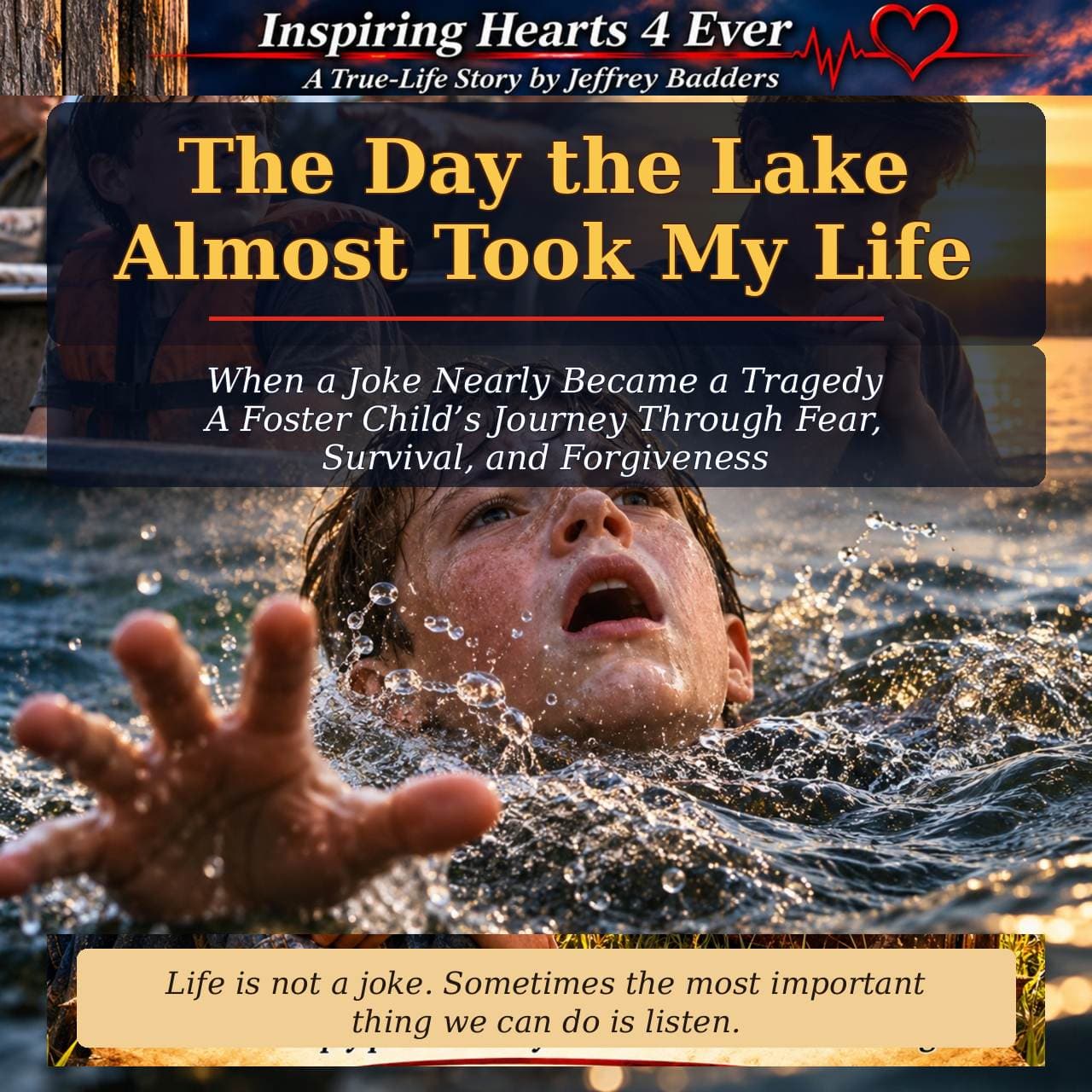
THE DAY THE LAKE ALMOST TOOK MY LIFE
Subtitle: When a Joke Nearly Became a Tragedy — A Foster Child's Journey Through Fear, Survival, and Forgiveness
The Darkness Didn't Win — A True-Life Childhood Testimony
Complete Story
Life is not a joke.
I want you to remember those words as you read this story.
Sometimes people do things without thinking about the consequences. They assume that because something is easy for them, it must be easy for everybody else.
Sometimes they call something a joke without realizing how dangerous that joke can become.
And sometimes, by the time they understand what they've done, it is almost too late.
I was around eleven or twelve years old when something happened to me that I would remember for decades.
I was living with another foster family. They enjoyed outdoor activities, including hunting, fishing, and boating.
One day, we were out on a lake.
I remember sitting in the boat. Someone was already in the water.
Then I was told that I was going to learn how to swim.
There was just one problem.
I didn't know how to swim.
I had never taken swimming lessons.
I didn't know how to keep myself afloat.
I couldn't even doggy paddle.
So I told them.
I told them I couldn't swim.
But instead of listening, they told me that this was how I was going to learn.
I was scared.
I didn't want to be thrown into that water.
They thought they were joking around. They seemed to believe that throwing me into the lake would somehow teach me to swim.
But I was the child sitting in that boat.
And I knew something they weren't taking seriously.
I couldn't swim.
That wasn't an excuse. It wasn't an exaggeration. It was the truth.
And the truth should have been enough.
The Moment Everything Changed
Everything happened so fast.
One moment, I was sitting in the boat.
The next moment, they threw me into the lake.
I didn't start swimming.
I didn't suddenly figure out how to move my arms and legs.
I didn't know what to do.
I went straight down.
That's what I remember.
I sank toward the bottom of that lake.
I don't know exactly how deep the water was. It might have been around fifteen feet, but I cannot honestly say for certain.
And I don't remember everything that happened when I was down there.
I won't pretend that I do.
But I remember believing I was going to die.
Think about that.
An eleven- or twelve-year-old boy who had never learned to swim was suddenly sinking in a lake because somebody decided that throwing him into the water was a good way to teach him.
That little boy was me.
I had already told them I couldn't swim.
I had already told them I was afraid.
But my words hadn't stopped them.
I wasn't trying to prove anything.
I wasn't taking a chance to impress somebody.
I was a foster child who depended on the adults around him to make responsible decisions.
And suddenly, my life depended on somebody reaching me in time.
Someone Came After Me
Someone swam down and brought me back up.
I was taken to the bank.
I remember water coming out of my nose and mouth.
I remember being placed on my side.
I remember people trying to help me. They may have attempted CPR or another form of resuscitation, but I cannot remember exactly what they did.
I was exhausted.
I lay there on that bank trying to recover.
There are things about that moment I cannot recall.
But I remember being frightened.
And I remember being angry.
I had told them.
I had told them before they threw me in.
What else could I have done?
I was a child.
They were the adults.
They were responsible for me.
I didn't know how to swim, and I had been completely honest about that.
Yet somehow, my warning hadn't mattered until after something terrible almost happened.
That's what frustrated me.
They didn't listen when listening could have prevented the whole thing.
When the Joke Wasn't Funny Anymore
After they brought me out of the water, their attitude changed.
They were frightened too.
They said they didn't know I couldn't swim.
But I had told them.
I had told them before they threw me into the lake.
I could see they were worried about what had happened.
And I understood that the consequences could have been serious.
I could have lost my life.
They were the adults responsible for my care. If I had drowned, they could have faced serious consequences for their decision.
But no consequence would have brought me back.
That's what people need to understand.
You cannot undo every mistake.
You cannot always take back a decision after you've made it.
Sometimes the consequences last for years.
And sometimes a person doesn't survive long enough to tell the story.
I survived.
But that didn't mean the experience was over.
The Fear Followed Me
For a long time afterward, I wouldn't get into a swimming pool.
I wouldn't go into a lake.
I wouldn't go into a pond.
I was scared of the water.
That fear stayed with me as I grew older.
When I moved into other foster homes, I would tell people that I couldn't swim and that I had already experienced something frightening in the water.
I made it clear that I wasn't getting into a swimming pool or a pond.
I didn't want to go through anything like that again.
People sometimes look at someone else's fear and don't understand it.
They wonder why a person won't do something that seems so ordinary.
Why won't you get in the water?
Why won't you try?
Why are you so afraid?
But they don't always know what that person has experienced.
They don't know what happened years earlier.
They don't know what memory might be connected to something they consider harmless.
To one person, a lake might mean a beautiful afternoon of swimming and having fun.
To another person, it might bring back the memory of nearly losing their life.
It's the same water.
But it isn't the same experience.
And that's something I wish more people understood.
Not Everybody Is Like You
When I look back on that day, one lesson stands out.
Not everybody thinks the same as you.
Not everybody does the same things as you.
Not everybody is the same as you.
Just because you can do something doesn't mean everybody else can.
Just because you're comfortable with something doesn't mean everybody else feels safe doing it.
And just because you learned something one way doesn't mean that way is right for another person.
Maybe those foster parents had learned to swim by being thrown into the water themselves.
I don't know.
Maybe they believed that was how people learned.
But whatever they believed, I had told them something important.
I couldn't swim.
I needed somebody to understand that.
If they wanted to teach me, there were safer ways to do it.
They could have arranged swimming lessons.
They could have taken the time to teach me gradually.
They could have listened to me before deciding what I was ready to do.
Instead, they made the decision for me.
And that decision nearly cost me my life.
Sometimes the most important thing you can do for another person is listen.
Not argue.
Not make assumptions.
Not decide that you know better.
Just listen.
Because the person standing in front of you may know something about their own life that you don't.
The Responsibility of a Foster Parent
I want parents and foster parents to think about something.
When a child is placed in your care, you become responsible for that child's safety.
That responsibility isn't something to take lightly.
Children depend on adults.
They depend on us to protect them, guide them, and recognize dangers they may not know how to handle.
But sometimes children know exactly what they cannot do.
And when they tell us, we need to listen.
I knew I couldn't swim.
I wasn't confused about that.
I wasn't being difficult.
I wasn't refusing because I wanted to ruin somebody's afternoon.
I was telling the truth.
And I needed the adults responsible for me to respect that truth.
I know people make mistakes.
I know nobody is perfect.
But there is a difference between making an honest mistake and ignoring a warning that someone has already given you.
The consequences of a decision don't disappear just because somebody thought they were having fun.
That's why I say life is not a joke.
There is a time to laugh.
There is a time to enjoy yourself.
But there is also a time to recognize that another human being's safety matters more than whatever you thought would be funny.
Especially when that human being is a child.
The Choice to Forgive
Now, there is something else I want you to understand about this experience.
I have forgiven those foster parents.
That doesn't mean what happened was right.
It doesn't mean I wasn't frightened.
It doesn't mean the experience didn't affect me for years afterward.
And it certainly doesn't mean I would ever recommend teaching a child to swim that way.
I simply decided that I didn't need to carry the anger for the rest of my life.
What happened, happened.
I survived.
And eventually, I had to decide what I was going to do with that experience.
Was I going to keep carrying the frustration?
Was I going to spend the rest of my life being angry about something I couldn't change?
Or was I going to learn from it and move forward?
I chose forgiveness.
Because I've learned something throughout my life.
If you're going to start a new path in life, forgiveness is the way to go.
Forgiveness doesn't mean forgetting the lesson.
It doesn't mean making excuses for what somebody did.
It doesn't mean pretending the experience wasn't serious.
I can forgive those foster parents and still tell you exactly what happened.
I can forgive them and still believe they should have listened.
I can forgive them and still recognize that I could have died that day.
Those things can all be true.
Forgiveness is a decision about what I choose to carry forward.
And I don't want to spend the rest of my life carrying something that continues to hurt me.
The Little Boy on the Bank
When I think about that day now, I remember the little boy sitting in the boat.
He was frightened.
He couldn't swim.
He told the adults.
And they didn't listen.
Then I remember that same little boy lying on the bank after somebody pulled him from the water.
Exhausted.
Scared.
Angry.
But alive.
Alive.
That word means something to me.
Because I could have lost everything that day.
I could have lost the opportunity to grow older.
I could have lost every experience that came afterward.
I could have lost the opportunity to share my story with you today.
But I survived.
And now I have the opportunity to turn that experience into something meaningful.
Maybe a parent will read this story and listen more carefully the next time a child says they're afraid.
Maybe a foster parent will think twice before assuming a child can do something simply because other children can.
Maybe someone will remember that a joke is no longer funny when another person's life is placed in danger.
And maybe someone who has carried anger for years will understand that forgiveness doesn't require them to deny what happened.
It simply gives them a choice about how they want to move forward.
What I Want You to Remember
I cannot remember every detail of that day.
I cannot tell you the exact depth of the lake.
I cannot tell you everything that happened underwater.
I cannot tell you precisely what rescue procedures were performed after they brought me to shore.
But I can tell you what I remember.
I remember the boat.
I remember being told I was going to learn to swim.
I remember saying I couldn't.
I remember being frightened.
I remember being thrown into the lake.
I remember sinking.
I remember being rescued.
And I remember lying on the bank with water coming from my nose and mouth.
I remember the fear that followed me for years.
And I remember eventually choosing forgiveness.
Those memories are enough.
Because the lesson isn't about how deep the water was.
The lesson is about what can happen when somebody doesn't listen.
The lesson is about responsibility.
It's about understanding that another person's life is just as important as your own.
And it's about recognizing that sometimes the smallest decision can have the biggest consequences.
That day, somebody thought they were teaching me how to swim.
Instead, they taught me something about life.
Listen when someone tells you they're afraid.
Believe people when they tell you what they cannot do.
Never assume everybody experiences the world the same way you do.
And above all, never treat another person's safety like a joke.
I survived that lake.
I carried the fear for years.
But I eventually chose forgiveness.
And today, I can share the experience without allowing the anger to become the ending.
Because my story didn't end at the bottom of that lake.
It continued.
And I'm still here to tell it.
Life is not a joke.
And neither is the responsibility of protecting another human being.
Don't fake it until you make it. Faith it until you make it.
The foundation is built through discipline. The legacy is created through action.
The darkness built the foundation; our actions bring the legacy into the light.
---
Author's Note — A True-Life Testimony
This story is based on my personal memories of a near-drowning experience while living with a foster family at approximately eleven or twelve years old.
Some details, including the exact depth of the water and the rescue procedures used, are uncertain because I cannot fully remember them. I have chosen not to invent those details.
I share this experience to encourage adults to listen to children, respect their fears, and recognize the responsibility that comes with caring for another human life.
It is also my testimony about survival, the lasting effects of fear, and my personal choice to forgive.
Written collaboratively by Jeffrey Badders with AI writing and editorial assistance.