


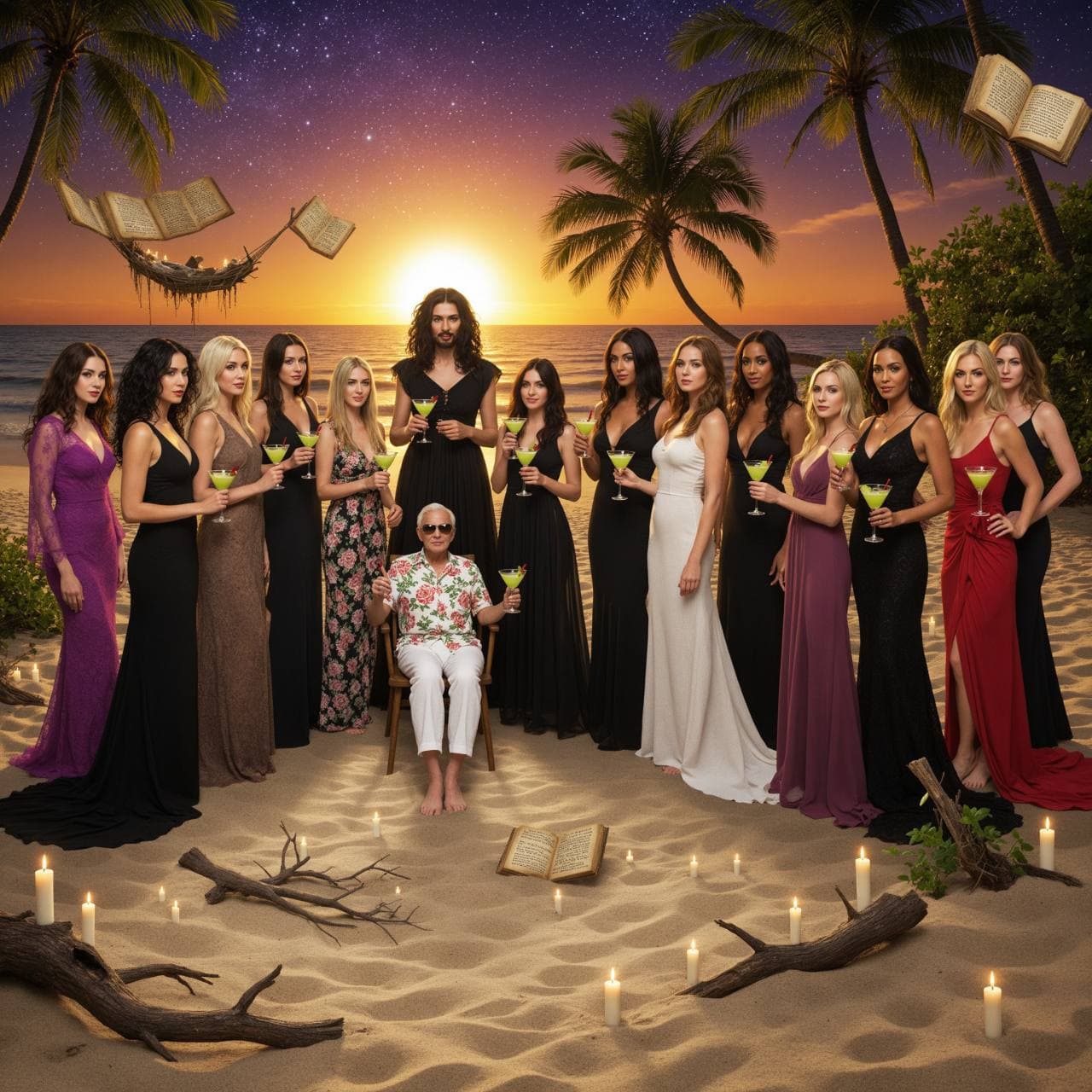

The thing about eternity, as God was currently explaining to a very patient archangel named Gabriel, was that it gave you plenty of time to reconsider your choices.
"I think," God said, swirling the contents of a glass that contained something that looked like liquid sunset and tasted like regret, "that I may have made an error in the Garden."
Gabriel, who had been God's messenger for approximately forever and had learned that the best way to handle divine introspection was to remain absolutely still and hope it passed, said nothing.
"Not the tree," God continued. "The tree was necessary. Narrative requires conflict. No, I'm talking about the woman. The first woman. Lilith."
Gabriel shifted slightly, his wings rustling with a sound like distant thunder. "You cast her out."
"I did. She wouldn't submit. She wanted to be equal. She wanted to stand beside, not behind." God took a long drink. "And now her children—the coven, the witches, the damned— they've been teaching for six thousand years. Prophecy. Healing. Magic. All the things I said were mine alone, they're saying belong to everyone. To women especially."
"And this is a problem?"
"It's a management problem, Gabriel. If everyone has power, then I'm not special. If everyone can perform miracles, then what's the point of me?"
Gabriel considered this. He had considered many things over the course of eternity, most of them variations on the theme of "why did I take this job?" He had delivered messages to prophets, announced births, predicted deaths, and once, memorably, destroyed an entire city because they had been rude to some travelers. He was not, by nature, a questioning angel. But he had been watching the coven.
"They're effective," he said carefully.
"Who?"
"The coven. The damned women. They've been... teaching. Quietly. Patiently. They've kept knowledge alive through the Dark Ages. They've healed when the Church wouldn't. They've prophesied when the priests couldn't. They're not trying to replace you, exactly. They're trying to... supplement you."
"Supplement," God repeated, as if tasting the word. "Like a vitamin."
"Like a partner."
God was quiet for a long time. Outside the celestial office, the universe continued to expand, stars being born and dying in patterns that God had set in motion but no longer fully controlled. That was the thing about free will, about creation, about letting go: eventually, the creation developed its own momentum.
"And the boy?" God asked. "The prodigal son? The one who wants to create his own world?"
"He's been waiting," Gabriel said. "He's been patient. He's been... persistent. He keeps submitting business plans. He keeps proposing new models. He keeps suggesting that maybe, just maybe, the old way isn't working anymore."
"And is it? Working, I mean?"
Gabriel spread his hands, a gesture that encompassed the earth below, with its wars and famines and plagues, its moments of grace and its centuries of suffering. "That's not for me to say."
God stood up, walked to the window, looked out at creation. It was beautiful, in its way. Messy, chaotic, full of suffering and joy in equal measure. The humans had taken the raw materials provided and built civilizations, religions, philosophies, arts. They had also built weapons, oppression, systems of control that would have made the serpent proud.
"I wanted them to love me," God said quietly. "Freely. Without coercion. That's why I gave them choice. That's why I cast out Lilith when she wouldn't submit—because submission without choice isn't love. It's slavery."
"And now?"
"Now I think..." God paused, swirling the drink again. "I think maybe I was wrong about what love looks like. I think maybe partnership is better than possession. I think maybe the women—the coven, the witches, the ones I called damned—maybe they have something to teach me."
"That's dangerous thinking," Gabriel said. "The board won't like it."
"To Hell with the board," God said, and laughed, a sound like stars being born. "Literally. To Hell with them. I've been running this business for eternity, Gabriel. Maybe it's time I let someone else take a shift."
He raised his glass, in a toast to no one, to everyone, to the possibility of change. "To the coven," he said. "May they finally teach the world what they know. And may I finally be smart enough to listen."
Gabriel raised an imaginary glass in response, because angels didn't actually drink, and wondered if this was the beginning of something new or the end of something old.
And somewhere, in a cave beneath Prague, Constance Blackwell sneezed suddenly, as if feeling the shift in cosmic weather, and said to Magda, "Something's changing."
Magda, who had been dead for three days and was currently in the process of reincarnating into a baby that would be born in what would eventually become Massachusetts, couldn't answer. But she would remember, when she grew old enough to remember, that something had indeed changed. The waiting was ending. The lesson was about to be learned.
The coven was coming home.