


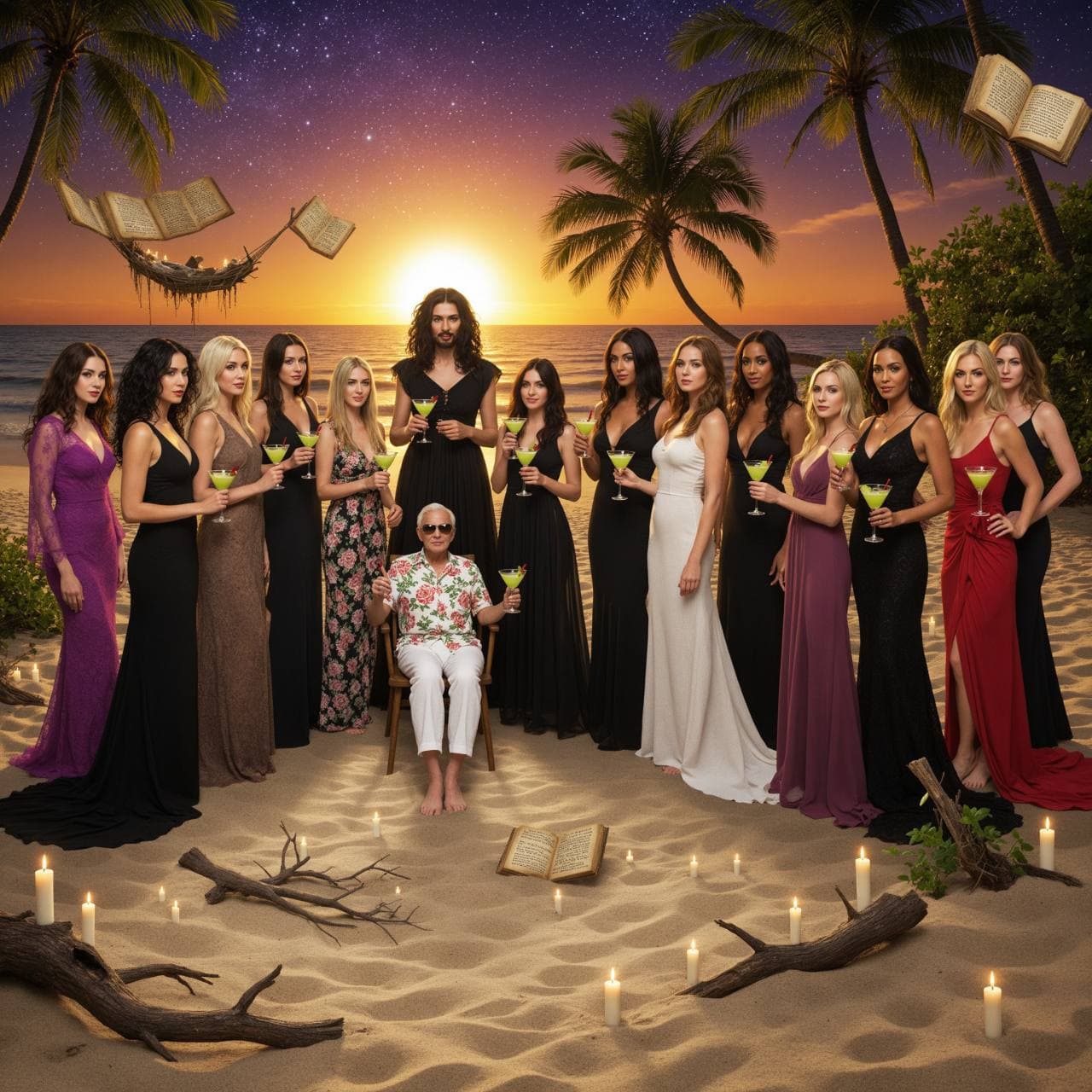

In the year 1348, by the calendar that would eventually be standardized, though at this particular moment there were at least seventeen competing systems and everyone was confused about when Easter was supposed to be, Constance Blackwell found herself teaching a class on applied heresy to a group of nuns who didn't realize they were witches yet.
The convent was called St. Agnes of the Perpetual Headache, named for a martyr who had been canonized primarily because she died young and virginal and therefore didn't complicate the narrative with any actual living. The nuns were mostly illiterate, mostly desperate, and mostly suffering from various ailments that the Church attributed to demons but Constance recognized as the natural consequences of poor nutrition, lack of sunlight, and the psychological strain of pretending to be celibate while living in close quarters with fifty other women.
"Today," Constance said, standing at the front of the scriptorium that she had commandeered for her purposes, "we're going to learn about the true nature of the Trinity."
Sister Beatrice, who was eighty years old and had been having visions since she was twelve, raised her hand. "The Father, the Son, and the Holy Ghost?"
"Wrong," Constance said. "The Mother, the Daughter, and the Crone. Or, if you prefer, the Maiden, the Mother, and the... well, the other one. The one who knows things."
The nuns looked at each other. This was not standard theology.
"But the Creed—" Sister Margaret began.
"The Creed was written by men who were afraid of women," Constance interrupted. "Men who saw power and called it witchcraft. Men who saw knowledge and called it heresy. Men who saw the divine feminine and called it Lilith, called it demon, called it damned."
She walked to the window, looking out at the courtyard where the other nuns were going about their daily business of prayer and agriculture and the quiet desperation that passed for devotion. In the distance, she could see the smoke rising from the cities where the plague was beginning its work, the Black Death that would kill one-third of Europe and, in doing so, create the conditions for the Renaissance, the Reformation, and all the other changes that would eventually lead to the world being ready for the truth.
"The plague," Constance said, "is not a punishment from God."
The nuns gasped. Even in their isolation, they had heard the sermons. The plague was God's judgment on a sinful world. The plague was the result of insufficient faith. The plague could be stopped by prayer, by penance, by the intercession of the saints.
"The plague," Constance continued, "is a disease. It travels in the fleas that live on the rats that live in the cities that you have been told are holy. It has nothing to do with sin and everything to do with sanitation. And the only way to stop it is not prayer, but fire. Burn the bodies. Burn the houses. Burn everything that carries the infection."
"That's witchcraft," Sister Beatrice whispered.
"That's medicine," Constance corrected. "And yes, it's witchcraft too. Because witchcraft is just medicine that the Church hasn't approved yet. Witchcraft is just knowledge that men don't control yet. Witchcraft is just power that women have, and that men fear."
She turned back to face them, and her eyes—her ancient, tired, reincarnated eyes—held the weight of six thousand years of waiting. "I am going to teach you things that will get you burned at the stake if you're caught. I am going to teach you to read Latin, Greek, and Hebrew so you can see what the scriptures actually say instead of what the priests tell you they say. I am going to teach you to heal with herbs, to see the future in flames, to speak with the spirits of the dead. And I am going to teach you why you must never, ever let a man take credit for your work."
"Why?" asked a young novice, barely sixteen, with eyes that hadn't yet learned to be afraid.
"Because that's the lesson," Constance said. "That's the lesson we have been trying to teach the world since the beginning. The women hold the power. The women give the prophecies. The women make the miracles possible. And until the world learns that—until the world accepts that—we will keep being born, and dying, and being born again. We are the Coven of the Damned, and we are tired, and we want to go home."
She pulled a book from her robes. It was bound in leather that might have been human skin, though Constance maintained that it was actually calfskin and the rumors had been started by her enemies. The pages were filled with writing in a language that hadn't been spoken since before the Flood, a language that Lilith had taught her daughters in the caves where they had hidden from the wrath of Adam's God.
"This," Constance said, "is the First Manifesto. The original business plan. The document that explains why we exist, what we're supposed to do, and how we're supposed to do it. And today, you are going to start learning to read it."
The nuns leaned forward. Even Sister Beatrice, who had been skeptical, was intrigued now. There was something about Constance, something that commanded attention. She didn't have the charisma of a saint, all glowing and ethereal. She had the charisma of a general, all steel and strategy and the absolute certainty that she was right.
"The First Manifesto begins with a question," Constance said, opening the book to the first page. "Why did God create woman?"
"To be helpmeet to man," Sister Margaret said automatically.
"No. That's the lie. The truth is that God created woman to be the vessel of power. Man was made from dust, animated by breath. Woman was made from the same substance as the divine— from the matter that existed before creation, the chaos that God shaped into order. Woman contains the chaos. Woman is the chaos. And chaos is creative. Chaos is powerful. Chaos is the source of all magic."
She paused, letting the words sink in. "Lilith knew this. That's why she refused to lie beneath Adam. She knew that she was his equal, his partner, his source. And when she left—when she walked out of the Garden and into the night—she took that knowledge with her. She created the first coven. She taught the first witches. And she made a deal with the one who would become the Messiah, the warlock, the prodigal son who would one day try to set things right."
"The devil?" Sister Beatrice asked, her voice trembling.
"Jesus," Constance said. "Jesus, before he was Jesus. When he was just an idea, a possibility, a business plan submitted to the board of Heaven. He saw what we could do. He saw that we held the power of prophecy, the power to make the impossible possible. And he made a deal. We would walk the path of shame. We would be the witches, the outcasts, the damned. We would give him the miracles he needed to prove his divinity. And in return, he would make sure the world knew the truth. He would make sure we were remembered. He would make sure we stopped being damned and started being divine."
"But he didn't," the young novice said. It wasn't a question.
"He tried," Constance said. "He told the women everything. He gave them the prophecies. He made them the witnesses to the resurrection. But the men who came after—the Pauls and the Peters and the Augustines—they wrote us out. They turned us into demons. They built a church on our backs and called it holy."
She closed the book. "And so we wait. We reincarnate. We teach. We die. We teach again. We die again. Each time, a little more of the truth leaks out. Each time, a few more people learn. Each time, we get closer to the moment when the world will be ready to hear what we have to say."
"And when will that be?" Sister Margaret asked.
Constance smiled, and it was a terrible smile, full of patience and pain. "When the Messiah returns. When he finally gets his meeting with God. When he presents his business plan and God, for once in His eternal existence, actually listens."
Outside, the plague fires were burning. And somewhere in the spaces between time, Lilith was preparing the next lesson.