


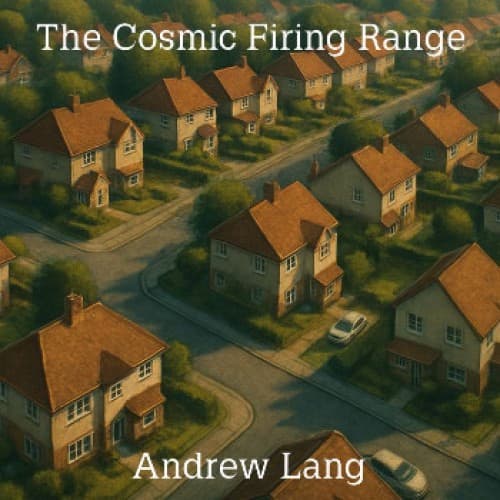
It was the next morning, the dread from yesterday still clinging to him like a film, when Alan stepped into the thin grey light — that washed-out, uncertain dawn that made everything look temporary, including his own prospects. He walked down the drive, keys in hand, the beginnings of a commute-sigh tightening in his chest, when he saw it again.
The car.
The same battered hatchback.
The same hunched silhouette behind the fogged glass.
And something — whatever mechanism had been maintaining Alan’s inner détente — snapped.
There was no hesitation. No moral warm-up. He walked across the pavement with a speed that surprised him, the kind of speed usually reserved for emergencies, or late trains, or sudden revelations. He rapped on the passenger-side window — not a polite tap, but a furious, open-palmed assault that made the whole car shudder.
Inside, the man turned, eyes nothing but exhaustion and anger, a face carved by sleepless nights and cold mornings.
He lowered the window an inch, then two.
“Fuck off,” he said.
Just that. No preamble. No civilities. Two words delivered with the weight of accumulated misery.
Alan felt heat rush up his neck.
“No, you fuck off,” Alan shot back, voice cracking with a decade’s worth of suppressed irritations. “Fuck off out of my neighbourhood. You’re lowering our fucking house prices. You’re worrying everyone. Just— just go.”
It was the unvarnished truth of what he had been thinking all week, spoken with the rancid clarity of a man finally allowing himself to be despicable.
The man in the car blinked, then huffed a disbelieving laugh.
“You know why I park here?” he said. “Because I used to live here, mate.”
The words hit Alan like a physical blow.
“I see you in your suit,” the man continued. “Looking all bloody important. You could be next. I lost my job — bang — there goes your house, your life. And this is how it ends up. You ever slept in a car, mate?”
Alan opened his mouth, found nothing in it, and closed it again.
The man leaned forward, voice rising. “You try sleeping in a fucking car at night. You try being completely vulnerable when you nod off — wondering if some pisshead’s gonna smash your window, or kids are gonna set fire to your tyres for a laugh. You know why I park here? Because it’s one of the few safe places left.”
Alan stared at him — the face creased by cold, the hands trembling slightly. A life’s worth of misfortunes embodied in one man, in one car, on one street.
“This is a public road,” the man said. “I’m entitled to park here. You got a problem, take it up with the council. They’ll tell you the same thing.”
He paused. His face settled into something almost serene.
“Now,” he said, “refer back to the first two words I said to you.”
And he rolled the window up.
Alan stood there for a moment, still breathing hard, as though the argument were continuing somewhere inside him. But the fight had gone out of him. It was that one sentence — I used to live here — that had detonated in his mind, leaving a silence where rage had been. He walked back to his own car in a daze, feeling his suit suddenly absurd, insufficient, fragile.
He drove to work on autopilot, the traffic a blur, the radio off, that sentence still looping with nauseating precision.
I used to live here.
As if fate had tapped him on the shoulder.
And 5 minutes before he pulled into work, he launched into a full autosermon, muttering at the windscreen as if it had wronged him personally. "The bloke’s right!", he spat. "Absolutely bloody right. Life’s a trap — a rigged carnival game. You lose your job and that’s it: no house, no wife, no bloody life. Everything collapses like wet cardboard. What kind of system is this? One misstep and you’re sleeping in a hatchback on your own old street, a ghost haunting your past. It’s all arbitrary — arbitrary and meaningless and fucking conditional. One wrong turn and the universe drops you through a trapdoor. And we’re meant to call this civilisation?"
By mid-afternoon he was at his desk, barely functioning. He watched emails appear and disappear like meaningless cosmic signals. His hands trembled. The office felt airless.
Then the phone rang.
“Alan, hi — it’s Priya from HR.”
His stomach dropped so quickly it felt like a physical malfunction.
“Oh God,” he said. “Are you firing me? Are you actually firing me?”
The words burst out before he could stop them — raw, panicked, humiliating.
A pause.
Then: “Alan… slow down. We didn’t say that. You’re just needed in meeting room three at four o’clock. That’s all we know.”
But the damage was done. His fear had spoken aloud, unfiltered, uncontrollable — like a confession overheard by strangers.
He hung up with a hand that wasn’t entirely steady.
Across the office, somebody laughed at something entirely unrelated. It sounded, to Alan, like the laughter of the damned