


The office was a converted warehouse overlooking a converted canal beside a converted district — everything in this part of England had been dutifully rehabilitated from its former usefulness. Now it served as habitat for a mildly panicked class of middle-aged professionals who spent their days tabulating numbers that, in a more honest era, might never have been allowed to exist.
Alan arrived as he always did: five minutes early, five minutes anxious.
His boss, Terry, was already holding court near the kitchenette — a man who believed his own jokes were a form of currency and who spent freely. This morning he was in full swing, telling a junior colleague how the company was “more likely to fire anyone in the department than promote them.”
It was said with chummy bravado, the kind of humour meant to signal: We’re all in the same boat — a leaking dinghy, but isn’t it fun?
Alan’s smile froze.
“Speak for yourself, Terry,” he said, arranging his voice into a casual defiance he didn’t feel. “I’d leave before I ever got made redundant.”
A laugh went around the kitchenette. Terry clapped him on the back.
“Sure you would, mate. Sure you would.”
Alan felt the sting precisely because it was the kind of thing he might have said himself — years ago, in another life, before the walls of adulthood contracted. There was nothing funny about redundancy; it was a word with the same chilly finality as “diagnosis.”
But he moved on, as people do, to his desk. The morning passed in its usual blur of emails that cancelled one another out. Around eleven, Terry wandered over and leaned against Alan’s partition like a man inspecting a defective appliance.
“So,” Terry said. “How are we feeling today? Ready for the firing squad?”
Alan smirked in the direction of humour, though he didn’t quite reach it.
“Actually,” he said, lowering his voice with false confidence, “I’m not long for this place. Between you and me, five years tops. Got, uh… FIRE plans.”
Terry blinked.
“Fire plans? What, for the building?”
“No.” Alan sat up straighter, summoning Paul’s insufferably breezy manner. “FIRE. Financial Independence, Retire Early. It’s a—well, it’s a thing. Movement. Optimising your finances so you can retire in your forties. Freedom lifestyle, all that.”
He regretted the phrase “freedom lifestyle” instantly. It sounded like a brochure for a cult.
Terry stared at him, and then — gloriously, catastrophically — burst out laughing.
“You? FIRE? No way, mate. You’re a lifer here. You’ll get your gold watch at seventy. That’s if you’re not made redundant before then.”
The laughter — hollow, hearty, oblivious — echoed across the open-plan floor.
Alan managed a chuckle, even leaned back as if amused, but inside he felt something soft collapse. A minor internal landslide.
Because Terry wasn’t joking — not really. Terry was one of life’s natural sadists, the petty kind, who performed cruelty the way other men performed karaoke. And Alan believed him. That was the worst part: the belief. Terry’s words fitted too neatly into the ongoing monologue in his head: the creeping fear that he was not promotable, not exceptional, not safe.
Certainly not FIRE material.
After lunch, the afternoon drained away in a series of mild humiliations — a spreadsheet correction from a colleague ten years younger, an ignored suggestion in a meeting, a typo discovered in a document he’d worked on all week. Nothing significant, nothing scarring, but enough to erode, molecule by molecule, whatever remained of his professional dignity.
When five o’clock finally arrived, Alan felt the familiar relief — the end of the performance. Time to return to the other performance at home.
He drove through the suburban lattice in a kind of daze, his mind replaying Terry’s laughter on a loop. It had been the laughter of a man who saw through him. Worse: a man who saw nothing in him.
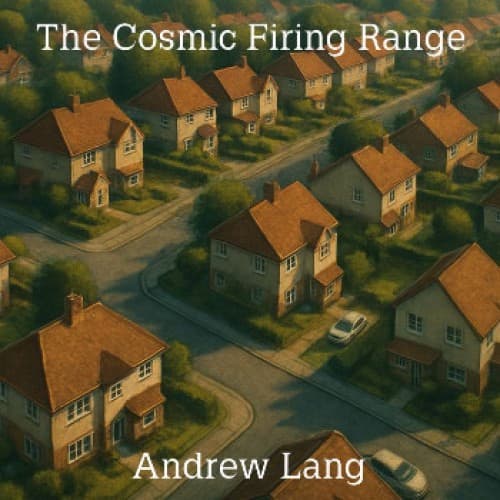
His street appeared, tidy as ever, each house practising its own architecture of respectability. And there it was again: the car. The same battered hatchback parked outside the neighbour’s house, spectral in the dusk.
A shadow moved inside it — the man shifting, or waking, or simply existing.
Alan felt something ease in him, absurdly.
“Well,” he muttered, pulling into his drive, “some people have it rougher than me.”
He said it with the mechanical benevolence of someone adjusting an internal thermostat. A minor recalibration of perspective. A comfort achieved at someone else’s expense — but a quiet one, a private one, the kind that leaves no moral fingerprints.
He gathered his bag, felt the cold bite his face, and walked toward his front door, rehearsing the smile he would wear.
Inside, the lights glowed warmly.
Outside, the man in the car shifted again, invisible to everyone but himself.
Alan closed the door.