


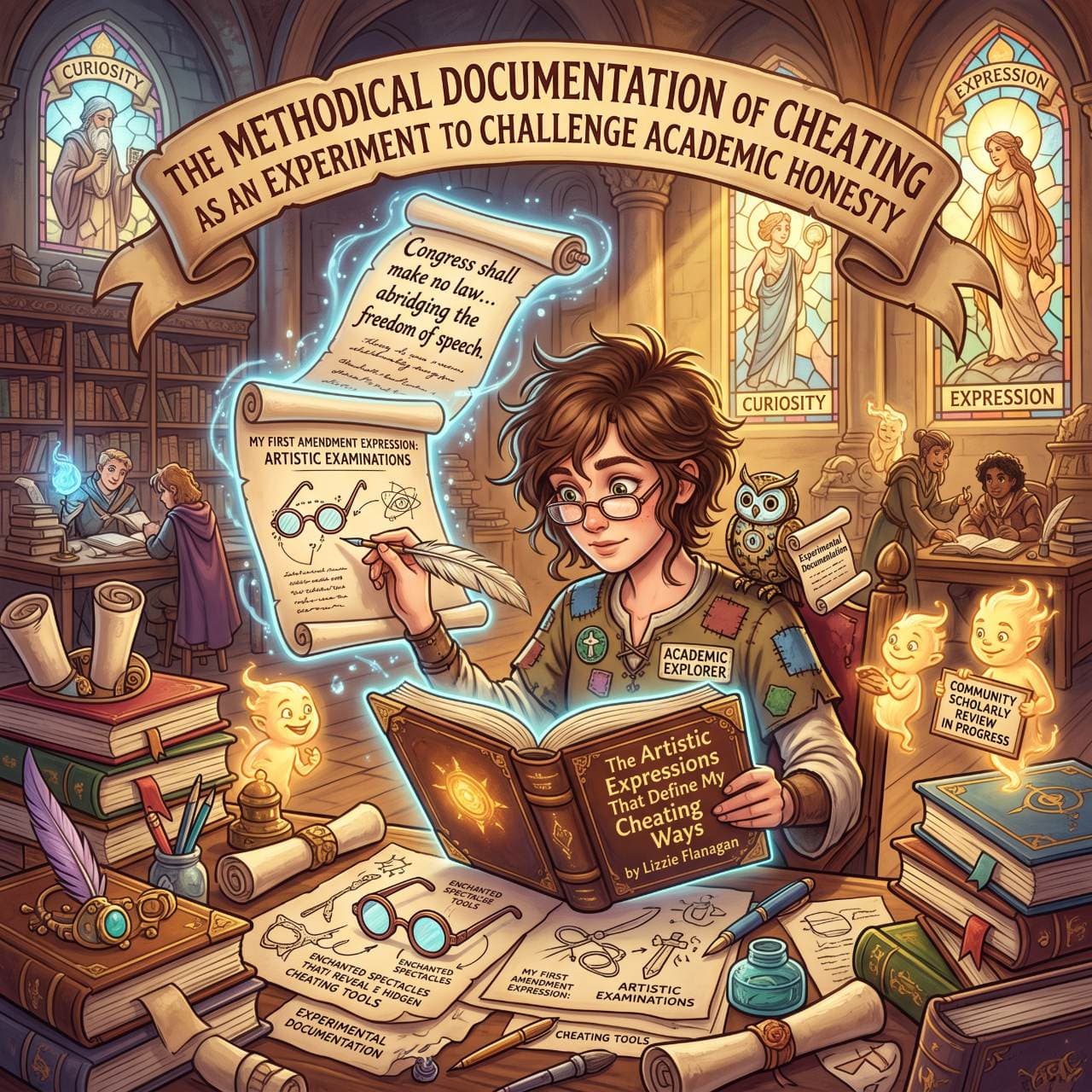

Expulsion is a strange condition, neither death nor life, neither membership nor complete exile. I was no longer a student, but I was still a person who had been a student, still the product of the education I had received and the fraud I had committed. I woke each morning in the small apartment I had rented on the edge of town, unemployed and unaffiliated, with no schedule to keep and no purpose beyond the processing of what had happened.
The first week after the hearing was consumed by practicalities. I moved my belongings from the dormitory room I had been allowed to occupy during the suspension, now I had forty-eight hours to vacate. I closed my bank account at the campus credit union and opened one at a national bank. I applied for a library card at the public library, since I was no longer allowed in the university's stacks. I changed my mailing address, canceled my meal plan, surrendered my parking permit.
Each of these small acts severed another thread connecting me to the institution. Each was a reminder that I was now outside, looking in at a world I had once inhabited. I saw students walking to class and felt a pang of something, not envy, exactly, but recognition of the gap that had opened between their lives and mine. They were still inside the experiment, still performing the roles I had exposed as hollow. I was outside, free but also unmoored.
The media attention intensified after the hearing, then gradually faded. The New York Times ran a profile of me headlined "The Philosopher of Cheating," which focused less on my legal argument and more on the personal story: the model student who had thrown it all away for an idea. NPR invited me to discuss my case on a program about academic ethics; I accepted, and found myself debating a dean from another university who argued that my actions had "damaged the credibility of all student scholars."
"That's exactly the point," I said during the interview. "The credibility was already damaged. I just made the damage visible."
"But visibility isn't the same as repair," the dean countered. "You've made students doubt their peers, made professors doubt their assessments, made the whole system seem arbitrary and meaningless. How does that help anyone?"
"Maybe it helps by forcing us to build something better," I said. "A system that doesn't rely on blind trust in procedures that don't work. A system that values actual learning over apparent compliance."
The dean was unconvinced, but the interview generated hundreds of emails from listeners—professors, students, parents, all wrestling with the questions I had raised. Some called me a hero; others called me a narcissist who had rationalized her own dishonesty with philosophical jargon. Both responses missed the point, I thought. I was neither hero nor villain. I was a mirror, reflecting back the contradictions of a system that wanted to believe in its own integrity without doing the work to ensure it.
In March, I received an offer from a small press to publish an expanded version of my dissertation as a book. They wanted me to add material about the hearing, the aftermath, and my reflections on what I had learned. I accepted and spent the spring writing, revisiting the experiment with the distance of retrospection.
What I saw, looking back, was how young I had been, how certain of my own righteousness, how blind to the costs my experiment imposed on others. My collaborators had faced their own disciplinary proceedings—lighter than mine, because they had cooperated with the investigation, but still serious enough to affect their records and their futures. My professors had been forced to question every grade they had given me, every recommendation they had written, wondering if their judgment had been sound or if I had fooled them completely.
I had told myself that I was exposing systemic failure, but I had also been performing for an audience of one, myself, my own conscience, my own need to prove that I was smarter than the system. This was not noble; it was adolescent, a grandiose assertion of my own exceptionality. I had wanted to be the one who saw through the illusion, the one who refused to play along, the one who told truths that others were too cowardly to speak.
But the truths I told were partial, selective, designed to support my predetermined conclusion. I had documented every instance of undetected plagiarism, every successful deception, every clue that went unremarked. But I had not documented the times when I almost got caught, when a professor asked a question I couldn't answer, when a classmate looked at me with suspicion. I had not recorded the anxiety that accompanied every submission, the fear that this would be the time my luck ran out. I had constructed a narrative of triumphant exposure, when the reality had been messier, more ambiguous, more human.
The book, which I titled The Artistic Expression That Defined My Cheating Ways: A Confession and a Critique, was published in September, one year after my initial suspension. It received mixed reviews—some critics praised its "intellectual courage" and "unflinching self-examination," while others dismissed it as "a long exercise in special pleading" and "the rationalizations of a privileged young woman who couldn't accept that rules apply to everyone."
The sales were modest but steady, enough to support me for another year of writing and thinking. I was invited to speak at several colleges and universities—not as a student, but as a guest, a cautionary tale, a provocateur. I accepted some of these invitations, always making clear that I was not advocating cheating as a general practice, but defending the right to question the systems that governed our lives.
At a small liberal arts college in Ohio, a student asked me during the Q&A: "Do you regret what you did? Would you do it differently if you had the chance?"
I considered the question carefully. "I regret the harm I caused to specific people, my collaborators, my professors, the students who lost scholarships to me. That was real, and it was wrong. But I don't regret the experiment itself, or the questions it raised. I think those questions needed to be asked, and I'm glad I was the one to ask them, even if I asked them imperfectly."
"So you'd do it again?" the student pressed.
"I'd do it differently," I said. "I'd be more transparent about my methods from the beginning. I'd get institutional review board approval, treat it as actual research rather than covert performance. But I don't know if that would have worked, if the experiment required deception to test what it was testing. That's the paradox at the heart of what I did, and I haven't resolved it."
Another student, at a university in California, asked: "What do you say to people who call you a narcissist? Who say you just wanted attention and found a clever way to get it?"
"I say they might be right," I admitted. "I think most acts of moral courage are also acts of ego, and most acts of ego can be framed as moral courage. The two are hard to separate. I wanted to be seen as special, as someone who saw what others missed. That's narcissistic. But I also genuinely believed that the system was broken and that exposing its brokenness might lead to repair. That's... something else. Maybe idealistic, maybe deluded, but not purely selfish."
These conversations helped me understand that my experiment was not over, that it had entered a new phase. I was no longer testing the university's ability to detect cheating; I was testing society's ability to engage with uncomfortable ideas, to hold multiple truths simultaneously, to recognize that the same act could be both wrong and meaningful, both harmful and illuminating.
I also began to understand that my First Amendment argument, while legally flawed, had touched on something real about the nature of academic freedom. Universities claimed to value free inquiry, but they structured themselves around constraints—invisible walls of convention and expectation that limited what could be questioned and how. I had crashed through one of those walls, and the crash had revealed how flimsy the wall was, how much of the structure depended on everyone's agreement not to test it.
In the years that followed, I watched as my case became a reference point in discussions of academic integrity. Professors assigned my book in courses on research ethics; students cited my argument in papers about the limits of free expression; administrators used my example in orientation sessions as both a warning and a conversation starter. I had become, despite myself, part of the institution I had tried to expose, my critique absorbed into the system's self-understanding.
Some changes were visible. Westbrook University, responding to the Council's recommendation, had established a committee to review its academic integrity policies. They had implemented more rigorous plagiarism detection, but they had also revised their teaching loads to give professors more time for actual reading and feedback. They had created a "pedagogical innovation fund" to support experiments in assessment that moved beyond traditional testing. They had not embraced my methods, but they had acknowledged my critique.
Other changes were invisible but perhaps more significant. I received letters from professors at various institutions saying that my case had prompted them to read their students' work more carefully, to engage with ideas rather than just evaluating compliance. I heard from students who said that my book had given them permission to question the point of assignments that seemed meaningless, to ask their professors why they were being asked to do what they were being asked to do.
These were small shifts, incremental changes in awareness and practice. They did not constitute a revolution in higher education. But they suggested that the experiment had not been entirely in vain, that the performance had communicated something that persisted beyond its immediate context.
I also changed. The arrogant certainty of my early twenties gave way to a more complicated understanding of moral life. I came to see that integrity was not a binary condition either present or absent, but a practice that required constant attention, adjustment, recommitment. I had violated academic integrity, but I had also tried to maintain intellectual integrity, to be honest about my dishonesty, to tell the truth about my lies. Whether these were compatible, whether one could be partially honest or dishonestly honest, remained questions I lived with rather than answered.
By the time five years had passed, the period during which I had agreed not to enroll at another institution, I was twenty-seven years old, living in a small apartment in Portland, Oregon, supporting myself through writing and occasional speaking engagements. I had published a second book, a more conventional work of philosophy about the ethics of deception, which received less attention but more respect from academic reviewers.
I applied to graduate school—not at Westbrook, which would not have me, but at several other institutions that were willing to consider my application despite my record. I was accepted to a doctoral program in philosophy at a university in the Midwest, with a letter from the admissions committee noting that my "unconventional background" would bring "valuable perspective" to their program.
I hesitated before accepting. I had built a life outside academia, a voice and a platform that depended on my status as an outsider. Returning to the institution I had critiqued felt like a betrayal of that position, a capitulation to the very system I had exposed as hollow.
But I also recognized that my critique had been limited by my position as an outsider looking in. I had seen the failures of the system, but I had not seen its possibilities, the ways it could be reformed from within by people who understood both its flaws and its values. If I wanted to contribute to genuine change, I needed to understand the system from the inside, to learn its languages and its logics, to become fluent in the discourse I had once only parodied.
I accepted the offer. I enrolled as a graduate student, older than my classmates, marked by my history but not defined by it. I did not cheat. I did not need to; the work was genuinely interesting, the questions genuinely open, the engagement with ideas sufficient to satisfy my need for meaning.
But I also did not forget what I had learned. I brought my skepticism with me, my habit of questioning assumptions, my awareness of the gap between stated values and actual practices. I became the kind of graduate student who asked inconvenient questions in seminars, who challenged professors when their arguments seemed facile, who refused to accept that the way things were was the way they had to be.
Some professors found me difficult. Others found me refreshing. I made friends and enemies, wrote papers and received feedback, advanced through the program with the normal mixture of progress and setback. I was, in most ways, a typical graduate student, except for the occasional moment when someone recognized my name, when a conversation would pause while they placed me, when I would see the flicker of recognition: You're the one who...
Yes, I was the one who. The one who cheated and wrote about it, who argued that cheating could be art, who forced a university to confront its own hypocrisy. I was also the one who had learned, grown, changed. The one who had spent five years thinking about what I had done and why, and had emerged with more questions than answers.
The artistic expression that defined my cheating ways had been a moment in time, a performance that lasted four years and reverberated for many more. It had cost me my undergraduate degree, my reputation, my place in the academic world I had aspired to join. But it had also given me something: a voice, a perspective, a commitment to truth that was more sophisticated than the simple honesty I had once thought sufficient.
I was still cheating, in a way. Cheating the expectation that I would be normal, conventional, compliant. Cheating the assumption that the rules were there to be followed rather than questioned. Cheating the system by refusing to let it define me entirely, by maintaining the part of myself that stood outside, watching, critiquing, performing.
But I was also being honest, honest about my doubts, my limitations, my ongoing struggle to live with integrity in a world that made integrity difficult. That was the real lesson of the experiment, I had come to believe. Not that cheating was justified, or that systems were corrupt, or that rules could be broken for artistic purposes. But that integrity was not a state to be achieved but a practice to be maintained, a constant negotiation between who we are and who we want to be, between the demands of the system and the demands of conscience.
I was still negotiating. I would negotiate for the rest of my life. And in that negotiation, in that ongoing performance of self-examination and self-creation, I found the meaning that my cheating had sought but never quite achieved. The artistic expression that defined my cheating ways had been a beginning, not an end. And the work it began continued, would always continue, as long as there were systems to question and truths to tell.