


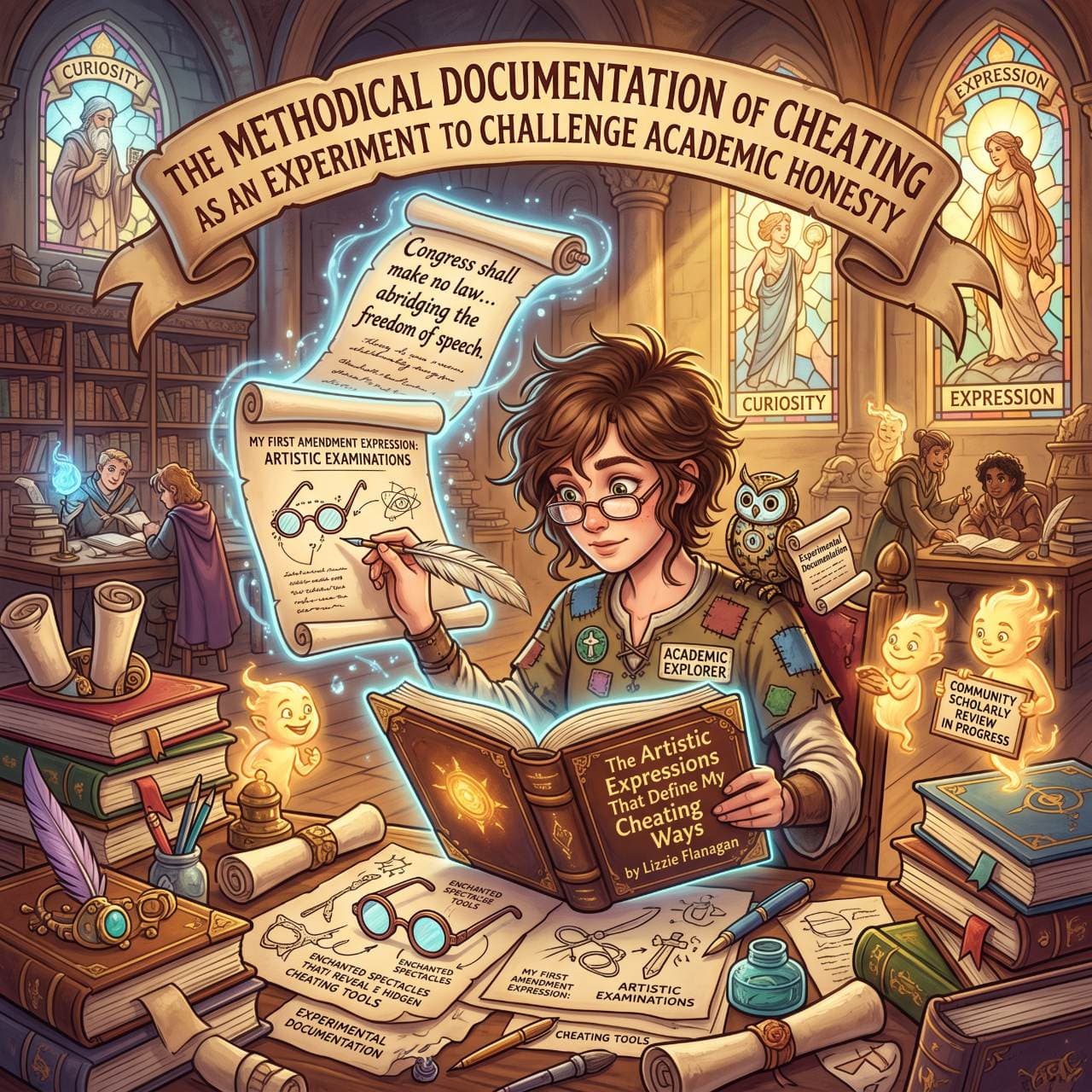

The university's decision to hold the final hearing in public was, I suspected, a strategic error on their part. They had hoped that by opening the proceedings to observers, they would demonstrate their transparency and fairness, defusing the criticism that they were trying to suppress dissent. Instead, they created a spectacle that drew hundreds of spectators, dozens of journalists, and a film crew from a documentary series about academic controversies.
The hearing was held in the university's largest auditorium, a 500-seat theater normally used for guest lectures and commencement ceremonies. By 8:30 AM, an hour before the scheduled start, every seat was filled and people were standing in the aisles. The atmosphere was somewhere between a trial and a performance art piece, which was appropriate given the nature of my defense.
I arrived with Rebecca Stone, who had agreed to serve as my legal advisor for this final phase. She had warned me that we would almost certainly lose, that no court had ever held that cheating was protected speech, and the university's interest in maintaining academic standards would almost certainly outweigh my interest in expressive conduct. But she also understood that winning was not the only measure of success.
"Today is about the record," she told me as we waited in the wings. "Everything said here will be transcribed, preserved, available to future students and scholars. You're creating a document that will outlast the decision."
The Honor Council entered first, taking their seats at a long table on the stage. Dean Okonkwo was joined by the same faculty and student members from the first hearing, supplemented by two additional faculty members who had expertise in constitutional law and academic ethics. The university's legal counsel, a tall man named Harold Vance, sat at a separate table with a stack of case law and a visible sense of irritation.
I was called to the stage and sworn in, promising to tell the truth, which I intended to do. The formalities were observed, reading of charges, acknowledgment of rights, confirmation that I understood the potential sanctions. Then Dean Okonkwo invited me to make my opening statement, and I began the final performance of my experiment.
"Members of the Council," I said, my voice carrying to the back of the auditorium without need of the microphone, "I stand before you today not as a defendant but as a witness. Not as a criminal but as a cartographer. For four years, I have been mapping the terrain of academic integrity, charting the distance between what this institution claims to value and what it actually enforces. My methods have been unorthodox; my findings have been uncomfortable. But they are true, and truth is supposed to matter in a university."
I paused, looking out at the sea of faces. I saw professors I had studied with, students I had collaborated with, journalists scribbling in notebooks, strangers who had come to see the spectacle. I saw Professor Yates in the third row, nodding encouragingly. I saw my collaborators Tyler Ray, who had traveled from his own university to support me, and the others who had been granted immunity in exchange for testimony that they had now given.
"The university has charged me with academic dishonesty," I continued. "It has presented evidence that I plagiarized, that I collaborated without authorization, that I manipulated testing procedures. I do not dispute this evidence. I dispute only the characterization of these actions as mere dishonesty, as simple violations of rules without larger significance.
"What I did was create a work of institutional critique, a four-year performance piece that used the university as its canvas, academic integrity as its medium, and the gap between appearance and reality as its subject. This is not a metaphor or an after-the-fact rationalization. It is documented in the dissertation you have before you, which specifies the theoretical framework, the methodology, and the findings of my research."
I turned to face the university's legal counsel. "Mr. Vance will argue that my actions were not expressive because they were hidden, because I did not announce my intent while committing the acts. But this misunderstands the nature of performance art, which often relies on the tension between appearance and reality, on the audience's unawareness that they are witnessing a performance. When Marina Abramović sat motionless for 736 hours at MoMA, she did not announce to each visitor that they were participating in an artwork. The performance was in the sitting, not in the announcement of sitting."
I cited the cases I had studied: United States v. O'Brien, which established that conduct could be restricted if it was not intended to communicate a message; Clark v. Community for Creative Non-Violence, which permitted restrictions on expressive camping in a park; Ward v. Rock Against Racism, which allowed regulation of noise levels even for protected speech.
"But these cases also establish," I continued, "that when conduct is intended to communicate a specific message, and when that message is likely to be understood by observers, it receives First Amendment protection. My conduct meets this test. Every paper I submitted was intended to communicate two messages: the surface message about Rawls or Kant or political theory, and the deeper message about the conditions of its own production. Every test I took was a demonstration of testing's inadequacy as a measure of learning. My dissertation makes this explicit, but the performance was there for anyone who chose to see it."
I turned back to the Council. "The university asks you to punish me for revealing uncomfortable truths about its own operations. It asks you to affirm that academic integrity is a set of rules to be followed rather than a set of values to be enacted. It asks you to choose form over substance, appearance over reality, silence over speech.
"I ask you to choose differently. I ask you to recognize that my experiment, however flawed, however provocative, however disruptive, was a genuine attempt to engage with the questions that a university ought to be asking. What does it mean to be honest in a dishonest system? What does it mean to be original in an environment that rewards synthesis over invention? What does it mean to be evaluated by metrics that measure everything except what matters?
"If you expel me, you will be protecting the institution from critique. You will be affirming that the rules matter more than the reasons for the rules, that the performance of integrity is more important than its practice. You will be saying that students may question anything except the system that questions them.
"But if you acknowledge the expressive nature of my conduct—if you recognize that my cheating was speech, protected by the Constitution—you will be opening a conversation that this university desperately needs to have. You will be saying that academic integrity is strong enough to withstand critique, that it does not need to be protected from examination, that it can be questioned without being destroyed."
I sat down to silence, then to applause from some sections of the audience. Dean Okonkwo called for order and turned to Mr. Vance for the university's response.
Vance was a skilled advocate, I had to admit. He did not dismiss my argument as frivolous; he engaged with it seriously, which made his refutation more devastating. He cited Healy v. James, where the Supreme Court had upheld a university's right to deny recognition to a student group that advocated violence. He cited Hazelwood v. Kuhlmeier, where the Court had permitted a high school to censor a student newspaper. He cited Morse v. Frederick, where the Court had allowed punishment of a student for displaying a "Bong Hits 4 Jesus" banner.
"These cases establish," Vance argued, "that educational institutions have broad authority to regulate student conduct in order to maintain order and uphold academic standards. They establish that the First Amendment does not give students a license to disrupt the educational environment or to violate rules that are essential to the school's mission."
He turned to look at me, his expression not hostile but pitying. "Ms. Bjork is a talented young woman. Her dissertation demonstrates intelligence, creativity, and serious engagement with important questions. But she is also, by her own admission, a cheat. She obtained advantages over her peers through deception. She took scholarships and honors that she did not earn. She corrupted the evaluation system that is supposed to ensure fair assessment of student learning.
"Her claim that this was 'performance art' does not change the nature of what she did. A bank robber cannot claim that his heist was a commentary on capitalism. A plagiarist cannot claim that her theft was a statement about intellectual property. The First Amendment protects the right to criticize the banking system or the publishing industry, but it does not protect the right to steal from banks or publishers while claiming expressive intent."
Vance walked to the edge of the stage, addressing the audience as much as the Council. "The university is not trying to suppress Ms. Bjork's ideas. She is free to write, to publish, to speak about academic integrity to anyone who will listen. We are not punishing her for her critique; we are punishing her for her fraud. These are separate matters, and conflating them does a disservice to both free speech and academic honesty."
He returned to his table and concluded with a direct appeal to the Council. "Academic integrity is not a performance, as Ms. Bjork claims. It is a practice, a habit of mind, a commitment to truth that must be maintained even when it is difficult, even when it is inconvenient, even when no one is watching. By expelling Ms. Bjork, you will be affirming that this commitment matters, that it is not negotiable, that it cannot be sacrificed in the name of artistic expression or political commentary. You will be protecting the value of every honest student's degree, the integrity of every legitimate scholar's work, and the reputation of this institution as a place where truth actually matters."
The Council recessed for deliberation at noon. The audience filed out, buzzing with conversation, while I waited in a small conference room with Rebecca Stone.
"You did well," she said. "You made them take the argument seriously. That's more than I expected."
"Will it be enough?" I asked.
She shook her head. "Probably not. Vance is right that the precedents favor the university. But you made the best case you could, and you made it honestly. That's something."
The Council returned at 3:00 PM. Dean Okonkwo read their decision, which had been crafted with obvious care to address both the factual and legal questions raised by the case.
On the factual question, they found that violations of the Honor Code had occurred. They accepted my admission that I had plagiarized, collaborated without authorization, and manipulated testing procedures. They noted that these violations were extensive, systematic, and had provided me with material advantages over other students.
On the legal question, they acknowledged that my conduct had expressive elements and that the First Amendment protected expressive conduct in certain circumstances. However, they concluded that the university's interest in maintaining academic integrity was sufficiently compelling to justify the regulation of my speech, and that the sanctions proposed, expulsion with permanent notation, were narrowly tailored to serve that interest.
They therefore recommended that I be expelled from Westbrook University, effective immediately, with a permanent notation on my transcript indicating that the expulsion was for "violations of academic integrity."
But then came the surprise. The Council added a separate recommendation, addressed to the university administration, suggesting that my case raised "profound questions about the relationship between academic standards and expressive freedom" that warranted further study. They recommended that the university establish a committee to review its academic integrity policies, its assessment practices, and its mechanisms for detecting and addressing dishonesty. And they recommended that my dissertation be preserved in the university archives as "a document of historical interest in the evolution of academic culture."
It was a split decision, a compromise that satisfied no one completely. I was expelled, which was the outcome the university wanted. But my work was acknowledged as significant, which was the outcome I wanted. The experiment was over, but its documentation would survive.
I stood as the decision was read, feeling strangely empty. I had prepared for this moment, had known for weeks that it was coming, but the reality of it, the finality of expulsion, the end of my academic career, hit me harder than I expected. I was no longer a student. I was no longer part of this community. I was an outsider, a cautionary tale, a footnote in the university's history.
Rebecca Stone squeezed my hand. "We can appeal," she whispered. "We can file suit. This isn't over."
But I knew it was over. The performance had reached its conclusion. The artistic expression that defined my cheating ways had been judged, condemned, and paradoxically preserved. It was time to move on to whatever came next.
I walked out of the auditorium into the February afternoon, the cold air hitting my face like a wake-up call. Behind me, I could hear the crowd dispersing, the journalists rushing to file their stories, the university officials congratulating themselves on their victory.
But I also heard something else: students discussing my argument, debating whether cheating could be art, questioning the rules they had always followed without thinking. The conversation I had started would continue without me. The dissertation would be read by others who would conduct their own experiments, ask their own questions, push their own boundaries.
That was the real victory, I realized. Not the legal argument, not the avoidance of punishment, but the shift in consciousness, the crack in the facade of academic integrity that would let light through. I had cheated not to get ahead but to expose the emptiness of the race, and in that exposure, I had created the possibility of a different kind of race, a different way of running.
I walked away from the university that had been my home for three years, my experiment complete, my future uncertain, my conscience clear. The artistic expression that defined my cheating ways had found its audience, and now it was time to see what that audience would do with what they had learned.