


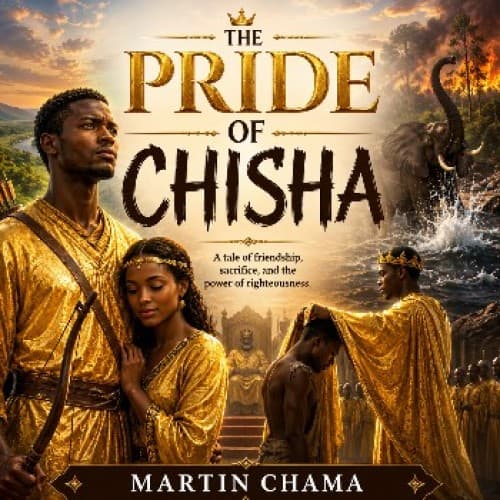

In the vast and breathtaking Kingdom of Maluba, beauty and order flowed together like music carried on the wind. The hills were green throughout the year, the forests rich with animals, and the rivers shone beneath the golden sun like threads woven by invisible hands. Villages stood peacefully across the land, each surrounded by fertile fields and fruit trees heavy with harvest.
But above all the wonders of Maluba, there was one thing strangers never forgot—the people themselves.
Every man, woman, and child wore a sacred golden robe from birth. The robes were unlike anything known in other kingdoms. They never faded with age, never tore upon stone or thorn, and never became dirty. The robe of a child grew as the child grew, fitting perfectly through every stage of life. The people believed the robes were gifts from heaven itself.
King Maluba, ruler of the kingdom, guarded this sacred tradition with fierce devotion. Throughout the land, one law stood above all others:
“No person shall uncover their nakedness.”
To break this law meant death.
The king believed nakedness was the ultimate disgrace, a rejection of dignity and honor. The people feared the law greatly and obeyed it without question.
Among the people of Maluba lived a young man named Chisha.
Chisha was admired throughout the kingdom, not merely because he was handsome, but because he possessed gifts few men could match. He was the finest hunter in all the land. His arrows flew with deadly accuracy, and his footsteps moved silently through the forest like drifting smoke. Hunters twice his age often returned empty-handed, but Chisha never failed.
Whenever he entered the forest, families prepared cooking fires in expectation, for they knew he would return carrying meat upon his shoulders. Children ran to greet him, elders blessed him, and women sang songs of gratitude as he passed through the villages.
Yet Chisha’s greatest strength was not his hunting.
It was his heart.
Though praised everywhere he went, pride did not appear to live within him. He greeted elders with respect, shared food with widows, and never boasted of his skill. The poor loved him as much as the wealthy admired him.
Most importantly, Chisha was the closest friend of Prince Katebe, the beloved son of King Maluba.
The two had grown together since childhood. Though one was born to a throne and the other to an ordinary family, their friendship remained unbroken. They hunted together, trained together, and shared secrets no one else knew.
Prince Katebe trusted Chisha more than anyone in the kingdom.
The prince was also known throughout Maluba for always riding a white donkey. Though many princes preferred mighty horses to display power and greatness, Katebe chose the humble white donkey instead. The people often wondered why.
Some elders said the white donkey symbolized peace and humility. Others believed it represented purity and mercy. Whatever the reason, whenever the prince entered a village upon the white donkey, fear disappeared from the hearts of the people.
One evening, as the sun painted the skies red and gold, Prince Katebe arrived at Chisha’s home riding his white donkey.
“My friend,” he said warmly, “I must leave Maluba for a distant journey.”
Chisha immediately welcomed him with honor.
“My prince,” Chisha said with a bow, “your presence blesses my house.”
Katebe smiled.
“You are more brother than servant to me, Chisha. I will travel to the Kingdom of Loza in search of wisdom and treasures for our people. The journey may take many moons.”
The prince grew serious.
“While I am away, I entrust all I possess to you—my lands, my cattle, my servants, and my household.”
Chisha lowered his head deeply.
“You honor me beyond measure. I shall guard all that is yours as faithfully as though it belonged to my own blood.”
Prince Katebe placed a hand upon his shoulder.
“I knew you would say so.”
That night the two friends sat beneath the stars speaking of many things—dreams, duty, and the future. Neither knew that darkness was already moving silently toward them.
At dawn, Prince Katebe departed from Maluba.
And from that very moment, the course of Chisha’s life began to change forever.