


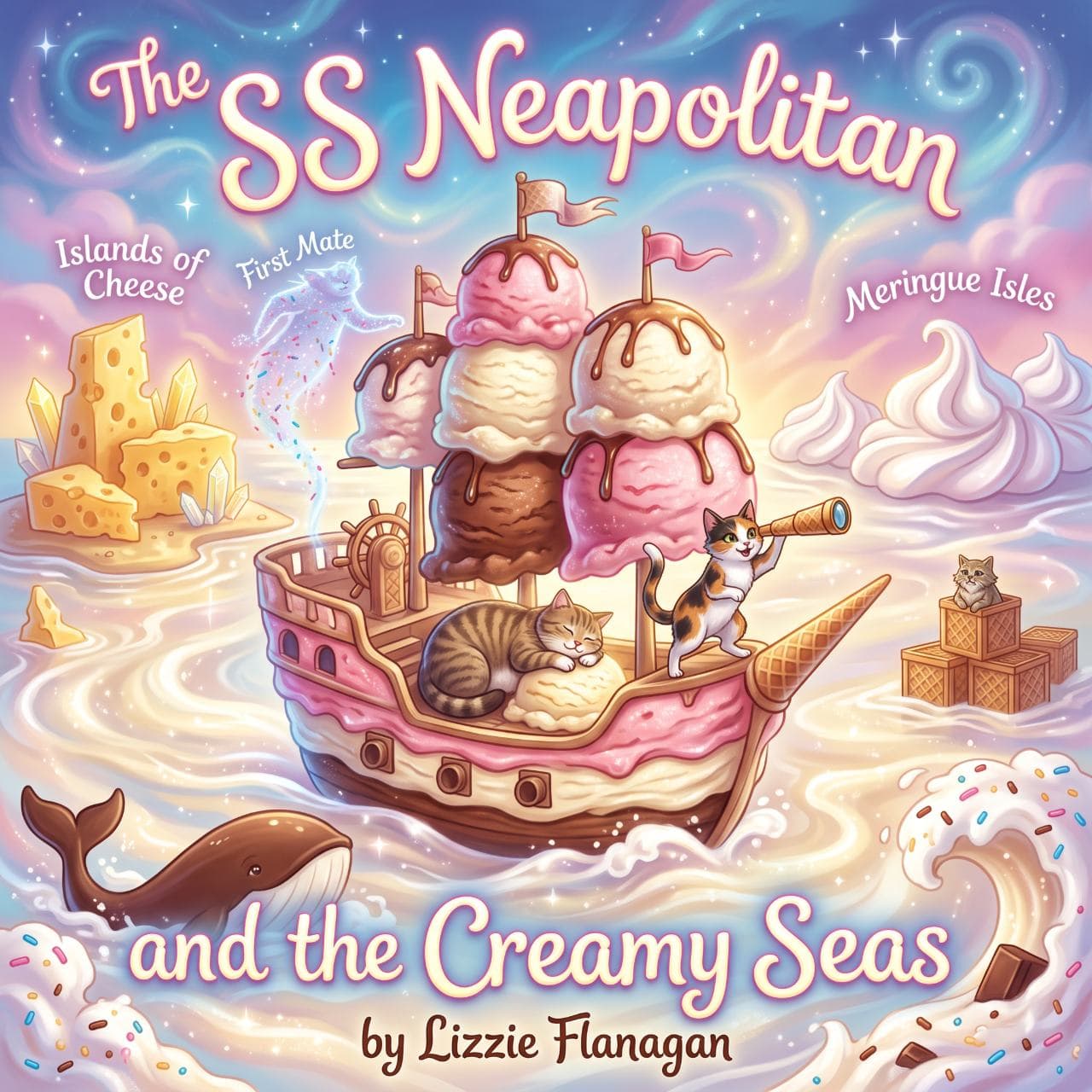

They stayed. Of course they stayed. The S.S. Neapolitan was their ship, the Milky Ocean their sea, and there were still so many places to see.
They sailed through the Strait of Stracciatella, where chocolate chips floated like islands and the cream was ribboned with vanilla streams. They visited the Meringe Isles, where clouds of egg-white foam supported entire ecosystems of flying fish made of butter and sugar. They braved the Caramel Currents, fast-moving rivers of golden sweetness that could carry a ship three days' distance in three hours if navigated with skill.
Pixie proved to be a natural navigator, her restless energy perfectly suited to reading the ever-changing patterns of the cream sea. She learned to identify the subtle color shifts that indicated depth, the particular ripple patterns that warned of approaching storms, the secret channels that led to hidden coves where the catnip grew wild and the cream was freshest.
Socket proved to be a natural diplomat. Her substantial presence and easy contentment made her welcome whe rever they docked. She negotiated with the Cheese Mice of Gouda Grove, traded stories with the Cream Wisps of the Floating Fjords, and once, memorably, mediated a dispute between two rival factions of Cookie Crumbs who had been warring for centuries over which was better: chocolate chip or oatmeal raisin. (Socket's solution, that both were excellent in their own ways and surely there was enough milk for all, became known as the Treaty of the Great Dunk, and was celebrated with a festival that lasted seven days and seven nights.)
And through it all, they balanced each other. When Pixie's schemes grew too elaborate, too risky, Socket would remind her of the simple pleasures—a warm nest, a full belly, a friend nearby. When Socket's laziness threatened to become true stagnation, Pixie would rouse her with a new horizon, a new challenge, a new reason to rise from the comfortable dark.
They grew, both of them. Not in size, (Socket remained substantially herself, Pixie remained compactly herself), but in depth. They became more themselves than they had ever been, their essences distilled and strengthened by the alchemy of acceptance and love.
They found other cats on their voyages, of course. The Milky Ocean called to dreamers of all kinds. There was a sleek Siamese who sought the legendary Fountain of Eternal Tuna, and who learned from Socket that some treasures are better sought with a friend than found alone. There was a battle-scarred tom who had been sailing for what he claimed was a thousand years, seeking vengeance against a dog who had wronged him in his kittenhood, and who learned from Pixie that some grudges are too heavy to carry across infinite cream, and that letting go was not weakness but wisdom.
They helped where they could. They sailed where the currents took them. And slowly, gradually, they began to understand that the Milky Ocean was not merely a dream-place, not merely a fantasy of cream and catnip, but something more profound: it was the collective unconscious of all cats who had ever lived, the shared dream of comfort and curiosity, of peace and passion, of the warm lap and the wild hunt.
And they were its guardians now, in their small way. The S.S. Neapolitan, with its chocolate mast and cream sails and hull of three-flavor harmony, became a legend in its own right—the ship of the balanced, the vessel of the whole, the craft that sailed between the extremes and found the golden middle.