


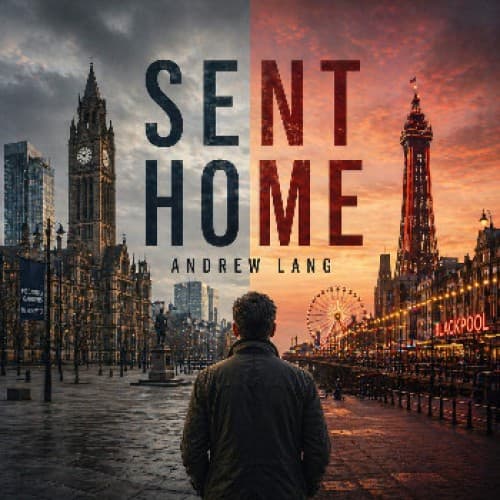
Colin Fenton prided himself on living a life that behaved itself.
His rent went out the first of every month, his bin was on the kerb by seven-thirty, and every USB cable he owned was wound into a little Velcro halo. People thought that sort of neatness was dull; Colin thought it was merciful. Chaos took energy. Order earned interest.
So when the coming week at the agency threatened to burst its calendar squares—three sites to launch, Matteo’s CSS “improvements” to mop up, and the twitchy promise of a Monday morning stand-up—Colin did what any sensible twenty-six-year-old web developer would do: he bought a cheap return to Blackpool and fled.
He booked the room on Thursday night with the professional care he usually reserved for version control. Three browser tabs, five hotel options, a filleting of reviews. One was two pounds cheaper but offered “continental breakfast,” a phrase Colin distrusted on sight. Another included a full English, but only between seven and nine, which struck him as unnecessarily doctrinaire. A third—slightly more expensive, though not offensively so—offered a buffet.
Colin had strong views on buffets. They were, in his experience, the only honest form of breakfast.
Once booked, he felt the small, satisfying click of a decision completed. The weekend existed now. It had a shape, a cost, a timetable. He printed the confirmation email, not because he needed to, but because it was, in a modest way, reassuring to have it in hand.
On a Sunny Saturday, just past noon, the Manchester–Blackpool train coughed itself out of Piccadilly on time, surprising everyone including, Colin suspected, the driver. He slid into a window seat, set his bag overhead with a quarter-turn of the strap, and let the city peel away.
For ten minutes he watched terraced roofs and satellite dishes recede, then let his thoughts drift to work. Next week would be carnage. Matteo would almost certainly ring. So might Steve, though the creative director preferred delegating panic downstream. Colin pictured the phone vibrating mid-seafront and resolved—without quite admitting it—that if they did call he would answer, but only after the third ring. Boundaries mattered.
Halfway to Preston a stray memory bobbed up: the last time he’d done this run. Five years ago, stag weekend, lethal volume of lager. He remembered laughing, definitely. He remembered Blackpool Tower tilting like a polite drunk. He did not remember boarding the return train, yet he’d surfaced at Piccadilly in a dead carriage sometime after midnight, disoriented as an unplugged toaster. A guard—arms folded, late-shift stoic—had been approaching to prod him awake. Colin had offered the man his sincerest apology, which, given the circumstances, had consisted of standing up and not vomiting.
A gap in the ledger, nothing more. Still, it twitched in his head as the train rolled into the same seaside station all these years later.
Blackpool greeted him with its usual battered optimism. Seagulls the size of house-cats wheeled over peeling façades; 8-bit chiptune music leaked from arcades; the air smelled of salt, vinegar, and a kind of municipal resignation. Colin loved it. Cities that admitted their shabbiness were honest cities; they saved you the trouble of pretending to be impressed.
He checked into his hotel—narrow stairwell, nylon carpet, a room whose chief feature was an obedient kettle—and set out again, pockets full of cash he’d withdrawn in Manchester. After twenty minutes of wandering he realised he hadn’t actually checked his balance. Small lapse. Easily fixed.
The promenade cash machine sat in the shadow of a greasy spoon that advertised “TEA LIKE MUM USED TO MAKE.” Colin inserted his card, typed his PIN, and waited for the familiar whirr.
CARD NOT RECOGNISED
He blinked, annoyed, re-entered the numbers with exaggerated care.
CARD NOT RECOGNISED
Behind him a man in a windcheater gave a sympathetic shrug. “That one’s temperamental, pal. Eats cards for breakfast.”
“Figures,” Colin said, tugging the card free. “Perfectly on brand.”
Windcheater laughed, wandered off. Colin pocketed the card—another item for Monday’s to-do list—and continued along the front.
By seven that evening he’d eaten fish-and-chips that tasted of nostalgia and hot oil, watched the tide scuff at the sand, and listened to a teenager on a BMX explain to a friend why donkeys were “basically obsolete.” What he hadn’t done was speak to anyone from work. No missed calls, no voicemails, no Matteo fretting about flexbox gremlins. Odd, given the looming deadline, but not unwelcome. If they were determined to let him rest, he would graciously allow it.
Crossing the road towards the neon throb of the North Pier, Colin caught someone’s eye. A broad-shouldered bloke in a wax jacket nodded at him—a mate’s nod, the half-second recognition you give a colleague in Tesco. Instinctively Colin nodded back, polite smile in place, then glanced over his shoulder to see whom the nod might really be intended for. No-one.
He walked on, faintly puzzled, the lights blooming ahead, the sea breathing its damp, briny approval. Blackpool, scuffed and shameless, seemed to fold him in without comment, as though he’d only stepped out for a moment and was now sensibly home.
It was, he told himself, exactly the weekend he’d planned: small, cheap, uneventful.
Exactly that—and nothing else.