


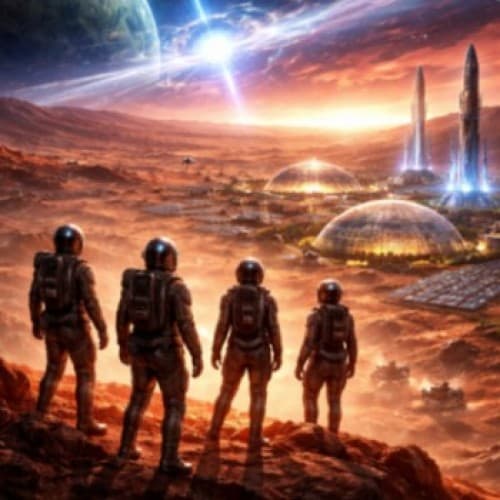

The sun rose over the Earth’s eastern horizon, illuminating the sprawling orbital spaceport of New Houston with a golden glow. The port hummed with activity, as cranes swung containers, shuttles roared into the sky, and engineers scurried along catwalks like ants. At the center of it all, docked in its bay, was the starship Odyssey. Its sleek hull gleamed, a blend of titanium and carbon weave, designed for the impossible: warp space travel.
Dr. Elara Finch strode along the observation deck, her eyes scanning the bay with the precision of a surgeon and the excitement of a child. Years of calculations, simulations, and late nights had all led to this moment. The first crewed test of a warp-capable vessel. The first jump beyond the confines of conventional space.
“Dr. Finch, your attention, please,” said Kai Navarro, a young engineer fresh from the academy, clutching a tablet. “All systems report green. Warp core stable. Life support nominal. External sensors… everything is within tolerance.”
Elara smiled, more to herself than to Kai. “Good. Let’s make history.”
The crew assembled:
Commander Rajesh “Raj” Iyer, the stoic and experienced astronaut whose calm under pressure balanced Elara’s intensity.
Sofia Vega, biologist and terraforming expert, here to observe potential effects of warp jumps on ecosystems during future Mars missions.
Kai Navarro, enthusiastic but inexperienced, eager to prove himself.
They boarded the Odyssey with a mix of excitement and apprehension. The ship’s interior was a maze of consoles, conduits, and glowing panels. The air hummed with the low vibrations of a warp core humming just beneath the deck.
“Elara, remind me why we’re doing this again?” Raj asked, stepping into the control room, voice calm but tinged with skepticism. “Warp travel isn’t proven outside simulations. What if—”
“We’ll succeed,” Elara cut him off sharply, her eyes fixed on the warp drive interface. “Or we’ll fail spectacularly and make history anyway. That’s the point of exploration, isn’t it?”
Raj shook his head but didn’t argue further. There was no point. The world watched. Governments, corporations, the media—all counting on this jump to redefine humanity’s place in the cosmos.
The countdown began. Elara’s fingers danced across the touchscreens, initiating the warp sequence. Lights dimmed, panels glowed bright blue, and a low hum built to a resonant roar.
“Three… two… one… warp!”
Reality seemed to bend around the vessel. The stars stretched into brilliant lines of light. The Odyssey shuddered, as if space itself were flowing around it. For a moment, time felt elastic, the crew suspended between the familiar and the infinite.
Then, just as suddenly, the hum ended. Silence. The stars snapped back to points of light, distant but normal.
“We… we did it,” Kai whispered, eyes wide.
Elara exhaled, a mixture of relief and triumph. “Not just a test. Humanity just touched warp space. And we survived.”
Yet even in the thrill of success, shadows loomed. Newsfeeds flashed with images of corporations lobbying for Martian claims. Governments debated regulations for warp technology. And unknown to the crew, the jump had triggered an anomaly—a subtle disturbance in the space-time continuum, a ripple that would be felt far beyond Earth.
As the Odyssey glided through orbit, preparing to descend toward Mars for the first colonization mission, Elara realized that history had only just begun. The frontier was no longer Earth’s orbit—it was the stars themselves.