


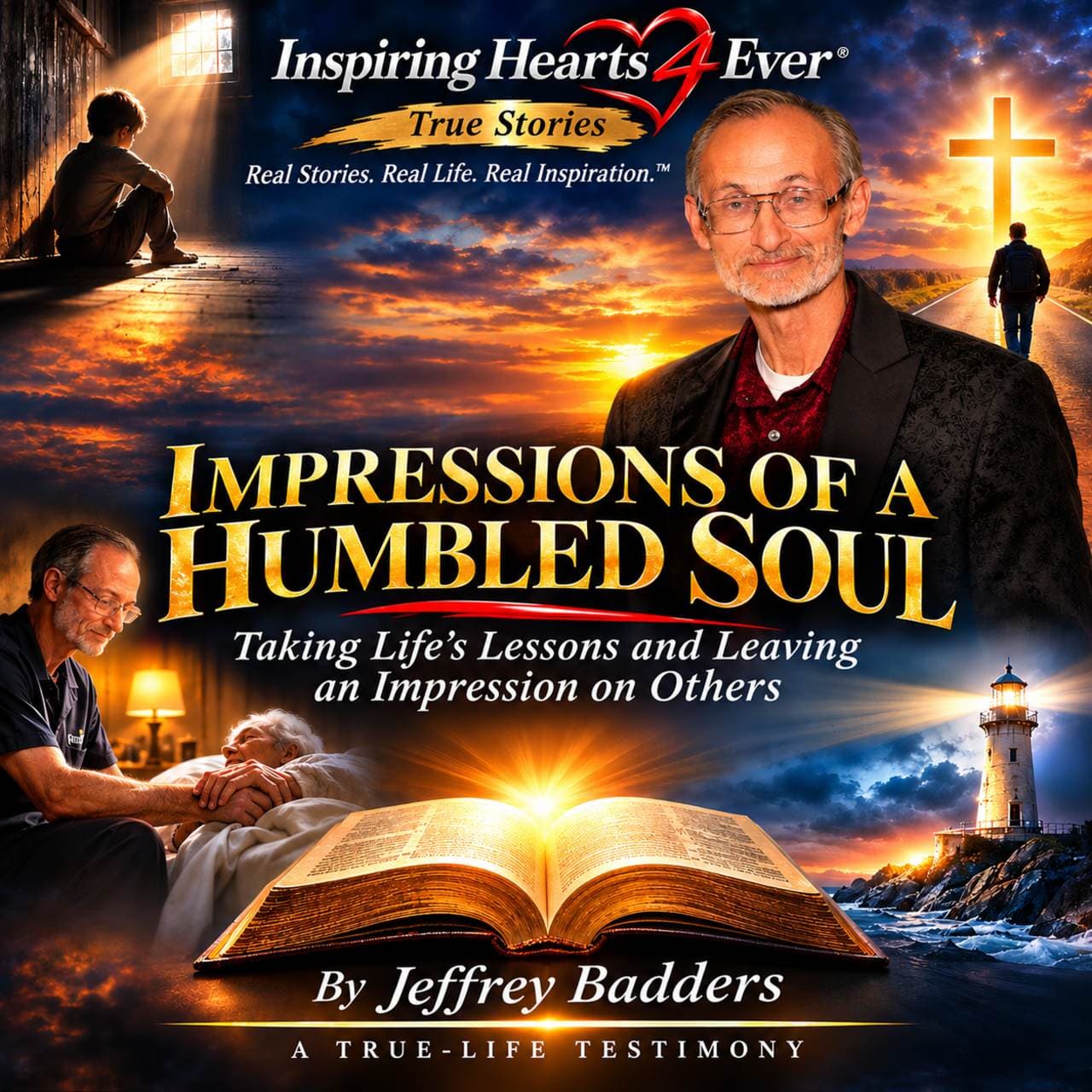
IMPRESSIONS OF A HUMBLED SOUL
Taking Life's Lessons and Leaving an Impression on Others
By Jeffrey Badders
Inspiring Hearts 4 Ever — True Stories
I've spent a lifetime learning how to survive. Now I'm asking myself a different question: Have I learned how to live for myself?
That may sound strange coming from a man who has spent decades helping other people. But the longer I live, the more I understand that giving love and receiving love are two different things. I know how to give. I have practiced that all my life. Learning to accept it, and learning to water the flower growing inside me, has been a much harder lesson.
I wasn't born with a blueprint for the life I would live. I entered this world as a ward of the state. I was never adopted, and I grew up moving through ten foster homes. In some of those places, childhood didn't feel like childhood. There were times when I was alone, when I had to stay quiet, when I learned that speaking could bring consequences. I remember being shut in a dark room. Looking back, it felt like a prison inside of me.
A child in that situation has a lot of time to think. I watched. I listened. I tried to understand what people wanted and how to get through another day. I began building instructions inside myself long before I had words like character, integrity, or purpose. Those instructions helped me survive. But as I've grown older, I've wondered whether some of those same instructions make it harder to accept love or take a new chance.
For a long time, I believed I had to be my own answer. When you grow up without the security you need, depending on yourself can begin to feel safer than expecting somebody else to be there. I still carry that independence. Sometimes I call it stubbornness. Sometimes it has helped me keep going. Sometimes it has left me alone with things I might have shared.
I learned early that respect mattered to me. So did loyalty. I wanted to know who would stand beside me, who would tell me the truth, and who would be there when life got difficult. But I also had to learn that I couldn't make somebody love me by giving them everything I had.
I was married, and that marriage ended. Relationships taught me that love could be one of the most expensive investments a person makes—not just in money, but in the heart, mind, body, and soul. I could learn from those experiences without pretending they didn't hurt. I had to look at myself, too. I couldn't spend my whole life pointing outside myself for the reason something had gone wrong.
One of the hardest things to do is stand in front of a mirror and ask who you are when nobody else is there to give you an answer.
Learning to Listen
I worked at Dillon's in Salina, Kansas, for seven years. I learned lessons there that stayed with me beyond the store. I remember listening to a coworker's ideas about how people might be better placed in different departments. Sometimes a person is struggling not because they don't want to work, but because nobody has stopped to understand where they might do their best. Listening can change the way you lead.
I also remember a young coworker who rode a bicycle several miles to work a night shift while dealing with problems at home. I knew what it meant to carry things other people couldn't see. You don't have to know every detail of a person's life to recognize that they might be fighting a battle.
Later, when I worked in sales, I found that listening mattered more than pushing somebody toward a purchase. If a customer came in looking for a suit or a pair of shoes, I wanted to understand what they needed. I didn't want to make the decision for them. I wanted to be part of the solution instead of creating another problem. I sometimes called that my own kind of reverse psychology: stop trying to sell yourself and pay attention to the person standing in front of you.
That lesson followed me into hospice work.
I've been a hospice aide for decades, across multiple states. The people I met came from different backgrounds, different families, and different beliefs. When I entered someone's life, I didn't want that moment to become about me. Their time was about them. Their needs were about them. Their loved ones were trusting me with someone precious to them.
There were times when I worked double shifts, slept in my van, and pushed my body farther than I should have. I had removed the back seats from my white Chrysler van and made room for a mattress and a few necessities. I remember a small refrigerator and a Coleman lantern. Sometimes I showered at a gym. I spent time writing and thinking by myself, trying to understand the life I was building.
I earned money, but I paid a price for the hours. There were times I was exhausted and cried because I wished I could give patients more of my time. I understood loneliness from my own childhood, and I didn't want somebody at the end of life to feel forgotten. But caring about other people didn't mean my own body stopped needing rest.
I used to say that money is a tool for freedom, but you can pay a price for it in the end. I still have to remember that lesson. Giving everything away, even your energy, doesn't leave much for the person who has to wake up and live your life tomorrow.
In 2008, while working with Hospice of the Valley, I remember receiving the Medical Director's Hospice Aide of the Year Award. When I spoke, I didn't want the recognition to be only about me. I talked about the team. I thought of a wagon wheel: every spoke matters. Nurses, aides, social workers, and the other people involved in someone's care depend on communication and one another. One person cannot be the whole wheel.
That experience meant something to me, but it didn't change what I believed about being with patients. I wasn't there to impress anyone. I was there to listen and to care.
The Things We Carry
Some memories don't settle simply because the years pass.
At my mother's funeral, I learned that she had kept baby photographs of me from before I entered state care. I wanted copies. I wanted to see where my legacy started. My sister refused to give them to me, and in anger I said something I have regretted ever since: "I wish you weren't here on this Earth."
I cannot take those words back.
Later, I tried to reconnect with her through Facebook and asked again about the pictures. She spoke about painful experiences from her own childhood and didn't want to go back into them. Our contact ended. She later died by suicide. I will not pretend to know everything she was carrying or why she died. What I do know is that I regret what I said, and I never received those photographs.
I still wonder what it would have been like to see that little boy before the foster homes, before all the lessons he had to learn. Sometimes the things we want most aren't money or possessions. Sometimes we want a piece of our own beginning.
I have spent much of my adult life trying to become a man who can learn from his mistakes. That doesn't mean I have stopped making them. It means I have to be willing to look in the mirror. Character and integrity aren't things you can announce and expect everybody to believe. They are things you have to practice.
I also learned that you cannot always change the direction life takes. Sometimes you have to change within yourself.
Finding a Voice I Didn't Know I Had
For years, a different dream sat quietly inside me. I wanted to write. I wanted to stand on a stage and speak to people about life, hope, and the things I had learned. But wanting something and believing you can do it are not the same thing.
I found an unexpected kind of courage through gaming and social media. Around the age of fifty, I began playing Overwatch. I wasn't the greatest player, and younger people sometimes made fun of my age or how I looked. I turned some of that into humor. I called myself "the number one trash player in the world on Xbox One."
For somebody who didn't have much opportunity to enjoy games as a child, playing brought me laughter and connection. It gave me something I could do for the joy of it. And eventually I had to face another fear: showing my face on camera. I was shy about it. But I told myself, "Just do it."
On TikTok, I began sharing stories and talking with people. One of my earliest followers was a woman who accepted me as I was; her husband followed too. Others came along. I wasn't trying to be someone I wasn't. I wanted to inspire, encourage, empower, and enlighten people's souls. I told people I wasn't there to impress them.
Over time, the account grew to about 52,000 followers. I never imagined that many people might listen to me. I had spent so many years doubting whether I had anything worth saying. Then I found myself speaking to an audience.
It didn't last the way I hoped. A conflict during a livestream involving a guest and another person escalated, inappropriate language became part of the situation, and my account was banned. I lost the audience I had built. I was devastated for a while.
But I had been through the experience of starting over before. I rebuilt on another platform and kept finding ways to connect with people. Life can feel like a washing machine, turning you through another cycle just when you thought you'd finally reached steady ground. I didn't enjoy losing what I had built. I also didn't want that loss to be the end of my voice.
The surprise is that I eventually began writing true-life stories. I'm still shocked by how far I have gone with them. A dream I had kept on the shelf became something I was actually doing.
The Dusty Book
I think of that old dream as a dusty book in the library of my life.
For years, I left it on the shelf. I told myself maybe I would open it later, maybe in five or six years. But the book was getting older. I was getting older. The world was changing. And I started asking myself a frightening question: If I finally take that book down, will the instructions inside still work for the man I am today?
The fear isn't only that people might judge me on a stage. It's that I may need to build a new blueprint for myself. I spent years building the habits that helped me survive. Now I might have to leave some of those habits behind, take a chance, and risk being hurt or disappointed again.
I've been through pain before. Sometimes I ask myself why I should walk toward more pain when I can't know whether the dream will work out.
And I have to be realistic. Not everybody gets to follow every dream. Not every dream comes true. If I finish writing my stories and put books into the world but never speak on a stage, does that mean everything was for nothing? I don't believe it does. Yet I still hope that if an opportunity comes, even ten years from now, I'll have the foundation and the strength to try. I call it speaking in a land of the unknown.
Writing has shown me that I can take a step without having every answer first. It hasn't erased my fear. It has given me something real to point to when I wonder whether I can change.
The Gardener and the Lighthouse
I have an image I return to when I think about the people I've met. Every person has a flower inside them. That flower needs attention. It needs time. It needs the chance to grow.
I've spent so much of my life watering other people's gardens. I wanted people to feel seen, accepted, and encouraged. I hoped that if I planted a good seed, someday that person might become a gardener for somebody else.
But I have to admit something: I have trouble watering my own flower.
I can be so focused on giving love that I forget to ask what I need. I can tell somebody else to believe in themselves while I'm still learning to believe in the man I see in the mirror. I can help another person recognize their worth and still struggle to understand that my own worth isn't dependent on what I do for anybody.
That is part of the story too. I don't want to pretend I have mastered a lesson I'm still learning.
I've made personal choices about my routines, eating, and caring for my body because I want to enjoy my later years. Those choices are mine, not instructions for anybody else. What I want people to hear is the deeper point: pay attention to your life while you are living it. I don't want to arrive at retirement and discover that all I know how to do is survive.
Discipline, determination, dedication, and motivation have helped me keep moving. But I am learning that discipline also has to include knowing when to listen to yourself.
If somebody opens one of my books years from now, I hope they understand that there will be days when they want to quit, days when they are happy, and days when sadness seems to fill everything. I don't want to promise them an easy life. I want them to know that they can keep learning who they are, and keep finding the courage to be the person they believe God meant them to be.
I don't know what every reader is going through. I cannot tell them that my way will work for them. I've spent my life reading myself, trying to understand my own heart, mind, body, and soul. Their life will ask them different questions. I hope my stories encourage them to ask those questions honestly.
You can call me the gardener and the lighthouse. The gardener wants to help something grow. The lighthouse wants to offer a little light when someone is trying to find their way. I don't need to know whether every seed takes root. I only know why I wanted to plant it.
A Different Kind of Goodbye
There is another book I know I will eventually have to close: my career as a hospice aide.
I love that work. The thought of stepping away from patients one day feels like heartbreak. I think it will take half my heart with it. Hospice gave me something I had wanted for so long: a place where people welcomed me, trusted me, and appreciated what I could do for their loved ones. In those moments, I felt valuable. I felt worth something.
That career became a safety net for me, almost a form of life support. I know that sounds strong, but it's how I describe it. After everything I experienced growing up, being allowed into people's lives and being trusted to care for them meant more than a paycheck.
I hope to keep volunteering after I retire. I don't expect the part of me that wants to give love to disappear. But I know that volunteering won't make the transition painless. I'll have to learn a new routine. I'll have to open unfamiliar doors and build another foundation, at a time when I feel I have less time to figure things out than I did as a child.
There are things I still want to experience. I want my golden years to be about living, not simply trying to make it through another day. I want to write. I want to keep learning. And if a stage opens up for me, I want to have the courage to walk onto it.
I am proud of the battles I've fought and the victories I've won. I am proud that I was strong enough to get through experiences that could have stopped me. But I don't want my life to become only a list of battles. I want to become a better person for myself as well as for the people around me.
The Man in the Mirror
If I could speak to the little boy who once sat alone in that dark room, I wouldn't tell him that everything turned out perfectly. It didn't. I wouldn't tell him that he would never make mistakes, never lose people, or never be afraid. He would know better than to believe that.
I would ask him to look at the battles he survived before he ever became the man he is today. I would tell him that pain can shape character, but that he still has choices about what kind of character he builds. Knowledge and wisdom matter. So do integrity and the way he treats people. Respect is something I have always valued deeply, and I want to live in a way that deserves it.
Most of all, I would tell him that changing your life isn't always about finding a different direction. Sometimes it's about changing within yourself.
I still have questions. I still have habits to examine. I still have a dream sitting partly in the unknown. And I still have to learn how to give myself some of the love I've spent so many years giving other people.
Maybe that's what it means to keep growing: not pretending the past never happened, and not waiting until you are fearless to begin the next chapter.
I am not here to impress anybody. I am here to keep becoming the man I believe I was meant to be, and to leave something of value with the people whose lives cross mine.
And when I look in the mirror, I want to have the courage to recognize that the man standing there matters, too.
---
Author's Note — A True-Life Testimony
This story is drawn from my lived experiences, recollections, beliefs, and reflections. Some events and relationships remain painful or unresolved. I share them not as a claim that I have every answer, but as an account of what I am still learning about love, respect, purpose, and the courage to change within myself.
My personal health practices are not medical recommendations. Details and quotations remain subject to final author verification.
Written collaboratively by Jeffrey Badders with AI writing and editorial assistance.