


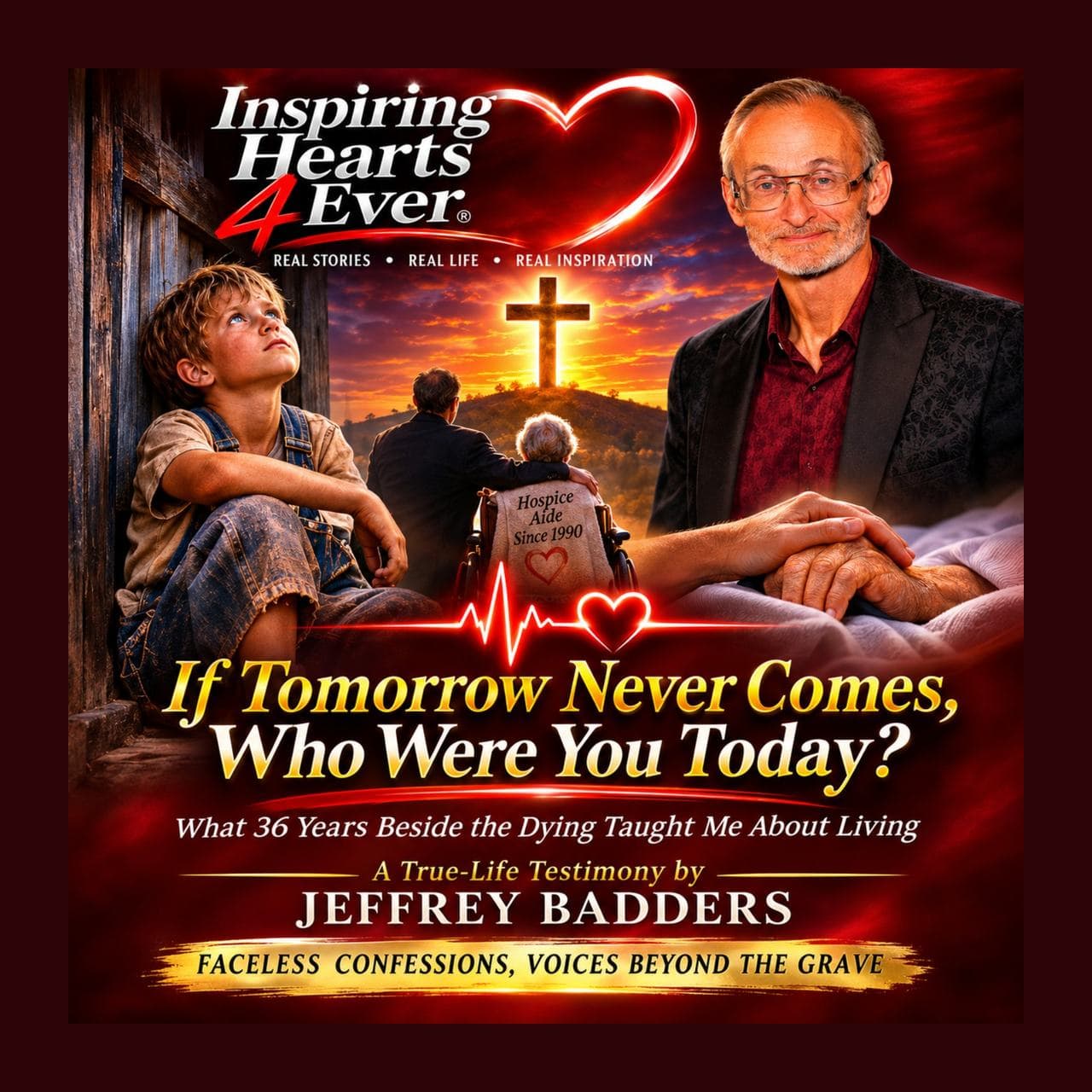
If Tomorrow Never Comes, Who Were You Today?
What 36 Years Beside the Dying Taught Me About Living
A True-Life Testimony by Jeffrey Badders
Faceless Confessions, Voices Beyond the Grave
---
Before You Read Their Stories
Before I take you into the lives of the people I met throughout my hospice career, there's something I want you to understand.
I want you to understand the man who was standing beside them.
Because I wasn't always that man.
Long before I became a hospice aide, I was a little boy searching for something that seemed so simple.
Love.
I wanted to know what it felt like to belong somewhere. I wanted to know what it felt like to have somebody look at me and see a child worth loving.
I was a ward of the state from birth. I lived in ten different foster homes, and I was never adopted.
Some of those years were filled with experiences that no child should have to endure.
I knew what loneliness felt like before I understood what loneliness meant.
I knew what it was like to be frightened, to feel forgotten, and to wonder whether anybody cared what happened to me.
And there were times when I felt like I was dying inside, even though I was still alive.
That's something I've never forgotten.
But this isn't going to be another story about everything that happened to that little boy.
I've written about him.
I've written about the darkness.
I've written about the love he searched for and the strength he had to discover within himself.
This story is about what happened when that little boy grew into a man and found himself standing beside people who were approaching the end of their lives.
Because somewhere along that journey, I discovered that the things I had experienced as a child would influence the way I understood other people's suffering.
And for 36 years, that understanding became part of my life's work.
My name is Jeffrey Badders.
I've been a hospice aide since 1990, working across multiple states.
And before you read the stories of the people who changed my life, I want you to know why I was there.
The Little Boy Who Never Stopped Looking
When I look back at my childhood, I don't just remember the places I lived.
I remember the feelings.
I remember what it was like to want somebody to understand me.
I remember how important a little kindness could have been.
I remember learning that sometimes you had to find your own strength because nobody was coming to give it to you.
But there was something inside me that I didn't want the world to take away.
My ability to love.
As a child, I searched for love in other people.
And when I couldn't find the love I was searching for, I eventually made a decision.
If I couldn't find love, I would give love.
I didn't understand where that decision would take me.
I didn't know that one day I would spend decades working with people who were dying.
I didn't know that the loneliness I experienced as a little boy would help me recognize loneliness in somebody else's eyes.
I certainly didn't know that some of the people who would give me the greatest understanding of life would be people who were approaching death.
But life has a way of teaching you things that you never expected to learn.
Sometimes the lessons don't arrive when you're ready.
Sometimes they arrive after you've already been through the storm.
And sometimes you don't understand what an experience taught you until many years later.
I found God along my journey.
My faith became part of the foundation I continued building as I grew older.
And I began to understand something about myself.
I didn't want to spend the rest of my life allowing the darkness of my childhood to decide who I was going to become.
I wanted to become somebody who could bring something different into another person's life.
I wanted to inspire, encourage, empower, and enlighten people's souls.
But wanting to do something and learning how to do it are two different things.
I still had a lot to learn.
The Other Side of the Fence
When I entered hospice in 1990, I knew a little about what hospice was.
But I didn't fully understand it.
Looking back, I wish somebody had sat me down and explained it in a way that I would never forget.
I wish somebody had told me there were two sides of a fence.
On one side, people are living their lives, making plans, thinking about tomorrow, and expecting that they'll have more time.
They're going to work.
They're raising families.
They're making decisions.
They're worrying about bills, relationships, and everything else that comes with everyday life.
They may be thinking about what they're going to do next week, next month, or next year.
But on the other side of that fence, there are people facing something entirely different.
They're approaching the end of their lives.
For many of the people I cared for, the focus was no longer on curing their illness.
It was on comfort.
It was on helping them through the time they had remaining.
And I had to learn what that really meant.
Because I wasn't entering their lives with a promise that I could make everything better.
I couldn't promise them another year.
I couldn't promise them another month.
I couldn't even promise them another tomorrow.
I had to understand that the work I was doing wasn't about defeating death.
It was about caring for a person who was still alive.
Think about that.
Somebody can be approaching the end of their life and still have feelings.
They still have memories.
They still have opinions.
They still have fears, hopes, regrets, and things they want somebody to understand.
They still have a story.
And that story doesn't stop mattering just because their time is becoming shorter.
That was one of the biggest things I learned about hospice.
The person was still there.
And while they were still there, the way I treated them mattered.
The First Thing I Had to Learn
I didn't begin my hospice career knowing everything.
I had to learn.
And one thing I believe applies to almost any occupation is that you have to learn how to put your ego aside.
When somebody has been traveling a road longer than you have, pay attention.
They have experience you don't have yet.
They've been there.
They've done that.
They've made decisions, faced problems, and learned things that you might not understand until you've experienced them yourself.
I respected that.
When I worked with people who had more experience than I did, I listened.
I didn't believe I needed to judge them or pretend I knew everything.
I wanted to understand what they had learned.
Because they had earned something through their years of experience.
And I could learn from it.
Eventually, when I was working more independently, I took that knowledge with me.
I didn't have to become an exact copy of somebody else.
I could take what I learned and discover what worked best for me within my responsibilities.
That's part of becoming experienced.
You listen.
You learn.
You practice.
You make mistakes.
You keep learning.
And over time, you begin to understand not only what you're doing, but why you're doing it.
I've made mistakes in my life.
A lot of them.
But I've always believed that when you make a mistake, you need to look for a solution.
Sometimes you have to look at the problem from a different direction.
Sometimes you have to ask somebody for advice.
And sometimes you have to admit that you don't have the answer.
There's nothing wrong with that.
In healthcare, you have responsibilities.
You have people depending on you.
And you need to understand when something is your responsibility and when it needs to be handled by somebody else.
I learned to use the chain of command.
I asked for advice when I needed it.
And I tried to remember something important.
Think before you react.
Because not every problem needs an immediate emotional response.
Sometimes you need to stop, understand the situation, and make a better decision.
I wasn't getting paid to solve every problem in the world.
And I didn't have to.
I needed to understand my role, do my work responsibly, and know when to ask for help.
Learning to Enter Somebody Else's World
Throughout my career, I met people with different personalities, different attitudes, different beliefs, and different ways of looking at life.
That included patients, families, and the people I worked alongside.
And one thing I learned was that everybody has their own world.
Everybody communicates differently.
Everybody has their own experiences that influence the way they see things.
Sometimes people don't understand each other because they're too busy trying to make somebody else see the world exactly the way they do.
I didn't want to do that.
I learned to recognize a person's vibe.
I paid attention to their attitude.
I listened to their opinions.
I tried to understand how they approached life.
And then I tried to communicate with them in their world.
Not mine.
That doesn't mean I agreed with everything.
There were times when somebody's attitude or behavior wasn't right for me.
And when that happened, I tried to remain calm.
I didn't believe I needed to tell everybody how to live.
I wanted to be a role model.
I wanted people to see how I conducted myself.
They could decide for themselves whether there was something they wanted to learn from it.
I believe actions can communicate things that words sometimes cannot.
And when you're working with people, especially people who are vulnerable, the way you conduct yourself becomes important.
It's not always about having the perfect words.
Sometimes it's about the way you enter a room.
The way you listen.
The way you respond when somebody is frustrated.
The way you respect another person's choices.
I had to learn that I wasn't there to make somebody live in my world.
I needed to understand theirs.
And sometimes that meant slowing down.
Because it wasn't about me.
It was about them.
When Hospice Becomes Family
When most people hear the word hospice, they think about death.
And I understand why.
Hospice is associated with people who are approaching the end of their lives.
But there's another side of hospice that I don't believe everybody sees.
I've cared for people who didn't have family there with them.
Think about what that means.
You're approaching the end of your life.
You know your time may be limited.
And the people who are there helping you might not be your children, your brothers, your sisters, or your lifelong friends.
They might be the people from hospice.
I've seen situations where hospice workers became the closest thing to family that a patient had during that time.
And that was sad to see.
Because nobody wants to feel forgotten.
Nobody wants to feel that their life didn't matter.
Nobody wants to feel that they're facing something frightening without anybody caring.
And I knew something about those feelings.
Not because I had experienced the end of life myself.
But because I had experienced loneliness.
I knew what it felt like to want somebody to be there.
And when I looked at those people, I didn't want them to feel that nobody cared.
I wanted to help them find some kind of peace within their hearts, minds, and souls.
I wanted them to feel safe.
Protected.
Understood.
Respected.
I wanted them to know that somebody recognized the person they were.
Not just the illness they had.
Not just the care they needed.
The person.
Because when somebody is approaching death, they don't stop being a human being.
Their dignity still matters.
Their privacy still matters.
Their choices still matter.
Their feelings still matter.
And I wanted to remember that every time I entered somebody's life.
The Things People Carry
Over the years, I learned a great deal from the older generations.
I listened to people who had lived through experiences I could only imagine.
They taught me about morals, values, ethics, and beliefs.
They had walked roads I hadn't walked.
And sometimes I would ask them a question.
What was the secret to living as long as they had?
I wanted to understand what they had discovered.
Because I believed there was knowledge in those years.
And some of the answers brought me back to something simple.
It starts within you.
I've thought about that many times.
As we get older, we carry things with us.
We carry memories.
We carry victories.
We carry mistakes.
Sometimes we carry regrets that we've never completely faced.
I've described it before as an invisible backpack.
A backpack filled with things nobody else can see.
And sometimes we carry that backpack for so long that we forget how much weight is inside it.
When you're approaching the end of your life, those things may become important in ways they weren't before.
You may begin thinking about decisions you made.
People you loved.
People you hurt.
Things you accomplished.
Things you never had the courage to try.
And sometimes you may want somebody to listen while you try to understand it all.
I didn't believe my job was to judge somebody's entire life.
I hadn't walked every road they had walked.
I didn't know every struggle they had faced.
And I certainly didn't know everything they carried inside them.
But I could listen.
I could respect the life they had lived.
And I could recognize that the person in front of me had a story that was worth hearing.
The Price of My Passion
There's something else I want people to understand about my hospice career.
I loved what I did.
And sometimes that passion came at a personal cost.
I spent many years on my own.
I dated off and on, but relationships weren't always easy for me.
There was a time when I was living in San Diego and dating a woman.
I was working full-time in hospice, and I was also volunteering.
On some weekends, I would spend time volunteering while she pursued her own activities.
But eventually, there was conflict over how much time I was giving to other people.
She questioned why I was spending so much time with them.
And I looked at it differently.
I felt that the people who were dying needed me more at that moment.
That was how strongly I felt about the work.
And that relationship ended.
When I look back, I can see that my passion affected my personal life.
There were sad days.
There were lonely days.
And sometimes I wondered whether the way I prioritized my work was selfish.
I don't want to pretend that I had everything figured out.
I didn't.
I had spent so much of my childhood searching for love.
Then I entered a profession where I was giving love, receiving kindness, and feeling appreciated.
It was almost like something I couldn't stop doing.
The more I helped people, the more I wanted to help.
The more I felt that I was making a difference, the more important the work became to me.
But I also had to learn that having a passion doesn't automatically mean you know how to balance every part of your life.
You still have to live your own life.
You still have to make decisions about your future.
You still have to recognize that time is passing for you, too.
And sometimes, when you're so busy trying to help everybody else, you have to remember to stop and look at the life you're living.
That's something I continued learning as the years went by.
Your Résumé Is Your Health
Here's another thing I want people to understand.
In my eyes, your résumé is your health.
Think about that for a moment.
You can have all the experience in the world.
You can have knowledge, education, ambition, and dreams.
You can have a long list of accomplishments.
But if you don't have your health, how are you going to make those things happen?
That's why I tried to take care of myself throughout my career.
I wanted to keep myself in shape.
I wanted to be able to do the work.
And when it came to physically helping patients, I had to use common sense.
You need to understand how to use the proper equipment and safe techniques when helping somebody move.
You need to recognize when you need assistance.
You need to think about the decisions you're making.
Because you can have the best intentions in the world, but that doesn't mean every decision you make is a safe one.
Taking care of yourself is part of being able to take care of other people.
And that lesson doesn't apply only to healthcare.
It applies to life.
Sometimes people spend years building their careers, chasing their dreams, and working toward something they want.
But they forget about the very thing that allows them to keep going.
Their health.
That's why I say your résumé is your health.
Without it, so much of what you want to accomplish can become more difficult.
And I wanted to keep doing the work I loved for as long as I could.
Learning What I Couldn't Control
One of the hardest things about wanting to help people is understanding that you can't make every decision for them.
You can't force somebody to accept your help.
You can't make everybody think the way you think.
And you can't control every situation just because you want a good outcome.
Sometimes I had to take a deep breath.
Sometimes I had to remind myself that people have to learn certain things on their own.
I understood that because I had learned so many things on my own as a child.
If somebody wanted my help, I was willing to give it.
But if they didn't want it, I had to respect that.
There is a difference between offering help and trying to control somebody else's life.
And I didn't want to become somebody who believed that my way was the only way.
I wanted to understand people.
I wanted to respect their choices.
And I wanted to recognize the limits of what I could do.
That doesn't mean I stopped caring.
It means I had to learn how to care without believing I could control everything.
There were also times when I had to work on myself.
I had to build my confidence.
I had to stay motivated.
I had to pay attention to my attitude.
I had to recognize when I needed to change the way I approached something.
Because you don't become a better person simply by getting older.
You have to be willing to keep learning.
And throughout those 36 years, I was still learning.
The Man Those Years Helped Me Become
When I look back at the man who entered hospice in 1990, I see somebody who had a lot of life ahead of him.
I also see somebody who had already experienced a great deal of pain.
I had been through ten foster homes.
I had lived through experiences that shaped the way I looked at the world.
I had made mistakes.
I had faced struggles.
And I was still trying to understand my purpose.
But the people I met throughout my hospice career taught me things I could never have learned from a textbook alone.
They taught me to listen.
They taught me to recognize that everybody carries a different story.
They taught me that people don't all communicate in the same way.
They taught me that respect isn't about agreeing with somebody on everything.
They taught me that experience matters.
And they taught me something about time.
Time is something we talk about constantly.
We talk about not having enough of it.
We talk about wasting it.
We talk about what we're going to do when we finally have more of it.
But when you're working with people who know their lives may be coming to an end, you begin to look at time differently.
You begin to recognize how much can happen inside one moment.
A conversation.
A memory.
A smile.
A person feeling heard.
Those things may seem small to somebody who believes they have years ahead of them.
But when time becomes limited, a moment can take on a different meaning.
I've said something throughout my journey that I want people to think about.
You can't give time more life, but you can give life more time.
To me, that means looking at the life inside the time somebody still has.
It means recognizing that a person's remaining days still matter.
And it means understanding that being present can sometimes be more meaningful than having the perfect words to say.
I didn't always have the answers.
I wasn't there to solve every regret or every problem.
I was there to do my part.
And I wanted to do it with dignity, respect, privacy, and love.
When They're Ready to Fly Home
There's a connection between the little boy I was and the man I became that I want you to understand.
When I was a child, there were times when I felt completely alone.
I didn't understand why certain things were happening to me.
I didn't understand why love seemed so difficult to find.
And I didn't know what my future would look like.
But that little boy kept going.
He kept searching.
He kept believing that there had to be something more waiting for him.
And years later, when I found myself working beside people who were approaching the end of their lives, I remembered what loneliness felt like.
I remembered what it meant to want somebody to care.
I didn't want those people to feel forgotten.
I didn't want them to believe that their lives no longer mattered.
And when their time was coming to an end, I wanted them to know that somebody was there.
I wanted to be a light in their darkness.
I wanted to show love where there was loneliness.
I wanted them to feel that somebody recognized their humanity.
And I wanted them to know that they weren't simply another patient on somebody's schedule.
They were people.
People who had lived.
People who had loved.
People who had experienced things I might never fully understand.
People whose stories deserved respect.
That's what these 36 years meant to me.
I wasn't just giving something to the people I cared for.
They were giving something to me, too.
They were teaching me about life.
They were helping me understand the man I was becoming.
And they were showing me that my childhood didn't have to be the ending of my story.
It could be part of the foundation.
The little boy who once searched for love grew into a man who wanted to give it.
And somewhere along the way, I discovered that giving love could also bring love back into my own life.
I found appreciation.
I found kindness.
I found respect.
And I found a purpose that continued carrying me forward.
Why I'm Telling These Stories
Now you understand a little more about the man behind these stories.
But there's something important I want you to remember as you read them.
These aren't stories about me being some kind of hero.
They're stories about human beings.
People who had their own dreams, struggles, accomplishments, regrets, and memories.
People who came from different backgrounds.
People who saw the world in different ways.
People who taught me things about life while they were approaching the end of theirs.
And I want you to meet them through the experiences I remember.
I want you to understand that hospice isn't simply a place where people wait to die.
It's a form of care centered on comfort, dignity, and quality of life for people facing serious illness near the end of life.
But beyond the medical side of that work, there are human experiences that deserve to be understood.
There are conversations.
There are relationships.
There are moments of loneliness.
There are moments of peace.
And there are people whose lives are worth remembering.
I'm not going to pretend I remember every word spoken during 36 years.
I don't.
And I won't invent something simply to make a story sound better.
These are my memories.
My experiences.
The things I learned.
The people who helped shape the person I became.
Their privacy and dignity matter, even when I'm telling a story about what I experienced.
And as you read, I hope you'll remember that every person has a story that extends far beyond the final chapter of their life.
The Voices I Carry Forward
I learned early in hospice that being there for someone at the end of life was not only about the physical work. There was a mental and emotional responsibility, too. I could not cure the people I served. But I could listen, respect their privacy, and offer love and dignity in the time we had together.
I remember the first patient I lost. Afterward, I wrote in my journal and questioned whether I was cut out for this work. But something in me told me to return. I wanted the next person I cared for to feel loved at the end of their life.
Over the years, I trained other hospice aides. I could explain the basics, but I could not give another person my rhythm. Each aide had to discover how to be present with the person in front of them. I believed we were helping write some of the final chapters in another person's life, and that our decisions would stay with us.
The experienced hospice workers taught me something I carried forward: do not make every difficult moment about yourself. You cannot control every circumstance. What you can give is your time, kindness, respect, love, and dignity.
I never wanted to be a polished speaker who stood on a stage just to sell something. I wanted to stand there and tell something real. I wanted people to feel the experience behind the words. I wanted to speak for the voices that could not speak, for the people whose stories had gone unheard.
For a long time, I invested my time, energy, and money in helping other people follow their dreams while I kept putting my own aside. I loved writing in my journal. I dreamed of becoming an inspirational and motivational speaker. I told myself that maybe my time would come someday.
But hospice taught me how quickly time passes. I cannot give yesterday another chance. I can only ask what imprint of kindness or gratitude I am leaving today.
I have never measured my success by whether I owned a house, drove a fancy car, or had expensive things. I have measured it by learning who I am and using the gifts God gave me. A listening ear is a gift. A helping hand is a gift. Forgiveness is a gift. You do not have to buy something to give something meaningful.
And I am still following my dream. I want to write my books, speak to people, and inspire, encourage, empower, and enlighten their souls. I want them to ask what they were put on this earth to do—not only for someone else, but for themselves.
The Story I Almost Kept on the Shelf
There is something I have struggled with even after all these years of listening to other people's stories: whether my own story was worth telling.
I remember being interviewed in Scottsdale in July. I told the speaker that everybody has a story, and mine was a dime a dozen. Everybody has suffered in some way. Some people have suffered more than I have. Why would my story be important?
I wasn't looking for the spotlight. I had spent so much of my life helping other people step into theirs. I wanted to see their dreams bloom. And if my chance came someday, I would be grateful. If it never came, I could still recognize the love and respect people had given me along the way.
But I kept thinking about all the people whose stories had gone unheard. The people who had something to say but didn't have the strength or courage to say it. I had listened to people who wanted to tell someone what they carried inside, sometimes things they had carried for years. They wanted to set down that invisible backpack and find peace.
I wanted to say to them: I'm here to listen. You have a heart. You have a story. You have a gift to offer this world in your own unique way. Don't hold back who you are because somebody judged your character. Stand tall, and let the way you live tell your story.
Maybe I needed to hear those words myself.
For 36 years as a hospice aide, I never took a break from that calling. There were so many people who needed love, who wanted to be heard, who needed someone to understand that their world was different from the world outside their room. I remember thinking that when one chapter was finished, it was time to put that book back on the shelf and reach for another. Another person needed my help.
I learned to slow down, trust the journey, and water the flower inside myself, too. I learned that attitude, motivation, direction, values, and self-confidence are like a billboard showing the world who you are. Whether you're on the job or outside it, your actions speak. You're always representing something, even when you think nobody is watching.
I still dream of writing my books and standing before an audience as an inspirational and motivational speaker. I don't want to stand there to sell people something. I want to tell them something. I want them to feel the experience behind the words.
And if I ever get that opportunity, I want to ask people what I have had to ask myself: After all those years working, collecting accomplishments, and helping build someone else's dream, what was your purpose on this earth? What did you do for the people in this world—and for yourself?
I cannot answer that question for anybody else. But I can keep trying to answer it with the life I have left.
If Tomorrow Never Comes
Now I want to turn the question toward you.
Because after spending 36 years working beside people who were approaching death, there's something I want you to realize.
We don't know when our time is going to come.
We can make plans.
We can build careers.
We can chase dreams.
We can tell ourselves that someday we'll do the things we've always wanted to do.
But none of us knows exactly how much time we have left.
And that's why I want you to look at the life you're living right now.
Not just the mistakes you've made.
Not just the things you've accomplished.
Not just the person you used to be.
I want you to look at who you are today.
Think about the decisions you're making.
Think about the way you're treating people.
Think about the dreams you've been putting aside.
Think about the values you believe in and whether you're living by them.
Think about the people who matter to you.
And think about the person you're becoming.
Because you're the author of your own story.
You may not get to choose every experience that happens to you.
I certainly didn't.
But you can make choices about what you do with the life you have.
You can keep learning.
You can change your direction.
You can recognize when something isn't working.
You can ask for help.
You can build yourself into somebody different from the person you were yesterday.
And while you're still here, you have an opportunity to decide what you want your life to represent.
I've asked myself many questions throughout my journey.
But there's one question I want to leave with you.
One question that I hope you'll remember long after you've finished reading these stories.
Is this who I was meant to be?
Not who somebody else wanted you to become.
Not the person you've been pretending to be.
The person you believe you were put on this earth to become.
Because someday, when your own story reaches its final chapter, you may look back at the life you've lived.
And I hope that when you do, you'll recognize the values you stood for, the battles you fought, the lessons you learned, and the people whose lives you touched.
I hope you'll recognize yourself.
I hope you'll know that you tried to live your purpose.
And I hope you won't have to wonder why you kept putting your dreams off until tomorrow.
Because tomorrow is something none of us has been promised.
So before you turn the page and begin reading the stories of the people I met throughout my hospice career, I want you to ask yourself one more time:
If tomorrow never comes, who were you today?
Don't fake it until you make it. Faith it until you make it.
The foundation is built through discipline. The legacy is created through action.
The darkness built the foundation; our actions bring the legacy into the light.
---
Author's Note — A True-Life Testimony
This introduction is based on my personal memories, experiences, and reflections from 36 years working as a hospice aide across multiple states.
My purpose in sharing these experiences is to help readers understand the connection between my childhood, the man I became, and the work that gave so much meaning to my life.
The reflections are presented as personal testimony. The narrative has been organized and edited for clarity and readability, without intentionally inventing events, patients, or conversations.
The individual hospice stories that follow will explore particular experiences while protecting the dignity and privacy of the people involved.
Written collaboratively by Jeffrey Badders with AI writing and editorial assistance.
Jeffrey Badders
Founder, Inspiring Hearts 4 Ever
Hospice Aide — 36 Years Across Multiple States