


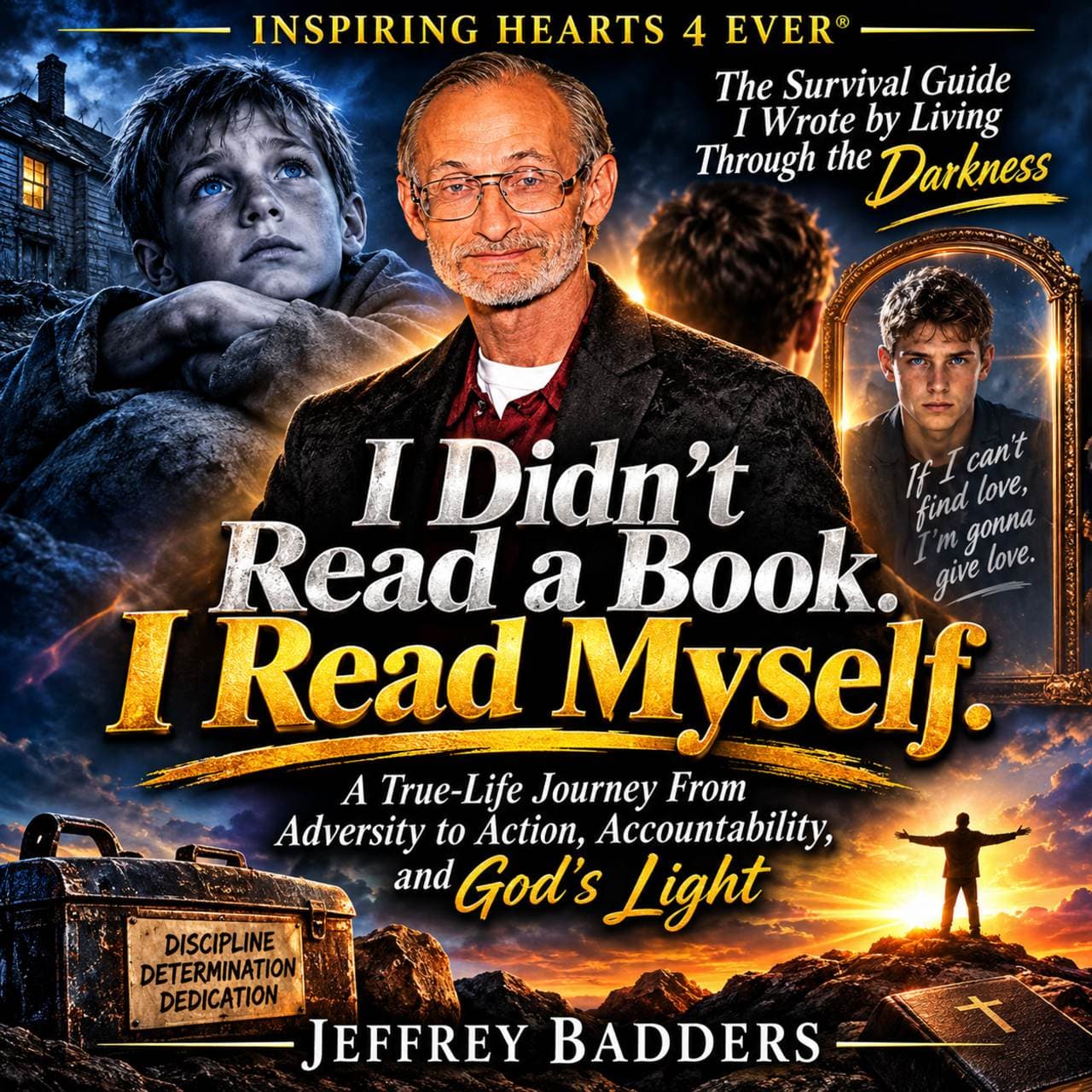
I Didn't Read a Book. I Read Myself.
The Survival Guide I Wrote by Living Through the Darkness
“Throughout my life, I didn't read a book. I read myself. That was the book that kept me alive.”
There are books that teach you how to succeed.
Books that teach you how to make money.
Books that teach you how to build relationships, overcome obstacles, and find happiness.
But what happens when you're a little boy who doesn't have anybody standing beside him, explaining how to survive another day?
What happens when the lessons aren't written on paper?
What happens when your classroom is the life you're living, and every day brings another test you never asked to take?
I know what that feels like.
Because long before I understood the meaning of discipline, determination, or dedication, I was learning something else.
I was learning how to read myself.
And that became my survival guide.
Chapter One — The Little Boy With Something in His Pocket
There is a childhood memory that I can still picture in my mind.
A little boy sitting alone in a room.
That little boy was me.
I was living in an abusive foster home, and there were times when I experienced hunger.
I remember putting dog food into my little pocket.
At night, when I was alone, it felt like a treat.
Think about that for a moment.
A child putting dog food in his pocket because that was something he could have later.
I can still remember the hunger pains.
I can still picture myself sitting in that room, trying to keep that fire going inside me.
There wasn't somebody sitting beside me, telling me everything was going to be all right.
There wasn't somebody handing me a book explaining what to do next.
I was alone with myself.
And when I look back at that little boy today, I remember something I said during the telling of my story:
“I understood what life was. You know it was about being with yourself all alone.”
I wasn't thinking about becoming successful.
I wasn't thinking about writing books.
I wasn't thinking about standing on a stage someday or sharing my experiences with the world.
I was trying to survive.
Trying to make it through another night.
Trying to understand how I was going to face another day.
But there was something inside me that I didn't want to lose.
That fire.
That little piece of myself that kept going.
And somewhere in those experiences, I began recognizing something important.
I matter.
I have a heart.
Those might sound like simple words to somebody who has always felt valued.
But when you're a child trying to survive circumstances beyond your control, recognizing your own worth can become one of the most important discoveries of your life.
I didn't have all the answers.
I didn't know what tomorrow would bring.
But I was still Jeffrey.
And my life mattered.
Chapter Two — The Masks Nobody Could See
As I grew older, I began carrying something else.
Masks.
Not the kind you wear on your face for Halloween.
I'm talking about the invisible masks people carry inside themselves.
The masks that protect their emotions.
The masks that hide their pain.
The masks they put on when they don't want anybody to know what they're really experiencing.
Throughout my life, I carried a lot of those masks.
I used them to protect my heart, mind, and soul.
When you've experienced pain, shame, and disrespect, you can begin believing that showing your true feelings will only give somebody another opportunity to hurt you.
So you protect yourself.
You learn when to be quiet.
You learn when to keep your thoughts inside.
You learn how to observe the people around you.
And sometimes you become so accustomed to protecting yourself that you forget what it feels like to simply be yourself.
But here's something I eventually learned.
You can spend so much time protecting yourself from the world that you stop allowing the world to see who you really are.
There came a time when I began questioning those masks.
Why was I allowing other people to define me?
Why was I allowing their opinions to determine how I felt about myself?
Why was I carrying shame for things I couldn't control?
I had a vision.
I had ideas.
I had a heart.
And I knew my life mattered.
I began telling myself that I needed to love myself more.
I needed to keep myself in check.
I needed to understand my journey instead of allowing the world to tell me what my journey was supposed to be.
And I began realizing that if I wanted to walk a different path, I had to develop a different mindset.
I couldn't spend the rest of my life hiding behind those masks.
I needed to show the world who I was.
Not who somebody else thought I should be.
Who I was.
And that's when another lesson became part of my survival guide.
When you believe in yourself, you're halfway to your dream.
Chapter Three — The Gentleman Who Never Needed a Speech
Now, I don't want anybody to think that every person I encountered during my childhood treated me badly.
That wouldn't be true.
There were moments of kindness.
And sometimes those moments were so simple that another person might not even remember them.
But I do.
I remember going to church as a foster child.
I would sit in the same pew.
And there was an older gentleman who would sit beside me.
He didn't give me a long speech.
He didn't ask me to explain my life.
He didn't try to tell me who I should become.
He would simply offer me a piece of gum.
Sometimes Juicy Fruit.
Sometimes Spearmint.
And every Sunday, there he was.
The same gentleman.
The same pew.
The same kindness.
I can still remember that today.
Why?
Because when you've spent so much of your life feeling torn down, a small act of kindness can mean more than somebody realizes.
I felt like somebody in society really cared.
Looking back, I think he might have recognized that I was a lost foster child searching for God's light and love.
I don't know what he was thinking.
He never told me.
But I know how his kindness affected me.
He made an impression that has stayed with me for a lifetime.
And here's something I want people to understand.
You don't always need a thousand words to make somebody feel valued. Sometimes all it takes is a simple act of kindness, repeated with sincerity.
That gentleman didn't know the entire story of the little boy sitting beside him.
He didn't need to.
He simply treated me with kindness.
And I never forgot it.
Chapter Four — The Boy Who Waited Until Everybody Ate
There's another childhood memory that connects with that lesson.
When I was at school, and we had a party or an occasion where food was being served, I would wait.
I wanted everybody else to get their food before me.
I would be the last one.
Not because there wasn't enough food.
I want to make that clear.
I never went without food at those school parties because I waited.
I simply wanted to make sure everybody else had eaten first.
Now, think about the difference between those two experiences.
In an abusive foster home, I had known hunger.
I had been that little boy with dog food in his pocket.
But when I was somewhere that food was being shared, I wanted other people to have theirs before I took mine.
I had compassion for people.
And even as a child, I felt that life wasn't only about me.
It was about the impact I could have on somebody else.
I didn't need somebody to applaud me for waiting.
I didn't need a reward.
I wanted to know that everybody had something to eat.
When I think about that today, I see a connection between the kindness I received and the kindness I wanted to give.
The older gentleman at church offered me gum without expecting anything.
And when I was around other children, I wanted to make sure they had something before I took my turn.
Those were different experiences.
But they taught me something about the kind of person I wanted to become.
Compassion isn't measured only by what you have. Sometimes it's revealed by what you're willing to consider about somebody else's needs.
I didn't have a perfect childhood.
I didn't have a perfect understanding of the world.
But I had a heart.
And I wanted to use it.
Chapter Five — The Promise in the Mirror
I was sixteen years old when I made a promise to myself that would help shape the direction of my life.
I remember looking in a mirror.
And I remember thinking about the love I had searched for.
There had been so much pain.
So much disappointment.
So many experiences that had left me questioning the world around me.
And there I was.
Sixteen years old.
Looking at myself.
Not looking at somebody else's opinion of me.
Not looking at the labels other people might have placed on my life.
Looking at Jeffrey.
And I made a decision.
“If I can't find love, I'm gonna give love.”
I wanted to show gratitude to the world.
I believed God had given me a special gift.
And I wanted to leave an imprint on a world that I had experienced as dark, cold, and sad.
Now, I want you to understand something.
That promise didn't mean every problem in my life suddenly disappeared.
It didn't mean I would never make another mistake.
It didn't mean I had figured out everything about myself.
I was sixteen.
I still had a long journey ahead of me.
But something had changed.
I had begun accepting myself.
Including my faults.
I understood that the narrow path I was walking wasn't going to be easy.
And I reminded myself that God was with me.
I needed to stay focused.
I needed to trust my journey.
I needed to keep walking.
That mirror wasn't showing me a perfect person.
It was showing me a young man who still had choices to make.
And I was beginning to understand that those choices mattered.
I couldn't go back and rewrite my childhood.
But I could begin deciding what kind of person I wanted to become.
That was the day I stopped looking only for the love I hadn't received and began thinking about the love I could give.
Chapter Six — When Someone Shows Their True Colors
Now, I wish I could tell you that once I made that promise, I never struggled again.
But that wouldn't be my story.
As I moved through life, I continued learning about people.
I learned that not everybody who comes into your life will treat you with the same respect you try to give them.
I learned that relationships require responsibility from both people.
And I learned that sometimes people expect accountability from you while refusing to accept accountability for themselves.
I remember my first relationship.
At the beginning, I didn't fully express myself.
But as I got to know that person, I began recognizing behavior that troubled me.
I felt there were double standards.
I believed both people in a relationship should take responsibility for their actions.
And I reached a point where I had to be blunt about what I was seeing.
That experience taught me something.
“When someone shows their true colors, don't keep painting it again.”
Think about that.
How many times do people see behavior that concerns them, but convince themselves it isn't really there?
How many times do we keep trying to repaint somebody else's actions because we want the picture to look different?
I had to learn that I couldn't control another person's choices.
But I could decide how I responded.
I could recognize what was happening.
I could consider my own responsibility.
And I could make decisions about the kind of environment I wanted in my life.
Because I had already spent much of my childhood around people who tore me down.
I didn't want to spend the rest of my life surrounding myself with the same kind of treatment.
I wanted to be around people who would build me up instead of tearing me down.
And I had to learn something else.
Being honest doesn't mean you have to be cruel.
Sometimes the truth can be difficult for people to hear.
Sometimes being too blunt can hurt somebody's feelings.
So I had to understand that honesty and compassion should work together.
I could recognize somebody's behavior without losing respect for myself.
I could speak my mind without forgetting that another person had feelings.
And I could learn from my own mistakes instead of pretending I never made them.
That was another page in my survival guide.
Chapter Seven — I Was the Solution to the Problem
Throughout my life, I've been independent.
I had acquaintances.
But when I think about my best friend, the one who was with me through the loneliness and the darkness, I think about God.
He was the friend I could turn to in my imagination.
He was the one I believed was walking with me.
And I developed a philosophy about life that has stayed with me.
No one owes you anything.
You have to save yourself.
You have to heal your own wounds.
You have to be your own hero.
That's how I came to understand my own responsibility.
I wasn't waiting for somebody to hand me all the answers.
I wasn't waiting for somebody to write my life for me.
I had to learn.
I had to make decisions.
I had to figure out how I was going to survive another day.
And when I look back over those experiences, I understand something.
I was the solution to the problem.
That doesn't mean I knew how to solve every problem.
It doesn't mean I never needed help.
And it certainly doesn't mean I always made the right choices.
It means I recognized that I had a responsibility to take action with the choices and resources available to me.
Sometimes the answer was to be patient.
Sometimes the answer was to walk away.
Sometimes the answer was to admit I was wrong.
Sometimes the answer was to ask somebody who knew more than I did.
But I couldn't spend my entire life waiting for the world to change before I began changing myself.
And that brings me to one of the most important lessons I've learned.
“Don't be the problem. Be the solution to the problem. If you can't fix it, ask someone who knows.”
That's not just something I say.
It's something I believe.
Because a problem doesn't disappear simply because we wish it would.
Sometimes we have to take responsibility for what happens next.
Chapter Eight — From Adversity to Accountability
As I grew older, I began understanding the difference between what happened to me and what I chose to do afterward.
My childhood was not something I controlled.
I didn't choose the circumstances I was born into.
I didn't choose every home I lived in.
And I didn't choose the painful experiences that became part of my childhood.
But as I became an adult, I had choices.
And those choices carried consequences.
Some of my decisions were good.
Some weren't.
There were times when I made mistakes.
There were times when I allowed emotions to influence my judgment.
And there were times when I had to face the results of my own actions.
I couldn't spend the rest of my life blaming every decision on what had happened to me as a child.
That wouldn't help me become the person I wanted to be.
I needed to understand myself.
I needed to recognize my faults.
And I needed to take accountability.
When I think about that sixteen-year-old boy standing in front of the mirror, I know what I would tell him today.
I took my adversity in life.
From adversity, I took action.
From action, I took responsibility.
And most importantly, I took accountability for the actions and choices I made in my life.
That accountability helped me become a better person.
It helped me understand that I couldn't control everything around me, but I could work on the person I was becoming.
And I could choose to give love through God's light.
That's the difference between surviving your past and building your future.
Survival helped keep me alive.
But responsibility and accountability helped me understand how I wanted to live.
Chapter Nine — The Book I Carry Within Me
Today, I've spent 36 years working as a hospice aide across 12 states.
I've met people from many walks of life.
I've witnessed moments of love, fear, sadness, courage, and compassion.
And I've learned that everybody carries a story.
Sometimes we see a person standing in front of us without knowing what they've experienced.
We don't know what happened during their childhood.
We don't know what they've had to overcome.
We don't know what memories they carry when they're alone.
That's why dignity and respect mean so much to me.
Because I remember what it felt like to be that little boy who wanted somebody to care.
I remember the hunger.
I remember the loneliness.
I remember the older gentleman who offered me gum.
I remember waiting until everybody else ate.
I remember the masks I carried.
And I remember that sixteen-year-old boy looking in the mirror, deciding that if he couldn't find love, he would give love.
Those memories are pages in the book of my life.
But the book didn't stop there.
I kept writing it through my decisions.
Through my mistakes.
Through my lessons.
Through the people I met.
And through the actions I chose to take.
When I look at my life today, I don't see a perfect man.
I see a man who has continued learning.
A man who has made mistakes and taken responsibility for them.
A man who believes that faith, compassion, dignity, and respect can make a difference in another person's life.
And I see that little boy who kept a fire burning inside himself when the world around him felt dark.
He didn't know what his future would become.
But he recognized something that mattered.
He had a heart.
He had value.
And his life was worth something.
The Last Page Hasn't Been Written
I want to leave you with something.
Maybe you've been through experiences that made you question your own worth.
Maybe you've spent years wearing masks because you were afraid of what people would think if they saw the real you.
Maybe you've made decisions you regret.
Or maybe you're standing at a crossroads in your life, wondering which direction to take.
I can't tell you what your journey is supposed to look like.
That's something you have to discover.
But I can tell you what I've learned from mine.
You can recognize your faults without allowing them to become your entire identity.
You can take responsibility without pretending you never experienced pain.
You can learn from the people who hurt you without becoming like them.
And you can carry kindness into the world even when kindness was something you once struggled to find.
You don't have to know every answer today.
You don't have to have the entire staircase figured out.
Sometimes you simply need to recognize the next step.
And take it.
Then take another.
And another.
Because your story is still being written.
Mine is too.
I have a vision for the life I want to live and the legacy I want to leave.
And I know that vision won't become reality simply because I talk about it.
I have to take action.
I have to accept responsibility.
And I have to remain accountable for the choices I make.
That's how I honor the promise I made when I was sixteen.
Not by pretending my life has been perfect.
Not by forgetting the little boy who struggled.
But by continuing to give the love I once searched for.
And by using the light God gave me to make whatever difference I can in this world.
I didn't read a book.
I read myself.
And every day I live, I'm still learning how to turn the page.
So here's the question I want to leave with you:
If your life were the survival guide somebody else needed tomorrow, what lesson from your own journey would you want them to remember?
---
Don't fake it until you make it. Faith it until you make it.
Author’s Note — A True-Life Testimony
Written collaboratively by Jeffrey Badders with AI writing and editorial assistance.
This story is a nonfiction testimony based on the personal memories, experiences, and reflections shared by Jeffrey Badders. AI writing and editorial assistance was used to organize the material, develop narrative transitions, and improve the presentation. The underlying personal experiences are the author's testimony; AI assistance does not constitute independent verification of historical events. The author reviews and approves the final narrative before publication.
The foundation is built through discipline. The legacy is created through action.
The darkness built the foundation through the experiences I survived, but the actions I take in God's light are what create the legacy I leave behind.