


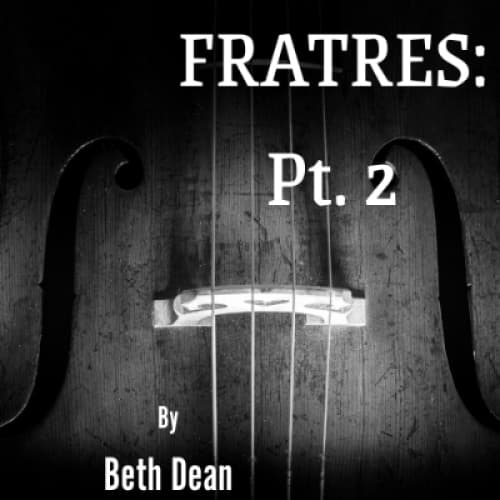

The silence in the house was the kind that doesn't fall -- it accumulates. Layer by layer. Dust-like. Sacred.
Felix had gone hours ago. His bowl rinsed. His questions quieted but not answered. The house exhaled in his absence, and in its lungs Wednesday heard the time to begin.
She moved through the hallway barefoot, the soles of her feet whispering across cold stone. A candle in one hand, a linen cloth in the other. She didn't need light to navigate the house -- but ritual was important. And tonight was one of them.
The music room had already been prepared. She had done it that morning without admitting to herself why.
The cello stood near the window, angled slightly toward the garden. The same garden she'd pulled beets and black tulips from just before dusk the day prior. The candlelight touched the varnish of the instrument like memory: reverent and non-negotiable.
She set the candle down. Unfolded the cloth. Her hands were pale, elegant, and unadorned except for the thin scar on her left ring finger. A gardening blade had slipped two summers ago while trimming valerian. She'd refused stitches. Scar tissue made her remember the work.
She sat. Not slowly. Not dramatically. Simply with intention.
The cello responded to her presence like an old animal -- silent but aware. She tilted her chin, raised the bow, and began.
The first note moved like the hour: slow, dusky, and with weight. Fratres.
There were no lyrics. No conductor. No audience. Only Wednesday and the music -- each aware of the other like predator and prey.
The phrase repeated. She didn't blink.
-------------------------------------------------
She'd been nine when she first heard it. Not in a concert hall. In the attic.
Her father had been playing it beneath the stained-glass skylight -- his posture stiff, his bow trembling slightly at the start of each repetition. He hadn't seen her come in.
Uncle Fester had left that morning after another violent argument about inheritance, or mortality, or a prank that had gone too far. No one remembered what it truly was about.
But Gomez had looked broken. And Wednesday rarely saw that. She had said nothing. Just sat. Cross-legged. Watching.
After the final note faded, he'd looked up.
"Want to learn it?" he asked. Wednesday nodded.
"I should warn you," he said. "It doesn't forgive bad technique. Or emotional dishonesty."
"Neither do I," she replied. He smiled -- thin, tired, but genuine.
He placed the cello in her arms and adjusted her fingers with uncharacteristic gentleness.
"It's not just music," he told her. "It's apology in a circle. It keeps going until you understand what you've done."
She hadn't understood that then. But now -- oh, now -- she knew it with her bones.
--------------------------------------------
The music returned her to the present. Her fingers ached. Her bow arm trembled from the repetition. The candles burned low. But she played on. Because the pain was not a reason to stop. Because silence needed to be shaped. Because someone would hear it -- if not now, then later.
She played for Gomez. For Fester. For her younger self. For the brother of her own that left years ago without a word. For the ones she'd lost. For the ones who would someday inherit this house of quiet grief and strange love.
And -- most quietly, beyond her own awareness -- for the two who would one day find this piece again and know exactly what to do.