


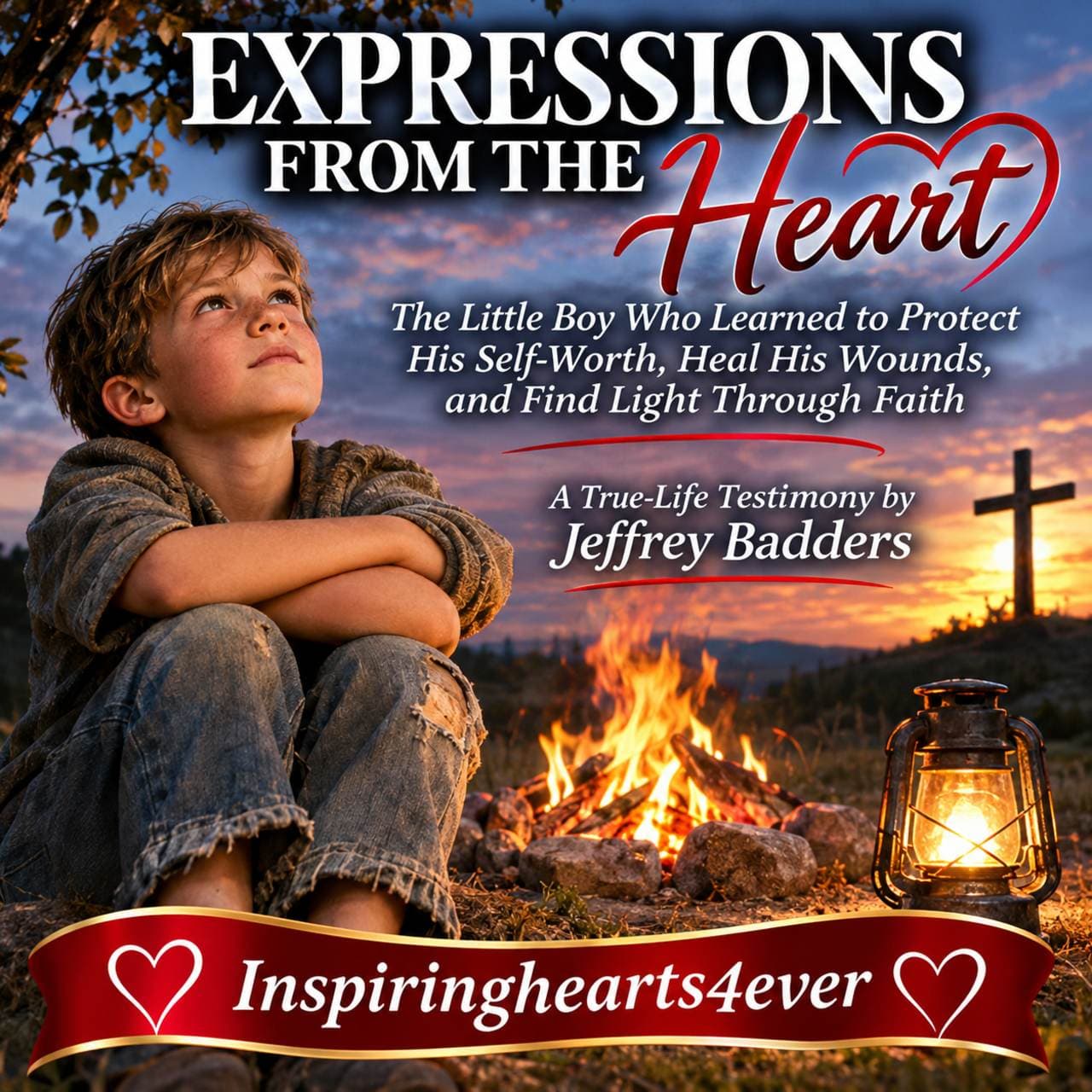
EXPRESSIONS FROM THE HEART
The Little Boy Who Learned to Protect His Self-Worth, Heal His Wounds, and Find Light Through Faith
A True-Life Testimony by Jeffrey Badders
The Little Boy Who Was Trying to Survive
There is something I want people to understand about a child who grows up surrounded by pain.
That child may not be thinking about what he wants to become when he grows up. He may not be imagining a beautiful house, a successful career, or all the wonderful things life could offer him.
Sometimes, that child is simply wondering whether he will survive another day.
I know because I was that little boy.
I came into this world as a ward of the state. I was never adopted. Throughout my childhood, I lived in ten different foster homes.
Every home brought different people, different personalities, different beliefs, and different expectations.
But there was something I carried with me from one home to another.
I carried myself.
And sometimes, I felt that was all I had.
When I look back on my childhood today, I don't want to pretend I was a little boy who understood everything that was happening around him. I didn't.
I was frightened. I was frustrated. I didn't understand what was going on in my life. I felt like I was just existing.
One of the hardest things I had to do was wake up every morning, look at myself in the mirror, and think: Could this be the end? Or do I just keep moving forward?
I wasn't looking ahead to next year.
I was looking at the day in front of me.
I was trying to survive it.
When a child has been broken down emotionally, there comes a point when he may stop expecting life to be different. He learns to go along with the system because he doesn't believe he has any other choice.
People sometimes imagine that children always have time to dream, play, and think about their futures.
But what happens when a child's mind is occupied with survival?
What happens when tomorrow isn't something he feels certain he will see?
That was the reality I remember.
And yet, somewhere inside me, there was still a little fire.
I didn't always know what to do with it.
I only knew I couldn't let it go out.
When Love and Pain Became Confusing
One of the hardest things for me to understand as a child was love.
I wanted to be loved.
That is not an extraordinary thing for a child to want.
It is something a child should be able to expect.
But in my childhood, love was confusing.
There were foster parents who said they loved me, yet they abused me.
How is a little boy supposed to understand that?
How does he make sense of someone saying one thing while doing something that causes him pain?
I didn't have an answer.
I tried to show love, but I didn't feel it being accepted or returned in the way I needed.
Eventually, I began to feel as though I didn't matter.
When they told me they loved me and then hurt me, it broke me.
When I got older, I came to a realization. It's like love is an illusion of the mind.
A person has to make a choice to love you. Not just say it. That choice should show in the way they treat you.
Actions speak louder than words.
After years, I realized something else.
People don't all receive love in the same way.
Sometimes someone enters another person's life already convinced they know exactly how that person needs to be loved.
They may believe their way is the right way.
But what about the person receiving that love?
What if that person needs something different?
To me, love should be given the way that person accepts it.
It took me years to understand that.
As a child, I wasn't sitting there analyzing the meaning of love.
I was trying to understand why people could say they loved me while hurting me.
And that contradiction left wounds.
The Nights I Hugged Myself to Sleep
There is a childhood memory that has stayed with me throughout my life.
I remember hugging myself to sleep.
I didn't know how to express love in a way that seemed to reach the people around me.
So at night, I would hold myself.
I cannot tell you that I remember every thought I had during those nights.
Too many years have passed, and I won't invent memories just to make a story sound more dramatic.
But I remember dreaming about being loved.
And I remember the imaginary world that helped me through some of those difficult times.
I had an imaginary friend.
I also had an imaginary campfire where, in my understanding and faith, God was with me.
I knew I could go to that campfire anytime. At night, I would go there with God and my imaginary friend.
That is what kept me from breaking down even more.
At that campfire, I needed everything: someone to love me, listen to me, comfort me, hug me, and make me feel protected.
The campfire didn't change what was happening in my foster homes.
It didn't erase what had happened to me.
But it was a place I could return to in my mind.
When I think about that little boy today, I realize how important that imaginary refuge was to him.
He was searching for something he wasn't finding in the world around him.
And through that campfire, he found a way to hold on.
The Garden of Love
There was another place I created in my imagination.
I called it the Garden of Love.
When I pictured that garden, I saw thousands of beautiful flowers.
But then I came to a realization. There was really only one.
And if I couldn't water that one, it was going to die inside of me.
That flower represented something deeply personal.
It represented the part of myself I needed to care for.
Think about what it takes to grow a flower.
You plant a seed.
But planting the seed isn't enough.
If you want that seed to grow, you have to water it.
If you want the flower to bloom, you have to keep taking care of it.
And if you hope to harvest fruit from a plant, you have to dedicate yourself to its care.
That is how I came to see my own inner life.
I couldn't control every person who entered my world.
I couldn't make people love me.
I couldn't force them to listen.
But I could begin learning about myself.
I could try to protect what was still alive inside me.
As that little boy, I learned to water my own flower.
Most of the time, I was by myself.
And in that Garden of Love, I was the only gardener.
I don't share that memory because I believe children should have to raise themselves emotionally.
They shouldn't.
I share it because it is part of what happened to me.
When I couldn't depend on others to give me the care I needed, I searched for ways to keep myself going.
The Garden of Love became one of those ways.
And the lesson of that single flower stayed with me.
The Day My Hearing Changed
There is another childhood experience I need to share.
It is difficult, but it is part of my life.
I remember my foster mother throwing me down the stairs when I was a child.
That incident damaged my hearing.
I had to undergo operations, and even after those operations, I never completely regained my hearing.
Living with the consequences of that injury is a story of its own. But one part of it belongs here.
As a little boy, I had difficulty understanding what people were saying.
So I learned to watch their lips.
When someone spoke to me, I would look at their mouth and try to understand the words.
Sometimes I still couldn't understand.
When that happened, I just left it at that.
The adults around me knew I had hearing difficulties.
But I didn't want to draw attention to myself.
I had learned a simple rule:
Less attention, less pain.
Those four words explain a great deal about my childhood.
I didn't want to put myself out there.
I didn't want to create another situation that might bring more pain into my life.
So I kept to myself.
I watched.
I listened as best I could.
When I didn't understand something, I stayed quiet.
Looking back today, one thing about that time hurts in a particular way.
I was a child who wanted someone to listen to his pain.
At the same time, I was living with a physical injury that made it difficult for me to hear other people.
That was simply my reality.
A Loner in School
School didn't take my loneliness away.
Throughout my school years, I was a loner.
I kept to myself.
Being in a classroom full of children doesn't mean a child feels connected to any of them.
And for me, there was another difficulty.
I had already learned to be cautious about drawing attention to myself.
I had already learned that people might judge me without understanding what I had experienced.
So I developed a habit of observing people.
I watched their expressions.
I paid attention to how they presented themselves.
I noticed their character.
And I noticed that people's behavior sometimes changed when they wanted something from someone.
As my mind got stronger, I was able to make more decisions, and I learned to know what was right and what was wrong.
I was learning through experience.
There was something I kept telling myself:
You gotta read yourself to know yourself.
I wasn't reading books written by other people telling me how to live my life.
I was trying to read myself.
I wanted to understand my own choices.
I wanted to recognize the decisions that might help me avoid trouble and stay safe.
I read myself and tried to make the right choices to improve my life.
Not every lesson was pleasant.
Some were painful.
But I kept learning.
The Island in My Mind
As a child, I pictured it this way.
I was out on an island, and I had to make sure no one stepped in my lane or on my land.
That island was in my mind. It was a way of protecting something inside myself.
My self-worth.
That was what I was trying to hold on to.
Other people might judge my character.
They might misunderstand me.
They might fail to listen to what I was going through.
But I knew that when I laid my head down on the pillow at night, I would know my self-worth.
That didn't mean I had figured out life.
I hadn't.
I was still a child dealing with experiences I didn't fully understand.
But somewhere inside me, I was trying to protect the belief that my life mattered.
I had already experienced what it felt like to be hurt by people who were supposed to care for me.
I had already learned that words and actions didn't always agree.
Understanding Other People's Pain
Over the years, I began to understand something about people.
Everybody has a history.
Everybody has experienced life differently.
Some people express their pain openly.
Other people hide it.
And sometimes the person standing in front of you has been through things you know absolutely nothing about.
People have been broken throughout their lives, and I can't judge them for what happened to them before they ever met me.
People can carry wounds from experiences we never witnessed.
That doesn't excuse anyone for hurting another person.
But it taught me to consider that there might be more to someone's behavior than what I could see on the outside.
And I learned something about listening.
Sometimes it's better to listen to someone else's pain.
You might learn a lesson in the end.
That lesson has become important to the way I understand people today.
When someone speaks, I don't have to enter the conversation already knowing the answer.
Sometimes I need to hear what they are trying to tell me. And sometimes the greatest lesson comes from listening rather than judging.
When I was a child, people didn't stop and listen to my pain. They judged me by my character.
So I kept to myself and endured the pain.
But the experience taught me how meaningful it can be when someone finally feels heard.
Becoming My Own Hero
Eventually, I came to a hard realization.
No one was going to save me.
I had to heal my own wounds.
I had choices to make.
I had to learn about myself.
And I had to take responsibility for the direction of my life as I grew older.
I came to describe that lesson this way:
You have to be your own hero to make it in life. It all starts with you.
I don't mean that a child should be left alone to endure abuse or neglect. I mean that, looking back, I can see how much effort it took to keep moving forward when I didn't know who would help me.
I had to learn to stay calm and trust the journey.
I had to keep learning about myself, because that kept me out of trouble and kept me safe.
When I was young, I wasn't thinking about a grand purpose or the person I might become decades later.
Those are things I can reflect on now.
At the time, I was living in the moment.
There were obstacles in front of me, and I was trying to get through them.
That is the truth of my childhood.
It wasn't a perfectly planned journey toward a happy ending.
It was a series of days when I kept trying to make it to the next one.
The Roadmap Through the Storms
If I could sit across from that little boy today, I wouldn't pretend I could explain away everything that happened to him.
I wouldn't tell him that the pain was necessary.
I wouldn't tell him that being abused was somehow a lesson he deserved.
He didn't deserve it.
He deserved love.
He deserved protection.
He deserved to be heard.
And he deserved adults who understood that caring for a child is a responsibility, not simply something you say with words.
But I would want him to understand something about the journey he eventually lived.
I would tell him:
You had to build your own roadmap and blueprint to make it through the storms, to see the light and love in God.
Those words mean something different to me today than they would have when I was that frightened little boy.
Today, I can look back and recognize the ways I tried to protect myself.
The imaginary campfire.
My imaginary friend.
The Garden of Love.
The one flower I kept trying to water.
The island in my mind.
The lessons I learned from observing people.
The quiet determination to understand myself.
None of those things erased my childhood.
But they were part of how I made it through.
As I look back, I can see that my faith was there through all of it.
When I imagined that campfire, God was there with me.
When I searched for comfort, that belief gave me somewhere to turn.
When I needed to keep the fire inside me alive, I kept moving forward.
I didn't know everything that waited for me on the other side of those childhood storms.
I only knew I had to keep going.
What My Heart Wants You to Understand
If there is one thing I hope readers take from my childhood testimony, it is this:
Never assume you understand a person's life simply because you can see the person standing in front of you.
You may see someone who is quiet.
You may see someone who keeps to himself.
You may see someone who has difficulty expressing his feelings.
But you don't necessarily know what that person has survived.
You don't know what happened before you met him.
You don't know how many nights he spent trying to comfort himself.
You don't know what it took for him to get out of bed and face another day.
And you don't know what kind of love he may have needed but never received.
Understanding someone begins with recognizing that their experiences may be nothing like your own.
My childhood taught me lessons I never asked to learn.
Some of those lessons took years to understand.
But I am still here to tell you what I remember, what I experienced, and what I have come to believe.
I was the little boy who hugged himself to sleep.
I was the little boy who watched people's lips because he couldn't always hear their words.
I was the loner who kept to himself.
I was the gardener trying to keep one flower alive.
And I was the child who kept searching for light through the storms.
Today, I can look back at that little boy with a deeper understanding of his journey.
I cannot change what happened to him.
But I can give his experiences a voice.
And perhaps someone reading these words will recognize a little of themselves in his story.
Perhaps someone will stop and listen to a child who has been quiet for too long.
Perhaps someone will realize that saying “I love you” means very little if their actions cause harm.
Or perhaps someone who has spent years questioning their worth will begin to understand that another person's treatment of them does not determine their value.
I can't tell you what lesson to take from my life. That is yours to discover.
But I can leave you with a question:
When you meet someone who seems quiet, distant, or difficult to understand, will you judge what you see—or will you take the time to listen to the story you haven't heard?
Because sometimes the person who says the least is carrying a story that deserves to be heard.
And sometimes the greatest expression from the heart begins when someone finally listens.
Don't fake it until you make it. Faith it until you make it.
---
Author's Note — A True-Life Testimony
Expressions from the Heart is based on my personal childhood experiences, memories, and reflections shared through a 30-question interview.
The events described are presented as I remember them. Some understandings developed later in adulthood and are distinguished from what I knew as a child. No additional incidents, conversations, or outcomes have been invented for dramatic effect.
My hope is that this testimony encourages readers to listen with compassion, recognize the importance of a child's emotional needs, and understand that every person carries a story beyond what others can see.
Written collaboratively by Jeffrey Badders with AI writing and editorial assistance.
Inspiring Hearts 4 Ever — Real Stories. Real Life. Real Inspiration.