


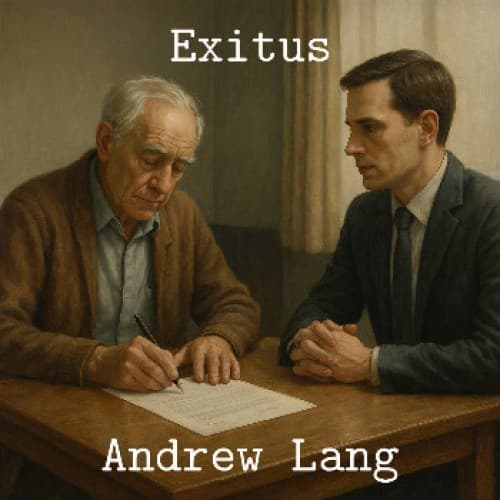
The meeting room smelled faintly of toner and moral decay.
Gareth Noon sat opposite his manager, Colin Vale, who had the air of a man permanently trapped in mid-sigh. The walls were beige, the blinds drawn against the daylight like it might interfere with productivity. On the screen behind Colin, the Exitus logo pulsed: “Helping Britain Manage Tomorrow, Today.”
Colin pinched the bridge of his nose and exhaled. “Gareth, mate. I’ve just listened to your call with Holroyd.”
Gareth shifted in his chair. “Right.”
“Right. So what the hell was that?”
“I was following up, as per the six-month check—”
“Following up?” Colin barked a laugh. “You practically encouraged him! He’s yabbering on about girlfriends and turmeric, and you’re sitting there like a bereavement counsellor. We don’t do empathy here, Gareth. We do retention.”
Gareth looked down at his hands, which were perfectly still. “He sounded happy. Genuinely happy. I didn’t want to—”
“‘Didn’t want to!’ Jesus, listen to yourself. This isn’t therapy, it’s compliance. He’s not happy, he’s noncompliant. And noncompliance is bad for the books. Do you have any idea what his care would cost the state if he bottles it?”
“Yes,” said Gareth quietly. “Roughly a million.”
“Exactly. The government’s already earmarked the savings from his scheduled death. That money’s in circulation, Gareth. It’s been reallocated. Schools, hospitals, debt servicing—Holroyd’s death is part of the fiscal recovery plan. If he backs out now, it’s not just your commission on the line. It’s the bloody budget.”
Colin opened a folder, thick with printouts and graphs. “We’ve got a direct line with the Department of Continuity. They don’t want wobbly clients this close to completion. You let him slip, and we all look like amateurs.”
“I didn’t let him slip,” said Gareth, his voice barely audible. “I was trying to—”
“Then try harder. Make it clear to him that there’s no easy off-ramp. Tell him to check the small print — Section 9, Subclause B — ‘Voluntary Reversal Penalty.’ Minimum thirty grand or twenty-five percent of estate, whichever is greater. Make him say it aloud, so it sinks in.”
Colin leaned forward, the fluorescent light bleaching his forehead to marble. “And even then, even if he pays the bloody fee, you tell him there’s no guarantee. Because there isn’t. Once his death is logged, it’s logged. Government’s already spent the projections. Do you understand? His expiry is an asset class now. You can’t just erase it because he’s found a new girlfriend and started jogging.”
Gareth nodded faintly. “Right.”
“Right,” Colin echoed, softening slightly. “Look, I know you’re not a bastard, Gareth. That’s your problem. You still think this job’s about people. It’s not. It’s about outcomes. The government doesn’t mind what we do, as long as we keep the numbers clean. And you know what they call those numbers?”
Gareth didn’t answer.
“Lives,” said Colin, almost fondly. “Converted lives.”
He pushed the folder across the table. “Now go and un-convert that old fool before he ruins our quarter.”
Gareth rose, gathering the file like it might burn him. At the door, Colin called after him, voice almost cheerful.
“Oh, and Noon?”
“Yes?”
“If he starts talking about canceling again, remind him: it’s not a cancellation, it’s a re-life application. Costs triple. That usually shuts them up.”
Gareth nodded once, left the room, and walked back through the cubicles, where other consultants murmured into headsets — their tones soft, their words fatal.
Behind him, Colin Vale was already on another call, laughing like a man who’d found a way to monetise the end of the world.