


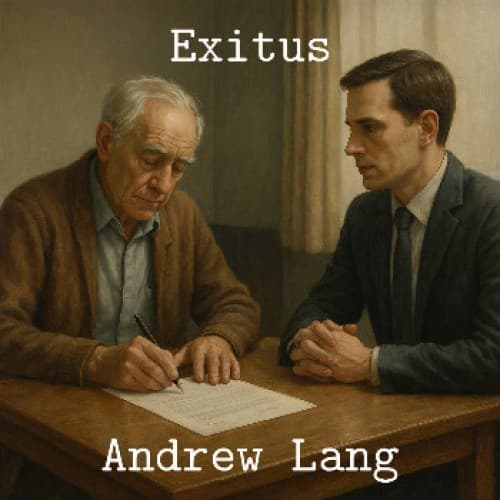
The man from Exitus arrived five minutes early. He was punctual in the way only those on commission can be: a car idling outside, a glance at the wristwatch, a quick rehearsal of empathy in the rear-view mirror. Then he was up the path, shoes whispering on gravel, portfolio in hand like a priest’s Bible.
David Holroyd, seventy-two, opened the door wearing the kind of cardigan that suggested retreat — beige, but with ambition. His right hand trembled imperceptibly on the doorknob.
“Mr. Holroyd,” said Gareth Noon, all smile and condolence. “Thank you for having me. Lovely place you’ve got.”
Holroyd’s living room was a museum of English perseverance: dried flowers, family photos, a faint smell of carpet shampoo and mortality. Noon set down his briefcase on the coffee table as if it contained the cure for everything.
“I’ll just get right to it,” Noon said, unclipping his case with the reverence of a surgeon. “I’m sure you’re aware of the—well, the broader picture.” He smiled that trained, tragic smile, the one that implied shared knowledge of decline. “The economy. The healthcare system. I don’t need to tell you the state of things. We’re all tightening belts these days.”
Holroyd nodded, warily. “So you said on the phone.”
“Quite. But it’s more than that, David — may I call you David? It’s a demographic crisis. Population’s shrinking. We’ve got too many of what the Chancellor calls ‘legacy citizens.’ That’s you and me, frankly. We’re the backlog.”
Holroyd frowned. “Backlog?”
“His word, not mine.” Noon opened a folder, produced a glossy brochure. Across the top, in a dignified sans serif: Exitus – The Rest of Your Life, On Your Terms. There was a photo of a grey-haired couple holding hands in a field of impossible sunlight.
“Now,” Noon continued, “you’ve been diagnosed with Parkinson’s. Early stages, yes?”
“That’s right,” said Holroyd. “A bit of a shake in the hand, that’s all. Doctor says it’ll get worse, but—well, I’m managing.”
“Of course you are.” Noon leaned forward, his voice dipping into the register of care. “But you know how it goes. Five, maybe six years from now — full-time care, specialist equipment, the works. It’s not dignified, David, and it’s not cheap. We’re talking two hundred, two-fifty thousand a year for twenty-four-hour hospice. Your estate’s what, about three hundred thousand?”
“Something like that.”
“Then you see the problem. You could burn through that in a year. Then what? The state foots the bill, the system collapses a little further. Everyone loses.” Noon paused, let the words sit there like an invoice. “But that’s where we can help.”
He slid another page across the table. “Our service is designed for people like you. People who want control, and — more importantly — who want their legacy intact. With Exitus, you choose your own date, a year from now, give or take. You go peacefully, painlessly, in a medical suite. The government recognises the choice as a contribution to fiscal recovery, so your children receive the full inheritance — tax-free. Every penny.”
Holroyd blinked. “And how does it… how does it actually happen?”
Noon smiled the way a man smiles when he’s told this story many times before. “Medication. Entirely painless. You’ll be in a comfortable environment — music, soft lighting. You won’t feel a thing. Just… a drifting off. Like a long exhale.”
Holroyd sat back. “You make it sound rather nice.”
“It is nice,” said Noon. “That’s the point. Dignity. Choice. Compassion.”
Holroyd’s eyes flicked to the window, where the garden lay empty and bright. “And people really do this?”
“Oh, thousands,” said Noon briskly. “In fact, it’s one of the government’s most successful programmes. You’re not alone, David. You’re part of something larger — helping stabilise the future. It’s patriotic, in a way.”
Holroyd gave a short, sceptical laugh. “Patriotic death.”
Noon chuckled as if it were a joke, though he didn’t think it was. “If you like.”
David exhaled, long and low. “You know, I’ve not been right since the diagnosis,” he said quietly. “It does something to you — like a door slamming shut somewhere in the distance. I’ve stopped going out much. Stopped seeing people. I wake up and I can already feel the day pressing down, like it’s impatient for me to get through it. Maybe that’s just the illness. Maybe it’s me. But truthfully, Gareth, it’s hard not to feel like I’m already finished. So when you talk about Exitus…” He gave a small, defeated shrug. “I can see the sense in it. It’s neat, it’s merciful. It makes the whole sorry business tidy.”
Gareth gave a small, sympathetic nod — the sort that had been practised, perfected. “I understand, David,” he said softly, hands steepled in what he hoped passed for compassion. “It’s not unusual to feel that way. Most of our clients describe something similar — that sense of the world quietly withdrawing its invitation. What Exitus offers, really, is a way to take back a little control. To say: I decide how this ends. There’s dignity in that. It’s not about giving up — it’s about choosing the terms.” He smiled, the salesman’s smile — thin, reassuring, wholly impersonal. “It’s what I’d want, if I were in your shoes.”
He produced the contract, heavy paper embossed with the Exitus crest — two hands meeting over a sunburst. “You don’t have to decide now, of course. But if you sign today, you’re guaranteed your chosen date next year. And peace of mind for your family.”
Holroyd looked at the papers for a long time. His right hand trembled faintly on his knee. Noon pretended not to notice.
“Your children,” Noon said gently, “will thank you. They really will. It’s the most generous thing you can do for them.”
Outside, a bird started up — thin, tuneless. Holroyd reached for the pen, steadying it with his left hand.
Holroyd studied the contract a moment longer, lips pursed. “Well,” he said, half to himself, “it’s a year off yet. I suppose if I changed my mind before then, that’d be all right?” He looked up, faintly hopeful, like a man testing the air for mercy. Noon gave a small, automatic smile, the kind that could mean anything. “You’re okay,” he said softly, and tapped the page with his pen. “It’s just a formality, really.”
“All right,” he said quietly. “Let’s get it done.”
The pen squeaked faintly as he signed.
Noon’s smile was automatic, professional — but in his chest there was that familiar, guilty flicker of triumph. Another one secured. He closed the folder, shook the man’s trembling hand, and said, with immaculate sincerity:
“Congratulations, David. You’ve just taken control of your future.”