


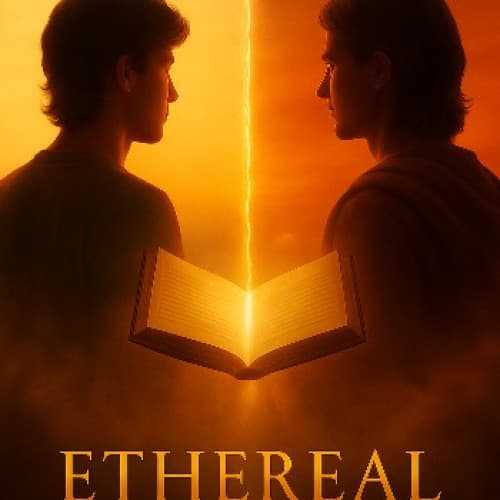
The lantern light trembled softly, casting a warm circle across the pages of the old cloth bound book. The room smelled of sandalwood and old paper, and the silence felt sacred, as if the walls themselves were listening. Arjun sat close to his mother, knees pulled to his chest, waiting for the story he had already begun to love without understanding why.
She opened the book slowly. The pages were thick and slightly uneven, the kind of paper made by hand, not machine. In the margins were drawings made with charcoal and ink. Some were bold. Some were soft. All of them felt alive.
The first drawing showed a village morning. There were huts with thatched roofs, a dirt path winding between them, and trees thick with leaves. A boy stood in the foreground, barefoot, clothes worn but eyes bright. His posture held something stubborn. Something curious. Something the world could not break quickly.
Under the drawing, in careful handwriting, words rested like truth.
"Nothing welcomed me at birth except hunger, and hunger has a way of carving a path even through stone"
His mother read the line aloud, and even her tone changed. Softer. Respectful.
Then she began the story.
He was born in a small village where most houses looked the same and every life was already decided before the child even learned to speak. Some families controlled land. Some worked that land. Some simply survived.
His family belonged to the last group.
There were mornings when the smell of boiling rice drifted from other homes while his own remained quiet because there was nothing to cook. His stomach learned the shape of emptiness, but his spirit did not.
Even as a child, Krishna was unlike the others. While most children lowered their gaze when elders spoke, he looked directly into their eyes, as if waiting for the world to make sense. The elders did not like being looked at that way, yet none could ignore him.
She turned the page.
The next drawing showed Krishna at the banks of a river. The water sparkled with reflected sunlight. His trousers were rolled to his knees, his feet in the cool running stream. Behind him, his friends splashed each other, laughing freely. Yet Krishna was still, staring at the river as though it were speaking to him.
Under the drawing, another line.
"The river keeps going.
Not because it knows the way,
but because stopping is not its nature."
The handwriting carried a weight that did not belong to a boy. It belonged to someone who questioned everything, someone who did not accept life simply because it was given.
His mother continued reading.
Many evenings, when his chores were done, Krishna returned to the river. He would sit with his notebook, sketching the way water touched stones, or how sunlight broke into pieces on the surface. Sometimes he would write questions. Sometimes sentences. Sometimes nothing at all, only draw and breathe as if that itself were prayer.
She turned another page.
The third illustration showed a large mango tree with thick branches heavy with fruit. Krishna stood near the trunk, one hand gripping the bark, his body ready to climb. A woman in the distance pointed toward him, her mouth open mid warning, yet the look on Krishna’s face showed mischief rather than guilt.
Below it, he had written:
"Hunger made me look at the fruit. Curiosity said, sure, climb and make your life harder for one mango."
Arjun smiled before he realized he was smiling.
His mother continued.
When he was caught stealing mangoes, he did not apologize. Instead he asked the man who owned the tree why those who have plenty keep more than they need when others have none. The man shouted. Krishna listened. And when the shouting ended, he asked another question.
"Why should a tree belong to someone who never sits under its shade."
Some laughed at his boldness. Some were offended. Some feared him because he said aloud the things no one else dared to think.
His mother turned the page.
The fourth drawing was different. Darker. More detailed.
Krishna stood in front of the village landlord. The man towered over him, wearing a fine dhoti and rings on his fingers. His posture was stiff with authority. Krishna’s clothes were simple, patched at the knees, but his gaze was unwavering. Behind them, villagers stood watching, unsure whether to admire him or pull him away before trouble found him.
Under the drawing, the boy had written:
"If fear is respect, I would rather be disrespected."
Arjun felt something shift inside him. A small ache. A small spark. A memory he could almost reach, but not quite.
His mother read on.
On that day, the landlord threatened Krishna’s family, saying rebellion was disease and he would cure it with punishment. Krishna did not flinch. He said the poor did not fear losing what they never truly owned.
The villagers whispered that Krishna lived like fire. Beautiful but dangerous.
Then she turned to the next page.
Here, the drawing stretched across the full sheet. Krishna lay on the rooftop of his home. One knee bent. One hand behind his head. His hair spread like ink. The night sky above him glittered with countless stars. His notebook rested beside him, as if he had fallen asleep while writing.
Under it, a single sentence.
The sky is too vast for my life to remain small.
His mother paused while reading, her fingers resting lightly on the picture. Something in her expression wilted, as if the story reminded her of something she wished she could protect.
Arjun watched her and whispered.
What happened next.
Before she could answer, a floorboard creaked outside.
Her breath caught.
The voice in the hallway was unmistakable. Deep. Irritated. Sharp.
His father.
In one swift motion fueled by fear rather than thought, she closed the book and pressed it to her chest.
The room felt suddenly colder.
She leaned close and whispered.
If he sees this, he will take it away. Not because the story is wrong. But because he is afraid you may want a life he cannot control.
Arjun stared at the closed cover, heart heavy.
He had not realized until the moment silence returned how badly he needed to know what came after that rooftop, after that sentence, after that boy dared to dream beyond the borders of his village.
His mother tucked the book beneath the pillow as if hiding flame from rain.
We will continue another night, she whispered.
But Arjun knew the truth.
Some stories are not paused.
They are interrupted.
And they wait.
Not in paper.
Not in memory.
But in the person who heard them.
And that night, long after the house grew still, Krishna’s drawings lived behind Arjun’s closed eyes.
A boy with fruit stained fingers.
A river that never stopped moving.
A question no authority could silence.
A sky too wide for obedience.
He did not know why these things felt familiar.
He only knew that something inside him had awakened.
Arjun slowly closed his eyes.