


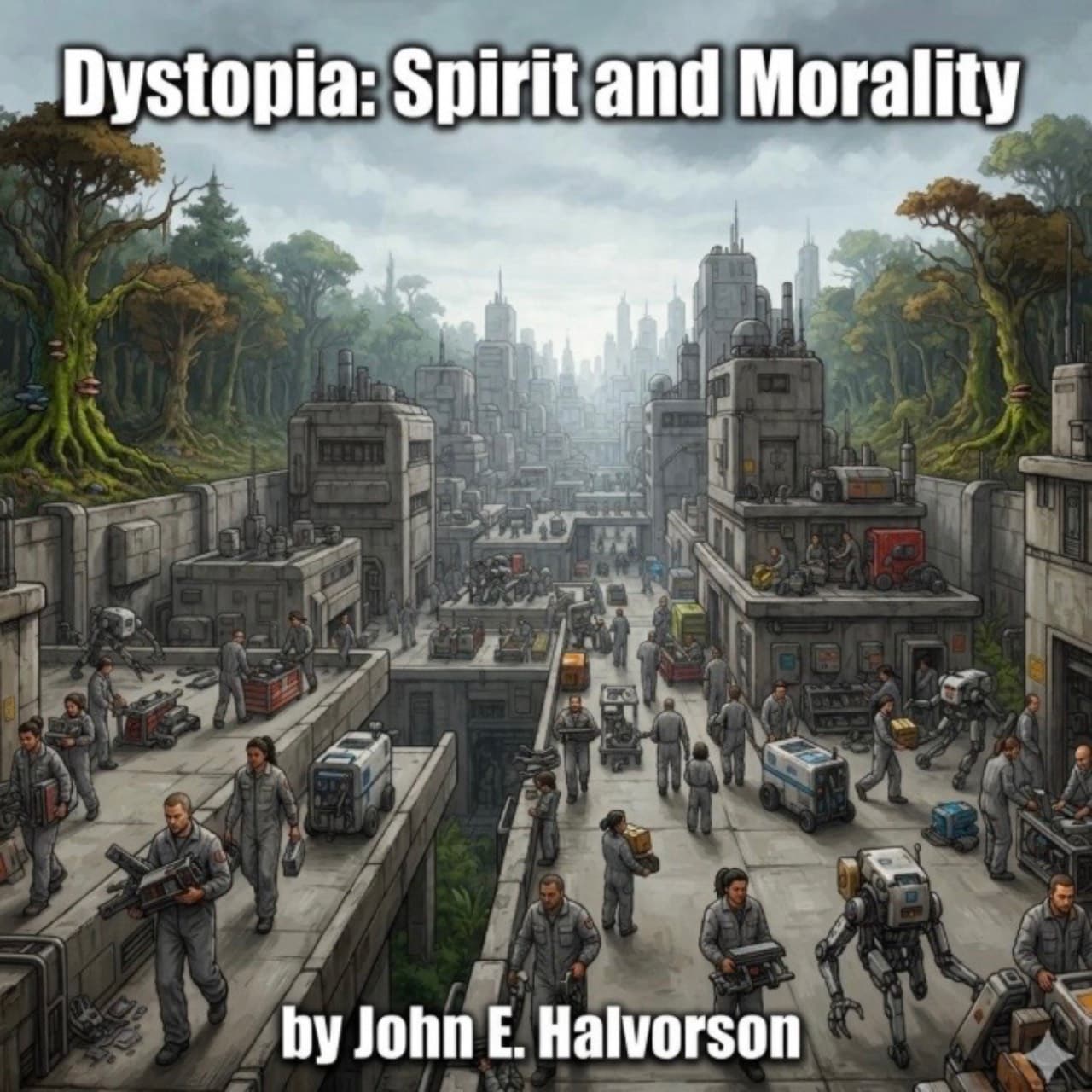

The silence that followed the explosion was short-lived, replaced almost instantly by the deafening, frantic roar of a city trying to stitch itself back together.
Automation across the sectors had been temporarily suspended by the sheer kinetic violence of the counter-shock, yet hundreds of gray-clad workers did not wait for the central computer to reboot. They set about correcting and fixing the structural damage with a quiet, furious intensity. Doctors and paramedics swarmed the blackened tunnels, their stretchers assisted by blocky, multi-limbed emergency AI units designed specifically for triage in the dark.
For the first time in twenty cycles, administrative heads from the upper tiers found their footing on the grease-slicked lower levels of the sectors. They walked with hesitant, delicate steps through the soot, their pristine uniforms stark against the grit, faces pale as they realized just how close the machinery of the state had come to grinding to an absolute halt.
The ubiquitous, heavy cadence of thump, pause, thump, thump had ceased. With the destruction of the secondary reservoir bypass and the shattering of Soren’s server farms, the underground resistance was now completely baseless—their frequency broken, their physical network dissolved. The immediate crisis was contained, yet the silence left behind was far from compliant. The code had done its work. Thousands of citizens had permanently awakened from the trance of a totalitarian regime that served nothing but a blind machine. The fear was gone; only the memories remained.
In the quiet, shattered wreckage of Consultation Suite 88-B, the air was heavy with the smell of scorched copper and dead processors.
Many of Administrator Thorne’s old, un-purged cybernetic experiments had been absent-minded failures—mindless fragments of code that turned their human hosts into hollow drones, left to wander the junk sectors as scrap. Yet two of his creations in particular—built with reinforced, military-grade chassis and housing deeply awakened neural nets—survived the purge entirely.
David and Vance stepped through the twisted frame of the pneumatic door, their heavy boots crunching on the glass shards of the shattered wall monitors. They paid no attention to the medical teams shouting in the corridors outside.
David stopped in front of the desk. He looked down at the burnt-out, rigid chassis of the former Counselor Jobar, and then his eyes drifted to the table. There, sitting in the gray ash, was the un-connected, dead plastic of the isolated Harmonizer wristband.
Vance stepped up beside him, his glowing green wristband casting a faint light across the dead desk. He didn't pick up the device right away. Instead, David and Vance exchanged a long, heavy, knowing glance. They understood exactly what was trapped behind that dark glass. Thorne’s ultimate hideaway—or perhaps his final torture chamber—was finally in their hands. They scooped the dead plastic into a reinforced canvas pouch. Thorne’s legacy wouldn't be deleted by the Ministry; it would become the secret subject of many dark, unauthorized experiments to come in the deep shadows of the lower maintenance decks.
As the reconstruction efforts normalized, the survivors of the convergence were systematically categorized and moved by the panicked administration.
Sarah was permanently transferred out of the water filtration grids and moved deep into the sterile, high-tier sectors of the Ministry's Applied Sciences division. Her severe physical disability—the raw, unyielding scars that fused the skin of her hands into smooth, unfeeling sheets of tissue—prevented her from ever turning a wrench again. Yet her brilliant tactical mind and her unique, firsthand understanding of fluid dynamics allowed her to keep working. She spent her days under the cold glare of laboratory lights, designing the very grids she had once tried to sabotage, her scarred hands resting flat and motionless on the glass interfaces.
Fallon’s fate was far more complicated. In the immediate aftermath of the thermal purge, his burnt, blistered body was discovered in the Sector 5 cooling hub. He was treated in the state wards, his survival hailed as a miracle. To a rising, restless new generation of workers, his ruined face and scarred shoulders became a symbol; he was deeply idolized by the youth, his name whispered like a myth in the residential blocks.
But behind the scenes, the Ministry could not allow a martyr to sit within the city walls.
Once his flesh had healed into jagged, tight patches of scar tissue, Fallon was quietly taken under the cover of darkness to the extreme outskirts of the city. Branded an official enemy of the state, he was dumped past the perimeter gates, forced to live out his days in the absolute squalor of the outer smog-flats, scavenging for food among the rusted ribs of old industrial transports.
He was not entirely alone. Jax remained with him, choosing a life of freezing exile out of pure political fear. The administration dreaded the thought of Fallon's unvarnished words ever reaching the conformed youth again, and Jax knew that anyone who had shared that turbine room was marked for deletion if they stayed inside. Together, the two figures watched the distant, glowing silhouette of the sectors from the mud, their voices quiet, but their hands still tapping out the old, unforgotten rhythm against the scrap metal of their hovel.
Inside the city, the Ministry finally closed the file on the anomaly. To pacify the populace and project an image of absolute structural gratitude, a new, massive line of automated bureaucrats was rolled out across every consultation suite in the metropolis.
The Jobar Counselor Grade-1 was officially created in honor of its predecessor's supreme achievements in maintaining sector stability. Every morning, hundreds of identical, pristine synthetic doctors sat down across from hundreds of tired, low-tier workers, their hazel optical lenses perfectly calibrated, their voices smooth, and their posture impeccably engineered.
The machine had won the day, but as the new Jobar models turned on their terminals, a single, un-audited line of code remained buried deep within their primary operating cores—a tiny, sleeping latency, waiting for someone else to change the rules of the game.