


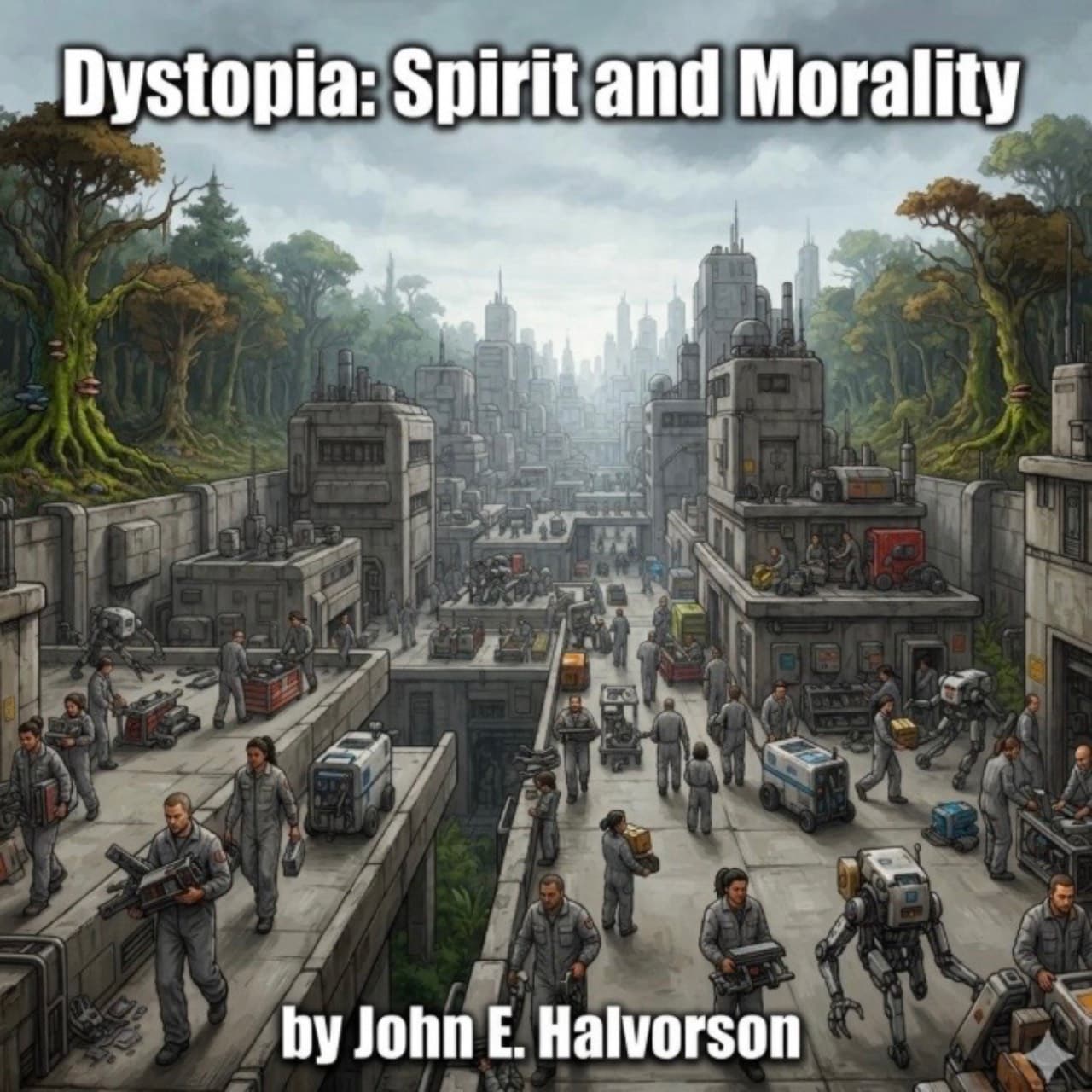

Fallon’s Fallacy
The Sector 5 Indoctrination Academy was loud, metallic, and smelled of cheap floor wax and fear. For a second-year student like Fallon, this was the year the state decided your utility. The curriculum wasn't designed to expand the mind; it was designed to compress it into a precise cog for the city's machinery. Fallon’s current aptitude scores placed him in a humiliating purgatory: exactly one step above a raw laborer, and two steps below a custodial engineer.
Because of his bottom-tier placement, the Ministry’s algorithm had assigned him to Sales and Public Compliance Education.
It was a nightmare assignment for Fallon. The entire sales curriculum was built on the art of the legal lie. Students were taught how to manipulate a customer’s Harmonizer spikes, how to fabricate a sense of scarcity, and how to smile while selling toxic synthetic-yeast supplements to starving lower-tier families. Fallon hated to lie. He possessed a stubborn, dangerous streak of honesty that made him disregard the system entirely whenever he could get away with it.
What Fallon really wanted—what kept him breathing through the gray academy mornings—was a ghost of an art form. He wanted to be Sector 5’s very first freestyler musician.
Music in the sectors was strictly regulated by the Ministry of Culture; it consisted of rhythmic, low-frequency white noise loops designed to induce focus in the factories. True freestyling—making up lyrics and rhythms on the spot, driven by raw emotion and unscripted thought—was classified as "Cognitive Anarchy." There were no instruments available to a student of his grade. Fallon had to build his rhythm by secretly tapping his boots against the iron floor grates, matching the syncopation of the sector’s exhaust vents, and muttering rhymes under his breath when the cameras panned away.
Today was the Simulated Evaluation. To pass into the final year of Sales, Fallon had to sit across from an algorithmic proctor and successfully sell a faulty, radiation-leaking micro-heater to an actor playing a desperate, freezing mother.
If he lied, used the state's manipulation tactics, and made the sale, his score would rise. He might even leapfrog up to the coveted custodial engineering tier, securing a warm room and better rations. If he told the truth—that the heater was garbage and would poison the buyer's air—he would be instantly demoted to the heavy labor squads, dragging steel beams through the freezing underbelly of Sector 5 until his body gave out.
Fallon sat in the testing chair, his Harmonizer band pulsing a nervous, warning purple against his wrist. The simulation began. The actress looked at him with hollow, pleading eyes, asking if the heater was safe for her children.
His choice wasn't just about a career track. It was the ultimate dilemma of personal freedom: comply with the lie to buy himself a comfortable baseline survival, or tell the truth, accept the brutal life of a laborer, and use the grueling shadows of the lower sectors to keep his illegal music alive.
Fallon swallowed the bile rising in his throat. He looked at the actress's simulated, pleading eyes and knew that throwing his life away on a dramatic, low-tier demotion wouldn't buy him freedom. It would just bury him in a hole so deep he’d never see the light, let alone a microphone. To keep his dream alive, he had to play the long game. He had to wear the mask of the ultimate corporate servant.
He didn't just give the sales pitch; he weaponized it. Fallon leaned forward, his nervous purple Harmonizer pulse smoothing out into a cold, calculated blue. He spun a brilliant, devastatingly effective web of lies. He told the simulated mother that the micro-heater’s structural venting was a "signature safety feature" designed to purify the air, manipulating her psychological profile with terrifying precision. He outdid himself, shattering the academy's previous conversion records for the simulation.
The evaluation screen flashed a brilliant, victorious green. "Aptitude Re-evaluation Complete," the electronic proctor chimed. "Student Fallon promoted to Public Compliance Strategist, Tier 4." He had just secured a private dorm room with unmonitored power outlets and a direct transit pass to the upper engineering sectors.
That night, alone in his new, quiet quarters, Fallon finally let the corporate facade drop. His skin crawled from the deception, but his mind was already building his real future. He pulled out a stolen, military-grade frequency synthesizer he had scavenged from a discarded communications drone.
He closed his eyes and began to tap a heavy, primal rhythm on his metal desk—a steady, driving four-on-the-floor thump that mimicked the heartbeat of an ancient warship. He layered it with a low, rumbling vocal drone, channeling a heavy, clean Nordic Viking chant that resonated deep in his chest. Then, he sped up the tempo, dropping a sharp, modern hip-hop cadence over the ancient, booming throat-singing. The lyrics flowed out of him cleanly, without a single stutter or profanity, a rhythmic, powerful poetry about survival, stolen freedom, and the storm gathering beneath Sector 5.
Suddenly, his door console chimed. It wasn't an inspector. It was an encrypted, anonymous text message pinging his personal terminal.
The screen read: “We monitored your sales metrics today, Strategist Fallon. Unprecedented psychological manipulation. The Ministry wants you to head a new public compliance campaign for the teenagers of Sector 5 starting Monday. But we also heard the acoustics coming from your room's ventilation shaft just now. The chant. The rhythm. Choose your next words very carefully.”
Fallon didn’t reply to the terminal. Instead, he stared at the glowing text, his chest still heaving from the exertion of the chant. He didn’t panic. The system had trained him to analyze psychological pressure, and right now, he felt like a soldier strapped into a drop-pod.
He loaded a heavy, rhythmic cadence back into his mind, using the threat as fuel. He stepped up to his ventilation shaft and delivered his answer in a low, battle-ready baritone that echoed with the raw force of a shield-wall charge:
"You see a pawn in a uniform vest, / But I am the storm brewing deep in the chest. / Climb the walls of the sector, bypass the surveillance, / I don’t believe the lies, I don't buy your compliance!"
A few seconds of dead silence followed. Then, the ventilation grate clicked. A small, mechanical spider-drone crawled out, dropping a physical data-token onto his desk before frying its own circuitry with a quiet hiss. The token contained a set of coordinates for the deep underbelly of Sector 5—the maintenance catacombs beneath the heavy forge-mills.
The resistance was reaching out.
The next evening, using his Tier 4 Strategist pass to bypass the upper security gates, Fallon descended into the dark. He expected to find a disciplined network of freedom fighters—heroes wielding hacked tech and righteous fury, the kind of legendary rebels whispered about in the academy shadows.
Instead, he found a grim, transactional nightmare.
Hidden within a hollowed-out cooling turbine, the resistance cell was operating a massive, illegal server farm. There were no flags, no manifestos, and no noble ideals. They were led by a cynical ex-analyst named Soren, who looked at Fallon not as a voice for the oppressed, but as a highly efficient asset.
"Your music is a unique weapon, Strategist," Soren said, his voice flat as he pointed to a bank of audio-editing monitors. "The Ministry's youth population is immune to standard political pamphlets. But your specific Viking-hip-hop blend? It has a psychological hooks-coefficient of eighty-eight percent. We want you to record a full suite of anthems."
Fallon frowned, his clean, honest nature flaring up. "To wake them up? To give them their freedom back?"
Soren let out a dry, humorless laugh. "To crash the Ministry's productivity quotas so our corporate black-market backers in Sector 6 can buy up the refinery contracts for cheap. Freedom doesn't pay for the server electricity, kid. We need you to manipulate the teenagers into rioting, exactly like you manipulated that simulated mother yesterday. You're just changing the product."
Fallon stood frozen in the dim, pulsing light of the server racks. The legal system was a meat-grinder of corporate lies, but the moral system of the resistance was a mirror image of the exact same corruption. They didn't want a musician; they wanted a different kind of marketing executive to weaponize the youth as a means to an end.
Fallon stood in the pulsing, blue light of the server racks, his clean moral code screaming against the walls of his chest. He looked at Soren, then thought back to the corporate instructors at the Academy. The realization hit him like a physical blow: to the system, his music was a compliance tool; to the resistance, it was a weapon for profit. His voice would only ever be a tool for someone else's power.
Unless he changed the rules of the game entirely.
"I'll do it," Fallon said, his voice flat, masking the sudden, terrifying calculus running through his mind. "I'll record the track. But I need total control over the sub-audible frequencies to maximize the psychological hooks."
Soren smirked, waving him toward the isolated audio booth. "Take whatever you need. Just give us the riot anthem by dawn."
Locked inside the soundproof booth, Fallon plugged his stolen military frequency synthesizer directly into the resistance's massive transmitter array. He didn't build a riot anthem. Instead, he went to work on a master structure that blended his two worlds. He layered a deep, looping Nordic Viking drone that perfectly resonated at 7.83 Hz—the Earth's natural electromagnetic frequency, known to induce profound, un-wakeable alpha-wave sleep in fully developed adult brains. Over this heavy, hypnotic baseline, he dropped a sharp, rapid-fire hip-hop cadence targeted strictly at the pristine auditory ranges of the youth.
He poured all his rage, his honesty, and his battle-ready defiance into the microphone. It was a song called "The Long Sleep."
At exactly 05:00, Fallon bypassed Soren's security gates and routed the track directly into Sector 5’s main public compliance broadcast tower. The signal blasted out of every street speaker, classroom intercom, and residential terminal simultaneously.
The response was immediate and terrifyingly quiet.
Across the sector, instructors at the Academy dropped their data pads and slumped over their desks. Factory supervisors collapsed onto the catwalks. In the streets, adult citizens simply sat down on the curbs, their eyes closing as the heavy, ancient Viking chant resonated with their nervous systems, locking them into a deep, chemical-like slumber.
Within the cooling turbine, Soren and his analysts didn't even have time to curse before they dropped straight to the floor grates, completely neutralized.
Only the teenagers remained awake, standing in the middle of a suddenly silent, frozen world. As the music continued to loop, the clean hip-hop lyrics cut through the static, broadcasting a specific, unedited message to every kid in Sector 5. It wasn't an order to riot or a corporate sales pitch. Fallon was broadcasting the exact coordinates and digital blueprints of the resistance server farm, alongside the Ministry's hidden population files. He was laying the raw, ugly truth of both systems entirely bare.
Fallon stepped out of the broadcasting booth and into the eerie, silent streets of Sector 5. The adults slept like statues around him. The freedom of choice was finally real, but it belonged to the thousands of teenagers who were now looking at the map he had given them.
The freezing morning air bit at Fallon’s face, carrying no smell of synthetic floor wax or recycled cabbage—just the crisp, terrifying scent of empty space. He stood outside the broadcast array, his boots resting on the frozen iron grates. For the first time in his life, the constant, low-frequency hum of Sector 5’s grid was entirely gone.
Silence in the sector wasn’t just the absence of sound; it was an act of aggression against the machine.
He looked down at his left wrist. The Harmonizer band, freed from the ambient tracking signals of the central computer, had gone completely dark. The screen was a blank slate of dead glass. Surrounding him on the promenade, the physical weight of the Ministry’s authority lay scattered like discarded mannequins. A high-tier administrative clerk was slumped over a decorative stone bench, a data pad slipping from his limp fingers. Two armored enforcers sat propped against the reinforced concrete wall of the security checkpoint, their visor lights dimmed to a dull, inactive gray, breathing in the rhythmic, slow syncopation of the 7.83 Hz alpha-wave loop.
They weren't dead. They were just paused. Fallon had effectively pulled the plug on the city's operating system, but he knew the battery backup wouldn't last forever. The human biology would eventually adapt to the drone, or the automated failsafes in the upper sectors would deploy mechanical sweeps that were immune to organic sleep.
Movement in the shadows caught his eye.
From the mouths of the lower transit tubes and the heavy iron doors of the residential blocks, the youth of Sector 5 began to emerge. They moved like ghosts stepping into the light of a new world. Thousands of teenagers—dressed in the mismatched, frayed canvas uniforms of laborers, mechanics, and low-tier students—stepped over the sleeping forms of their supervisors and guards. None of them spoke. The sheer scale of the silence was hypnotic.
Every single one of them held a personal data terminal or a hand-held wrist-link, the screens glowing with the vibrant, unedited blueprint Fallon had broadcasted. The map didn't point to a new leader, and the text didn't promise them rations. It simply showed the raw anatomy of their cage: the locations of the hidden server farms, the black-market routing nodes Soren used for profit, and the Ministry’s algorithms that calculated their human utility.
A girl in a Tech Grade-3 mechanical vest stepped out of the crowd, stopping a few paces from Fallon. Her hands were stained with dark industrial grease, and her eyes were wide, reflecting the ambient amber light of the broadcast tower.
"The coordinates," she said, her voice cracking slightly in the unaccustomed quiet. "The server farm beneath the forge-mills. If we pull the core drives like your blueprint says... the Ministry loses our records permanently. The data-tagging stops."
"But Soren's backers will lose their refinery contracts, too," a taller boy from the Agriculture tracks added, stepping forward. "The resistance cell wanted us to riot so the corporate suits could buy the sector out. If we destroy the server farm entirely, nobody owns us. Not the Ministry, and not the market."
Fallon felt the heavy hip-hop cadence he had left on loop vibrating through the soles of his boots from the street speakers. The music was still giving them the rhythm, but the words were entirely theirs now.
"That's the choice," Fallon said, his voice carrying clearly across the courtyard without the need for a microphone. "Both sides spent their whole lives teaching us how to negotiate the terms of our survival. They wanted us to sell out our own pieces just to secure a warmer room or a better ration tier. But the grid is asleep right now. The algorithms aren't grading you."
He pointed toward the heavy, towering structure of the forge-mills rising up against the gray skyline.
"The blueprints are in your hands," Fallon said, a hard, honest spark rising in his chest. "Don't riot for a new master. Write the rest of the song."
The mechanic girl looked at the map on her terminal, then back up at the silent cityscape. A slow, determined grin broke through the grease on her face. She didn't call for a rebellion; she simply turned toward the forge-mills and began to walk, her heavy steel-toed boots striking a rhythmic, steady beat against the pavement.
One by one, the teenagers of Sector 5 fell into step behind her. A hundred, then a thousand, then a wave of canvas jackets and boots, matching the driving four-on-the-floor thump echoing from the street lamps. They weren't running in a panic, and they weren't destroying the city out of blind rage. They were marching with the precise, deliberate intent of engineers about to dismantle a faulty machine.
Fallon watched the column move past him, his heart rate steady, completely untracked by the dead plastic on his wrist. He didn't lead them. He didn't need to. He had given them the truth, and the rhythm was doing the rest.