



Soon they were at the Honeycomb to the hearty welcome of the Chandras.
"What a reunion," said Chandra hugging Sathya.
"What a pair you make!" Nithya couldn't hide her admiration.
"We owe it all to you!" Sathya addressed Chandra.
"I feel, we owe it to Nithya no less," said Prema, taking Nithya's hand.
"What a twist of destiny!" said Chandra with mixed feelings.
'Well, to push Vasu into the doghouse.' Nithya thought with satisfaction.
By the time they sat for dinner, the logistics to stop Vasu in his tracks were worked out.
After Vasu came back, it was agreed that Prema would stay at the Honeycomb till she got her divorce. Well, Sathya would be a welcome guest all the time. That way, Vasu couldn't cast any aspersions on Prema during the divorce proceedings. Besides, her presence would deter him from stalking Nithya. As Prema was averse to dealing with Vasu anymore, Nithya took it upon herself to deliver the missive penned by Prema for him. It was agreed that Nithya would invite Vasu to the Honeycomb, instead of her going to the Ritz, and deal with him appropriately. Well, Chandra and company would lie in wait just in case. Sathya, who was impressed by Nithya's spiritedness, thought that Vasu could've met his nemesis in her.
The D-day came two days later, and as expected, Vasu rang up Nithya, only to be led into her trap.
"If it were okay for you here," said Vasu in anticipation, as he came in, "why did you deny me all these days?"
"I called you for a different reason," said Nithya feigning nervousness.
"Enough of leading me up the garden path," said Vasu determinedly. "It's time I had you even if it comes to raping."
"You'll turn cold if you hear the news."
"Why, what happened?"
"Your letter has fallen into Chandra's hands and he's sore about us."
"Good riddance bad rubbish," he stated gleefully. "If he divorces you, my absurd proposal would no longer be absurd. Prema could take care of me and I'll maintain you."
"But sadly," she said affecting pity, "Prema chose to desert you to see you get your just deserts."
"What do you mean?"
"It's what Prema thinks that counts, isn't it?" she said as she handed him Prema's fatal missive.
Vasu,
When you first disclosed your love, I made it known to you that I loved Sathya. Having told me about his affection for his classmate, when you goaded me to break with him, I believed you acted out of your own love for me. Well, all is fair in love and war, I thought. But it was only after our marriage that I realized you eyed me only for my money. Had I not burnt my bridges with Sathya, I would've walked out on you then and there. So I stayed put in a cold storage of a marriage.
When I'd seen you flirting with Nithya, I didn't care, as we've no love lost between us. But when I saw your letter to her, shaming me, I could take it no more. If it was right for you to goad me to leave the man I loved because he slighted my love, you can't say it's wrong for me to leave the spouse who demeans me to curry the favor of another woman.
As I have decided to leave you, it's only proper you shouldn't have anything that would remind me of you. So I've given away to the needy all those goodies that my father gave us. Any day now you would get the summons from the court and it may be wise for you not to contest, for your letter of shame is in my possession.
I'm going in search of Sathya to make amends as best as I can. If I can't become his wife, it would still be honorable becoming his mistress. My only regret is I've dishonored myself by being your wife for so long!
Never Yours,
Prema.
'Oh God!' he collapsed, 'I'm ruined.'
"Be a man, Vasu," Nithya said tauntingly. "After all, being a woman, I didn't cry when you left me in the lurch then. But, there's still hope for you. If Chandra chooses to leave me, I may still come to you, of course, along with his child in my womb. You can have it as a bonus, won't you? Moreover, there would be no need to spend on abortion as its no shame conceiving in marriage. Isn't it?"
"Oh stop it," said Vasu in exasperation. "Now it's clear, you planned it all and took your revenge. You'd induced me to write that letter to use it for my ruin. You prompted me for our family friendship to turn Prema against me. Oh, how you poisoned her mind. You bitch!"
"Mind your language, Mister!" said Nithya contemptuously, "and then stop blaming me. Why, I was indifferent to you when we met again and I snubbed you when you came to my place to cajole me and yet you coveted me, didn't you? Oh, how you had hinted at blackmailing me! You thought I would chicken out and come to sleep with you, didn't you? Fool, did I ask you to write that your wife is cold? As you sow, so you reap, you better realize that?"
Vasu got up to leave.
"Blame it upon your attitude towards women," she said as he crossed the threshold of her house. "Blame it upon your lack of character. Blame it upon your mean nature.
It pays to know that our nature is our fate." Nithya said, slamming the door after him.
This is but an end for the beginning of a lovely sojourn of a fulfilling life and the interested my grasp the author's literary beginnings with his My 'Novel' Account of Human Possibility:-
"Whenever I look at my body of work of twelve books, the underlying human possibility intrigues me no end, and why not. I was born into a land-owning family in a remote village of Andhra Pradesh in India that is after the British had folded their colonial tents from there, but much before the rural education mechanism was geared up. It was thus the circumstances of my birth enabled me to escape from the tiresome chores of the primary schooling till I had a nine-year fill of an unbridled childhood, embellished by village plays and grandma's tales, made all the more interesting by her uncanny ability for storytelling. As my maternal grandfather's grandfather happened to be a poet laureate at the court of a princeling of yore, maybe their genes together strived to infuse the muses in me their progeny.
However, as the English plants that Lord Macaulay planted in the Indian soil hadn't taken roots in its hinterland till then, it's the native tongues that ruled the roost in the best part of the vast land, and in Andhra it was Telugu, the Italian of the East that held the sway. No wonder then, leave alone constructing a sentence on my own in English, whenever I had to read one, I used to be afflicted by stammer. Maybe, it was at the behest of the unseen hand of human possibility or owing to his own foresight that my father in time had shifted our family base to the cosmopolitan town of Kakinada to put me into the missionary McLaren High School in Class X. With that began my tryst with English, which, courtesy one of my maternal uncles, eventually led me to the continental fiction in translation that engaged me more, far more than the technical subjects I had to pursue for a career as a mechanical engineer.
While the Penguin classics inculcated in me a love for English language that is besides broadening my outlook of life, my nature enabled me to explore the possibilities of youth, and given that letter-writing was still in vogue then, I was wont to embellish my letters to friends and loved-ones with insights the former induced and emotions the latter infused. Clearly, all those letters that my novels carry owe more to my impulse to write them than to my muse's need to express itself through them. Even as the fiction enabled me to handle the facts of life with fortitude, as life, for its part, chose to subject me to more of its vicissitudes, I continued tending my family and attending my job.
Fortuitously, when I was thirty-three, my mind and matter combined to explore the effect of the led on the leader, and when the resultant "Organizational ethos and good Leadership" was published in The Hindu, I experienced the thrill of, what is called, seeing one's name in print. Encouraged, I continued to apply my mind on varied topics such as general management, materials management, general insurance, politics, and, not to speak of, life and literature resulting in some thirty published articles. But fiction was nowhere in the sight, nor I had any idea to turn into a novelist for Leo Tolstoy, Fyodor Dostoyevsky, Nikolai Gogol, Ivan Turgenev, Emily Zola, Gustav Flaubert et al are literary deities (I hadn't read Marcel Proust and Robert Musil by then), were, and are, my literary deities, and how dare I, their devotee, to envision myself in the sanctum sanctorum of the novel.
But when I was forty-four, having been fascinated by the manuscript of satirical novel penned by one Bhibhas Sen, an Adman, with whom I had been on the same intellectual page for the past four years then, it occurred to me, 'when he could, I can for sure'. It was as if Bhibhas had driven away the ghosts of the masters that came to shadow my muse but as life would have it, it was another matter that as he didn't want to foul his novel by dragging it to 'publishable length', it remained in the limbo.
With my muse thus unshackled, I set to work on the skeletal idea of Benign Flame with the conviction that for fiction to impact readers, it should be the soulful rendering of characters rooted in their native soil, not the hotchpotch of local and foreign caricatures sketched on a hybrid canvas, the then norm of the Indian writing in English. Yet it took me a fortnight to get the inspiring opening sentence - "That winter night in the mid-seventies, the Janata Express was racing rhythmically on its tracks towards the coast of Andhra Pradesh. As its headlight pierced the darkness of the fertile plains, the driver honked the horn as though to awake the sleepy environs to the spectacle of the speeding train."
From there on, it was as though a 'novel' chemistry had developed between my muse and my characters' psyche that shaped its fictional course, and soon, I came to believe that I had something unique to offer to the world; so, not wanting to die till I gave it to it, I used to go to lengths to safeguard my life till I finished it with a 'top of the world' feeling. What one Spencer Critchley, an American critic, thought about my contribution - "It's a refreshing surprise to discover that the story will not trace a fall into disaster for Roopa, given that many writers might have habitually followed that course with a wife who strays into extramarital affairs" - made me feel vindicated, though there were no takers to it among the Indian publishers and the Western agents.
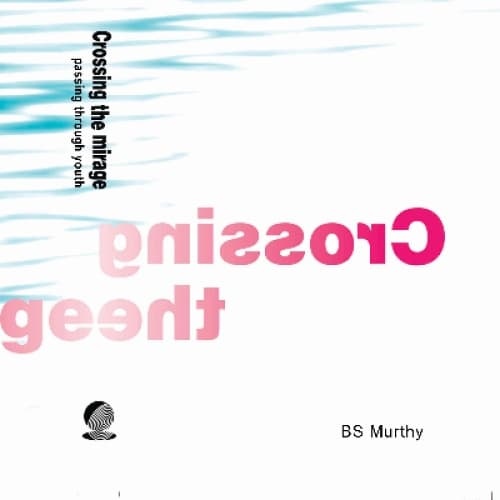
So, I had no heart to bring my pen to any more paper (those were the pre-keyboard days) though my head was swirling with novel ideas, triggered by an examined life lived in an eventful manner. Sometime later, that was after I read a book of short stories presented to me; I had resumed writing due to a holistic reason. While it was the quality of Bhibhas' satire that set me on a fictional track from which I was derailed by the publishers' indifference, strangely, it was the lack of it in that book that once again spurred me onto the novel track to pursue the joy of writing for its own sake, and that led me to the literary stations of Crossing the Mirage and Jewel-less Crown. But in the wake of the hotly debated but poorly analyzed Godhra-Gujarat communal rioting in 2002, as I was impelled to examine the role religions play in social disharmony, my fictional course had taken a non-fiction turn with Puppets of Faith.
Then it was as if my muse, wanting me to lend my hand to other literary genres led me into the arena of translation, pushed me onto the 'unknown' stage, put me on a stream of consciousness, took me to crime scenes, and dragged me into the by-lanes of short stories. However, it was Michael Hart, the founder of Project Gutenberg, who lent his e-hand to my books in search of readers. Who would have thought that life held such literary possibilities in English language for a rustic Telugu lad in rural Andhra even in post-colonial India? The possibilities of life are indeed novel, and seemingly my life has crystallized itself in my body of work before death could dissipate it.
My body of work of free ebooks, in varied genres, is in the public domain."